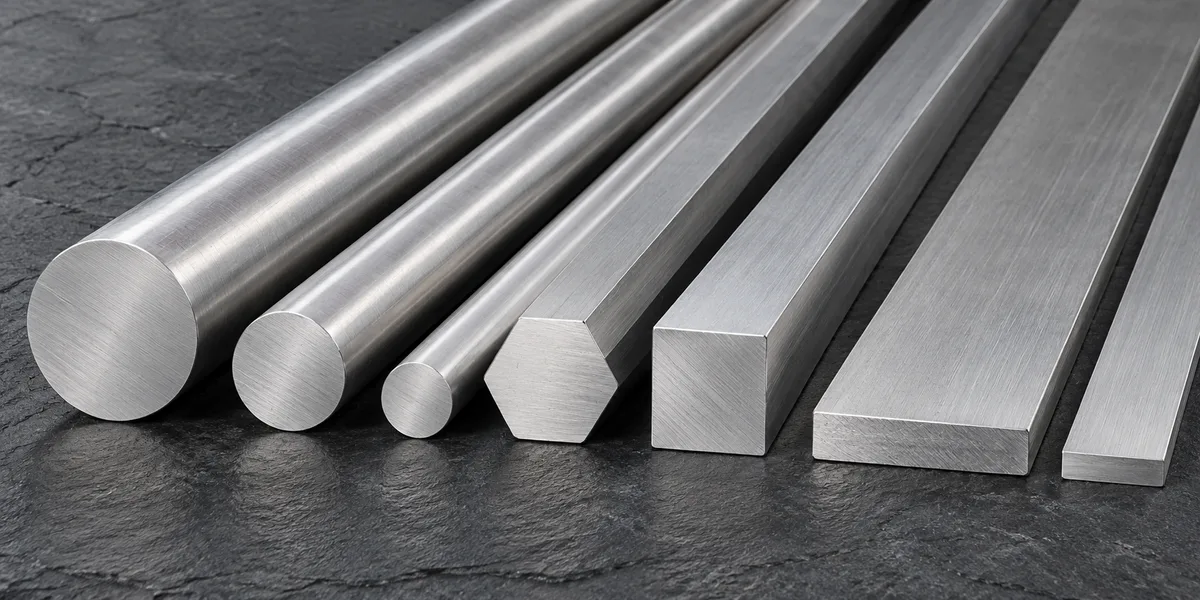
Aluminium hex bar is solid six-sided bar used mainly as feedstock for nuts, fittings, standoffs, couplings and turned parts that need flats for a spanner or anti-rotation. The right choice depends on three things: the alloy (6061 for general use, 2011 or 6262 for high-speed turning, 2024 or 7075 for strength), the process (extruded or cold-finished) and the across-flats size. This guide compares them and gives weights for metric and imperial sizes.
A hexagon gives a bar six flat faces at 120°, so a finished part can be gripped by a standard spanner or socket, cannot rotate in a hexagonal recess and sits accurately in a collet. Starting from hex stock means those flats need no machining: an automatic lathe simply drills, turns, threads and parts off.
This makes hex bar the standard raw material for nuts, coupling nuts, hydraulic and pneumatic fittings, hose adaptors, spacers and standoffs, valve bodies, bolt heads and electrical connectors. It also appears as a structural or decorative section in furniture, railings and instruments, and in tool handles where the flats give grip.
Because the part is usually turned from the bar, the selection questions are about machining as much as strength: how well the alloy breaks chips, how good a surface it leaves, whether threads are clean, whether it will anodise to the required colour, and whether it must meet RoHS limits on lead.
Alloy comparison
Hex bar alloys compared
Six alloys cover almost every hex bar requirement. Typical values below are from the Aluminum Association and ASM; the specified minimums for your size and temper are on the mill certificate.
Alloy & temper
Typical tensile (MPa)
Typical yield (MPa)
Machinability
Corrosion resistance
Anodising
6061-T6 / T6511
310
276
Good
Very good
Excellent
2011-T3
379
296
Excellent (free-machining)
Poor
Fair (protective only)
6262-T9
400
379
Very good (free-machining)
Good
Very good
2024-T4 / T351
469
324
Good
Poor
Fair
7075-T6 / T651
572
503
Good
Fair
Good
7075-T73 / T7351
505
435
Good
Good (high SCC resistance)
Good
6063-T5
186
145
Fair (gummy)
Very good
Excellent
6061 hex bar
The default choice. Strong, weldable, corrosion resistant and an excellent base for clear and coloured anodising. Supplied extruded (T6511) or cold-finished (T6/T651). Good for fittings, standoffs, structural nuts and general machined parts.
2011 hex bar
The classic free-machining alloy: lead and bismuth additions make chips break into tiny pieces, allowing very high spindle speeds and clean threads. Poor corrosion resistance, so parts are usually used indoors or coated. Lead-free 2011B-type and similar grades exist for RoHS-sensitive work.
6262 hex bar
A free-machining 6xxx alloy with strength similar to or above 6061-T6 and much better corrosion resistance and anodising than 2011. Widely used for fittings, valve parts and fasteners. T9 temper is cold-worked after heat treatment for extra strength.
2024 hex bar
High strength and fatigue resistance for aerospace fasteners and highly loaded fittings. Needs anodising or coating for corrosion protection.
7075 hex bar
The strongest common hex bar. T6 for maximum strength; T73 or T7351 when resistance to stress-corrosion cracking matters, as it often does in aerospace fittings and fasteners.
6063 hex bar
Lower strength but excellent surface finish and anodising. Used for decorative rods, furniture fittings and light-duty spacers rather than threaded load-bearing parts.
For marine service, 5xxx hexagon bar (5052, 5083, 5086) is also produced; see our 5083 marine hexagon bar page for those grades.
Process
Extruded or cold-finished hex bar?
Feature
Extruded hex bar
Cold-finished (drawn) hex bar
How it is made
Billet pushed through a hexagonal die, then heat treated and stretched
Extruded bar drawn through a finishing die to final size, then heat treated
Typical tempers
T6511, T6510, T5 (6063), T73511
T6, T651, T3 (2011), T4/T351 (2024), T9 (6262)
Size range
Small to large; large across-flats sizes are usually extruded
Mainly small and medium sizes for automatic-lathe stock
Tolerances
Standard extrusion tolerances (ANSI H35.2, EN 755-6)
Tighter across-flats and straightness tolerances (ANSI H35.2, EN 754-6)
Bar-fed automatics work best with cold-finished bar because consistent size and straightness keep the bar running smoothly through the feeder and collet. For larger sizes, saw-cut blanks or structural uses, extruded bar is usually the more economical choice. Stress-relieved tempers (T6511, T651) are worth specifying whenever parts are long or asymmetrically machined.
Dimensions
Hex bar sizes and weight per metre
Hex bar is ordered by the distance across flats (AF). The distance across corners is AF × 1.155, which matters when checking whether bar will pass through a collet or spindle bore. Cross-sectional area is 0.866 × AF², so weight in kg/m is about 0.00234 × AF² (AF in mm) at a density of 2.70 g/cm³. 7075 and 2011 are slightly denser (about 2.81 and 2.83 g/cm³), so add roughly 4–5 % for those alloys.
Across flats (mm)
Across corners (mm)
Area (mm²)
Weight (kg/m)
6
6.9
31
0.084
8
9.2
55
0.150
10
11.5
87
0.234
12
13.9
125
0.337
13
15.0
146
0.395
14
16.2
170
0.458
16
18.5
222
0.599
17
19.6
250
0.676
19
21.9
313
0.844
22
25.4
419
1.132
24
27.7
499
1.347
27
31.2
631
1.705
30
34.6
779
2.104
32
37.0
887
2.394
36
41.6
1122
3.030
41
47.3
1456
3.931
46
53.1
1832
4.948
50
57.7
2165
5.846
55
63.5
2620
7.073
60
69.3
3118
8.418
65
75.1
3659
9.879
70
80.8
4243
11.457
80
92.4
5542
14.964
100
115.5
8660
23.382
Imperial hex bar follows the same geometry. The weight in lb/ft is about 1.01 × AF² with AF in inches.
Across flats (in)
Across corners (in)
Weight (lb/ft)
1/4
0.289
0.063
3/8
0.433
0.142
1/2
0.577
0.253
5/8
0.722
0.396
3/4
0.866
0.570
7/8
1.010
0.776
1
1.155
1.013
1-1/4
1.443
1.583
1-1/2
1.732
2.280
1-3/4
2.021
3.103
2
2.309
4.053
2-1/2
2.887
6.333
3
3.464
9.119
Weights are calculated from nominal geometry with sharp corners; real bar with rounded corners weighs very slightly less.
Standards
Standards for aluminium hex bar
Standard
Covers
Typical use
ASTM B211 / B211M
Rolled or cold-finished bar, rod and wire
Cold-finished 2011, 2024, 6061, 6262, 7075 hex bar
ASTM B221 / B221M
Extruded bars, rods, wire, profiles and tubes
Extruded 6061, 6063, 7075 hex bar
ANSI H35.2
Dimensional tolerances for aluminium mill products
Across-flats, straightness and twist tolerances for ASTM orders
AMS-QQ-A-225/3, /6, /8, /9, /10
Aerospace bar specifications for 2011, 2024, 6061, 7075 and 6262
Aerospace and defence fittings
AMS 4117, AMS 4120, AMS 4124
6061-T6, 2024-T4/T351 and 7075-T7351 bar
Aerospace hex bar to SAE specifications
EN 754-2 and EN 754-6
Cold-drawn bar: properties and hexagonal bar tolerances
European orders for drawn hex bar
EN 755-2 and EN 755-6
Extruded bar: properties and hexagonal bar tolerances
European orders for extruded hex bar
Quote the standard and temper on your order, for example "6061-T6511 hex bar to ASTM B221, 3/4 in AF" or "EN AW-6082-T6 hexagonal bar to EN 755-2, 24 mm AF". That fixes both properties and tolerances.
Working with hex bar
Machining, threading and finishing tips
Chip control
2011 and 6262 produce small broken chips and suit unattended automatics. 6061 and 7075 give longer chips; use chip-breaker inserts, high-pressure coolant and correct feeds. 6063 tends to be gummy and is better kept for decorative parts.
Threading
All these alloys thread well with sharp, polished tools. For repeatedly assembled threads, 2024, 7075 or 6262-T9 resist thread wear better than 6061 or 6063; thread inserts are another option.
Collets and feeders
Use hex collets matched to the across-flats size. Check the across-corners dimension against spindle bore and feeder tube.
Anodising
6061, 6063 and 6262 give bright, even anodised finishes in clear and colour. 2011 and 2024 anodise with a duller, uneven appearance, so specify them only for protective anodising.
Corrosion
Avoid unprotected 2011 or 2024 parts outdoors or in wet service. Use 6061 or 6262 instead, or anodise. In contact with stainless or carbon steel, isolate to limit galvanic corrosion.
RoHS and lead
2011 and 6262 traditionally contain lead. Where RoHS or similar limits apply, specify lead-free free-machining grades and confirm compliance on the certificate.
Selection
How to choose the right hex bar
Define the part dutyIs the part load-bearing, threaded, decorative, outdoor, or conductive? This decides between strength, machinability and corrosion resistance.
Pick the alloy familyGeneral: 6061. High-volume turned parts: 6262 or 2011. High strength: 2024 or 7075 (T73 for stress-corrosion resistance). Decorative: 6063.
Choose the processCold-finished for automatic lathes and tight tolerances; extruded for larger sizes and structural uses.
Set size and lengthPick a standard AF size close to the finished flats. Specify random or fixed lengths to suit your bar feeder.
Add requirementsStandard and temper, certification (EN 10204 3.1), RoHS declaration, packing and Incoterms.
Aluminium (aluminum) hex bar: frequently asked questions
Which aluminum alloy is best for hex bar?
6061 is the best general choice: strong, corrosion resistant and easy to anodise. For high-volume turned parts choose 6262 or 2011, for high strength choose 2024 or 7075, and for decorative parts choose 6063.
How do I calculate the weight of aluminium hex bar?
Area is 0.866 × AF². For 6061 at 2.70 g/cm³, weight in kg/m is about 0.00234 × AF² with AF in mm, so 20 mm AF weighs about 0.94 kg/m. In imperial units, weight is about 1.01 lb/ft × AF² with AF in inches.
What is the difference between extruded and cold-finished hex bar?
Extruded bar comes straight from the extrusion die and is heat treated and stretched. Cold-finished bar is drawn through a die afterwards, giving tighter tolerances, sharper corners and a brighter surface, which suits automatic lathes.
Is hex bar better than round bar for turned parts?
If the finished part needs flats, yes: starting from hex saves milling, reduces material removed and gives consistent flats. If the part is round all over, round bar is cheaper and easier to feed.
Is 2011 hex bar RoHS compliant?
Traditional 2011 contains lead and bismuth, so compliance depends on lead content and the applicable exemption. Lead-free free-machining grades are available; ask for a RoHS declaration with the certificate.
What tolerances apply to aluminium hex bar?
ANSI H35.2 for ASTM B211 and B221 orders, and EN 754-6 (drawn) or EN 755-6 (extruded) for EN orders. Cold-finished bar has tighter tolerances than extruded bar of the same size.
Ordering aluminium hex bar?
Send alloy, temper, across-flats size, length and quantity. We reply with availability, tolerances, certification and a delivered price.