Discharge manifolds
Pipes running from each compartment's bottom valve to the API couplers or hose connections. Usually 3 in or 4 in nominal size.



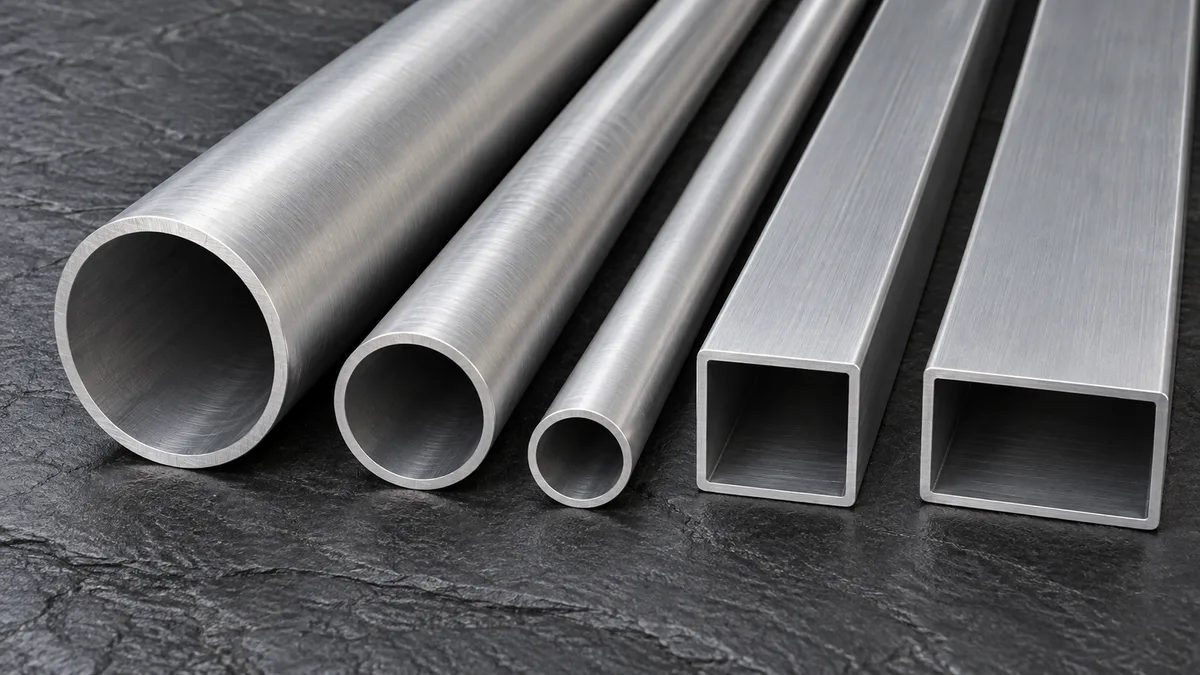
Road tankers that carry petrol, diesel, lubricants and other oil products use aluminium tube for discharge manifolds, vapour-recovery lines, drains, breather fittings and body hardware. 6063 in T4, T5 or T6 temper is the usual choice for these parts because it extrudes into accurate, smooth-bored tube, welds well, resists fuel and weather and does not rust. This guide covers its properties, sizes and what to check before ordering.
A fuel tanker body is a set of welded aluminium compartments, each with its own bottom valve, discharge pipe and vapour connection. The shell itself is normally rolled from 5xxx plate such as 5083, 5182 or 5454, which keep their strength after welding. The pipework and secondary structure around the shell is where 6063 tube is used.
Pipes running from each compartment's bottom valve to the API couplers or hose connections. Usually 3 in or 4 in nominal size.
Tubes that collect vapour from each compartment during loading and return it to the terminal. Low pressure, but they must be leak-tight and conductive.
Bodies for breather valves, flame-arrester housings and vent pipes, where a light, non-rusting metal is preferred.
Small-diameter tube carrying rain and spills away from manholes and walkways.
Handrails, folding guardrails, ladders, hose trays and cabinet frames along the top and sides of the tank.
Brackets, stiffeners and support frames where loads are moderate and low weight increases payload.
Using aluminium for these parts keeps the whole vehicle in one material family, avoids galvanic problems at welded joints with the shell and removes the rust that steel pipework sheds into fuel. Each kilogram saved on fittings is a kilogram of extra legal payload on every trip.
| Element | Limit | Note |
|---|---|---|
| Silicon (Si) | 0.20 – 0.60 | Combines with Mg to form Mg2Si |
| Iron (Fe) | ≤ 0.35 | Low iron gives a bright, smooth surface |
| Copper (Cu) | ≤ 0.10 | Kept low for corrosion resistance |
| Manganese (Mn) | ≤ 0.10 | |
| Magnesium (Mg) | 0.45 – 0.90 | Main strengthening element |
| Chromium (Cr) | ≤ 0.10 | |
| Zinc (Zn) | ≤ 0.10 | |
| Titanium (Ti) | ≤ 0.10 | Grain refiner |
| Others, each / total | ≤ 0.05 / 0.15 | |
| Aluminium (Al) | Remainder |
These are the Aluminum Association limits used by ASTM B221, ASTM B241 and EN 573-3. The low copper content is one reason 6063 resists fuel, condensate and road salt better than copper-bearing alloys such as 2024 or even 6061.
Minimum values below are from ASTM B221 for extruded tube; EN 755-2 values are similar. Design to the minimums. Welding locally softens T5 and T6 tube to roughly T4-level strength near the weld, so welded pipework is sized on the as-welded strength.
| Temper | Wall thickness | Tensile min | Yield min | Elongation min (50 mm) |
|---|---|---|---|---|
| T4 | ≤ 12.5 mm | 130 MPa (19 ksi) | 70 MPa (10 ksi) | 14 % |
| T5 | ≤ 12.5 mm | 150 MPa (22 ksi) | 110 MPa (16 ksi) | 8 % |
| T6 | ≤ 3.2 mm | 205 MPa (30 ksi) | 170 MPa (25 ksi) | 8 % |
| T6 | 3.2 – 25 mm | 205 MPa (30 ksi) | 170 MPa (25 ksi) | 10 % |
Softest of the three. Choose it for manifolds with tight bends or flared ends; the tube can be aged to T6 after forming if strength is needed.
Air-cooled from the press and aged. Adequate for vapour lines, drains and body rails at the lowest cost.
Peak strength. Choose it for handrails, guardrails, ladders and frames that carry people or equipment, and for straight discharge pipe.
Mass per metre = π × (OD − wall) × wall × 2.70 / 1000, with dimensions in millimetres. Reference values for common tanker sizes:
| OD (mm) | Wall (mm) | Mass (kg/m) |
|---|---|---|
| 50.8 | 3 | 1.216 |
| 63.5 | 3 | 1.540 |
| 76.2 | 3 | 1.863 |
| 88.9 | 3.5 | 2.535 |
| 101.6 | 3.5 | 2.912 |
| 101.6 | 5 | 4.097 |
| 114.3 | 4 | 3.742 |
| 127 | 4 | 4.173 |
| 152.4 | 5 | 6.251 |
| Area | Standard | What it covers |
|---|---|---|
| Extruded tube | ASTM B221, EN 755-2/-8 | Properties and tolerances of extruded tube |
| Seamless pipe and tube | ASTM B241, ASTM B210 (drawn) | Seamless extruded and drawn tube for pressure applications |
| Chemistry | EN 573-3, Aluminum Association registration | Composition limits |
| Tank design | EN 13094, ADR | Metallic tanks for dangerous goods with low working pressure; vehicle approval |
| Certificates | EN 10204 3.1 | Inspection document for each lot |
Tank design approval covers the whole vehicle; the tube supplier provides the material certificates the body builder needs for that approval file.
It is about one-third the weight, does not rust into the product, welds to an aluminium tank without galvanic problems and conducts static charge well.
Yes for typical gravity and pump discharge pressures. 6063-T6 has a minimum yield strength of 170 MPa before welding; designers size the wall on the lower as-welded strength.
6061-T6 is about 40 % stronger and suits highly stressed frames. 6063 is easier to bend, has a better surface and lower cost, so it is preferred for piping, rails and trim.
Yes. It gives one of the most even anodised finishes of any aluminium alloy, which suits visible handrails and ladders.
Most bottom-loading systems use 3 in or 4 in nominal lines, so tube with an OD around 76 – 115 mm is common. Match the size to your valve and coupler.
Tell us the tube sizes, tempers and quantities, and Metline will quote with mill certificates and export packing.





