Cold heading
Head from O or H13; solution treat and quench; drive or use promptly as natural ageing hardens the alloy.



2017A is the European form of the classic 2017 duralumin alloy, designated EN AW-2017A or AlCu4MgSi(A). As wire rod in T4, H13 or H18 from about 1.6 to 10 mm, it is used for solid rivets, cold-headed screws and turned fasteners that need roughly 380 MPa tensile strength. This guide sets out the correct composition, properties and buying checks.
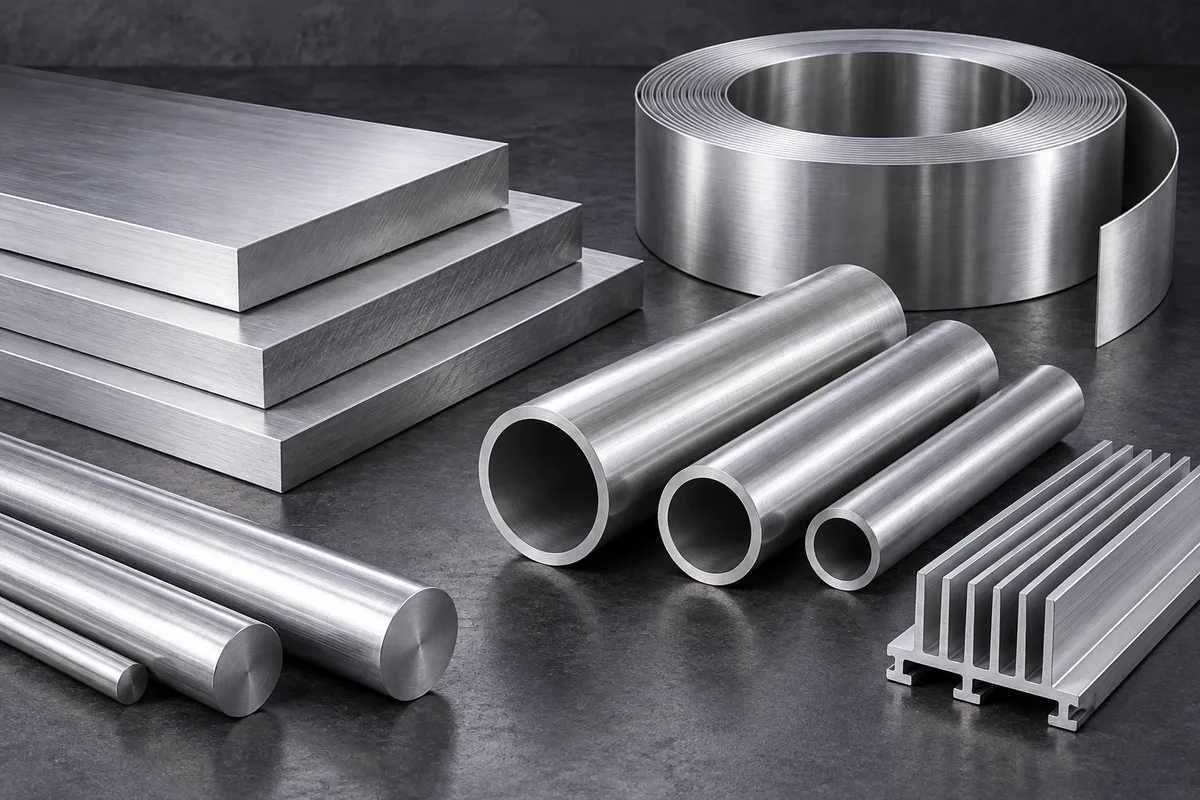
2017A is registered as a European variant of 2017. It shares the same copper level, about 4 %, so it behaves almost identically: heat-treatable, strong in T4 and easy to cold head when soft.
The differences are small but matter on certificates. 2017A allows magnesium up to 1.0 % (2017 stops at 0.8 %) and uses a combined zirconium plus titanium limit. In Europe it has largely replaced 2017 for wire, bar and fastener stock, and it is the alloy behind many EN-standard solid rivets and cold-formed fasteners.
Some datasheets in circulation list 2017A with only 0.5 – 0.9 % copper. That is incorrect: 2017A contains 3.5 – 4.5 % copper, like 2017. A low-copper material would not reach 2017A strength.
| Element | 2017A | 2017 (for comparison) |
|---|---|---|
| Copper (Cu) | 3.5 – 4.5 | 3.5 – 4.5 |
| Magnesium (Mg) | 0.40 – 1.0 | 0.40 – 0.8 |
| Manganese (Mn) | 0.40 – 1.0 | 0.40 – 1.0 |
| Silicon (Si) | 0.20 – 0.8 | 0.20 – 0.8 |
| Iron (Fe) | ≤ 0.7 | ≤ 0.7 |
| Chromium (Cr) | ≤ 0.10 | ≤ 0.10 |
| Zinc (Zn) | ≤ 0.25 | ≤ 0.25 |
| Zirconium + Titanium | ≤ 0.25 | Ti ≤ 0.15 |
| Others each / total | ≤ 0.05 / 0.15 | ≤ 0.05 / 0.15 |
| Aluminium | Remainder | Remainder |
| Temper | Condition | Tensile Rm | Notes |
|---|---|---|---|
| O | Annealed | low, for heavy heading | Heat treated to T4 after forming |
| H13 | Lightly drawn | about 210 – 300 MPa | Standard heading supply temper; straight, feeds well |
| H18 | Hard drawn | about 315 MPa minimum | For straight wire, pins and parts used without heat treatment |
| T4 | Solution treated, naturally aged | ≥ 380 MPa (typical about 400 – 420 MPa) | Yield typically about 250 – 270 MPa |
Exact guaranteed values for each diameter band are in EN 1301-2 (drawn wire) or EN 754-2 (drawn bar). Request the values from the standard on your order rather than a generic datasheet.
EN 1301-3 sets the standard tolerances for drawn wire. Many fastener makers also order to tolerance classes like the ones below, which are widely used for rivet wire.
| Diameter (mm) | Class A | Class B | Class C | Class D |
|---|---|---|---|---|
| ≤ 1.6 | +0 / −0.015 | ±0.015 | ±0.015 | +0 / −0.04 |
| > 1.6 – 4.0 | +0 / −0.025 | +0.025 / −0.015 | ±0.025 | +0 / −0.05 |
| > 4.0 – 6.0 | +0 / −0.030 | ±0.025 | ±0.040 | +0 / −0.08 |
| > 6.0 – 10.0 | +0 / −0.040 | +0.050 / −0.025 | ±0.060 | +0 / −0.12 |
Head from O or H13; solution treat and quench; drive or use promptly as natural ageing hardens the alloy.
In T4 or H18 it machines well into turned screws and pins, with better chip control than soft alloys.
Not suited to fusion welding because of hot cracking. Join by riveting, bolting or bonding.
Copper lowers corrosion resistance. Anodise or conversion coat fasteners, and install with sealant in damp service.
2017A allows up to 1.0 % magnesium (2017: 0.8 %) and limits zirconium plus titanium together to 0.25 %. Copper, manganese and silicon ranges are the same, so properties are very similar.
3.5 – 4.5 %. Any certificate showing under 1 % copper is not 2017A.
H13 for most headers, or O for severe upsets. The headed parts are then solution treated to T4.
No, fusion welding is not recommended because of hot cracking. 2017A parts are joined mechanically.
Yes. Each lot can be supplied with a 3.1 mill certificate showing chemistry and mechanical results.
Send the temper, diameter range and quantity. Metline will confirm availability and certification for delivery worldwide.





