T4
Solution treated at roughly 495 – 505 °C, water quenched and naturally aged at room temperature for at least four days. This is the standard supply condition for machining bar.



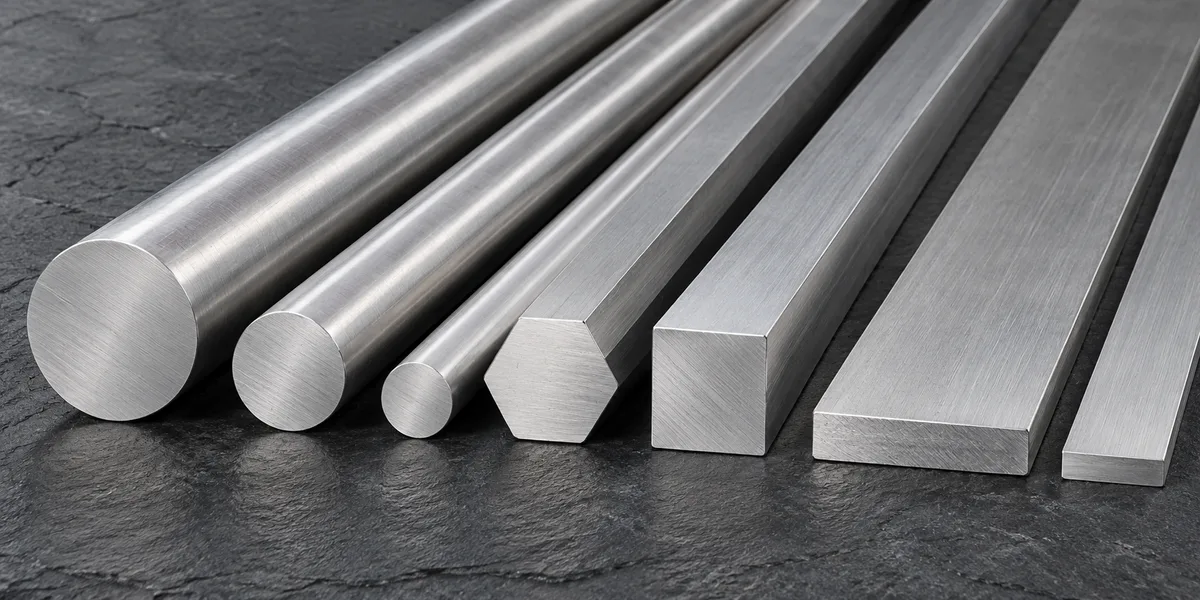
2A11 is an aluminium-copper-magnesium-manganese duralumin, formerly designated LY11, used as bar and rod for medium-to-high strength machined parts, fasteners and fittings. In its usual naturally aged T4 temper it behaves much like 2017 and 2017A. Metline supplies 2A11 round, square and hex bar certified to GB/T 3190 and GB/T 3191, or dual-certified where an international equivalent is acceptable, to customers worldwide.
2A11 belongs to the original family of duralumin alloys: about 4 % copper with smaller amounts of magnesium and manganese, strengthened by solution treatment and natural ageing. Under the older naming system it was called LY11, which is still printed on many drawings and certificates.
The alloy fills the middle ground of the 2xxx bar range. It is stronger than 6061 and far stronger than the 5xxx alloys, but a little below 2A12 and 2024, which carry more magnesium. In exchange it is slightly more ductile in the freshly quenched state, which is why it has long been used for rivets, bolts and parts that are upset or formed before ageing.
As bar and rod, 2A11 is mainly bought for machining: turned shafts and pins, bushings, hydraulic and pneumatic fittings, instrument parts, brackets, jigs and moulds. It cuts cleanly with short chips in the T4 temper, holds thread form well and takes anodising for protection. Like all high-copper alloys, it has only fair corrosion resistance and should be protected when it will see moisture or salt.
Limits below follow GB/T 3190. The 2017 and 2017A columns show how close the international alloys are; the main difference is that 2A11 allows a slightly higher copper range.
| Element | 2A11 (GB/T 3190) | 2017 (AA) | 2017A (EN 573-3) |
|---|---|---|---|
| Silicon (Si) | 0.7 max | 0.20 – 0.8 | 0.20 – 0.8 |
| Iron (Fe) | 0.7 max | 0.7 max | 0.7 max |
| Copper (Cu) | 3.8 – 4.8 | 3.5 – 4.5 | 3.5 – 4.5 |
| Manganese (Mn) | 0.40 – 0.8 | 0.40 – 1.0 | 0.40 – 1.0 |
| Magnesium (Mg) | 0.40 – 0.8 | 0.40 – 0.8 | 0.40 – 1.0 |
| Nickel (Ni) | 0.10 max | — | — |
| Fe + Ni | 0.7 max | — | — |
| Chromium (Cr) | — | 0.10 max | 0.10 max |
| Zinc (Zn) | 0.30 max | 0.25 max | 0.25 max |
| Titanium (Ti) | 0.15 max | 0.15 max | Zr + Ti 0.25 max |
| Others, each / total | 0.05 / 0.10 | 0.05 / 0.15 | 0.05 / 0.15 |
| Aluminium (Al) | Remainder | Remainder | Remainder |
2A11 contains no lead, bismuth or tin. Free-machining additions belong to alloys such as 2011 and 2011B, not to 2A11. If a supplier sheet mentions them, check it against GB/T 3190.
Specified minimum tensile, yield and elongation values for 2A11 extruded bar are set in GB/T 3191 and vary with diameter and temper; the mill test certificate reports the values for your lot. The table below gives typical values for orientation only. Because the chemistry is so close, published typical data for 2017-T4 is a good guide.
| Temper | Tensile strength (typical) | Yield strength (typical) | Elongation (typical) | Hardness |
|---|---|---|---|---|
| T4 (solution treated, naturally aged) | about 400 – 430 MPa | about 250 – 280 MPa | about 12 – 20 % | about 100 – 110 HB |
| O (annealed) | 245 MPa or less (specified as a maximum) | about 70 – 110 MPa | about 12 – 20 % | about 45 HB |
| H112 / F (as extruded) | Not guaranteed; varies with section | — | — | — |
For the annealed O temper, the standard caps tensile strength rather than setting a minimum, because the purpose of the condition is softness for forming. A certificate showing a high tensile figure for O bar would indicate incomplete annealing.
Solution treated at roughly 495 – 505 °C, water quenched and naturally aged at room temperature for at least four days. This is the standard supply condition for machining bar.
Fully softened for cold forming, heading or deep machining before re-heat treatment. Re-solution treat and age after forming to recover strength.
As extruded, with no guaranteed properties. Used as stock for forging or when the buyer heat treats the finished part.
For about the first hour or two after quenching, 2A11 is soft enough to drive as a rivet or straighten. Cold storage delays natural ageing.
2A11 is normally used naturally aged. Artificial ageing raises yield strength slightly but reduces ductility and is not usual for bar.
Prolonged exposure above about 100 – 150 °C over-ages T4 material. For hot service, 2618 or 2219 are better choices.
| System | Designation | Typical standards |
|---|---|---|
| GB (current) | 2A11 | GB/T 3190 (chemistry), GB/T 3191 (extruded bar), GB/T 3880 (sheet and plate) |
| GB (former) | LY11 | GB 3190 earlier editions |
| Aluminum Association / ASTM | 2017 (nearest) | ASTM B211 (cold finished bar), ASTM B221 (extruded bar) |
| European (EN) | EN AW-2017A / AlCu4MgSi(A) | EN 573-3, EN 754-2, EN 755-2 |
| UNS | A92017 (for 2017) | — |
| German Werkstoff | 3.1325 (AlCuMg1) | DIN 1725 (withdrawn) |
| Japan (JIS) | A2017 | JIS H4040 (bar) |
| Russia (GOST) | D1 (Д1) | GOST 4784 |
These are nearest equivalents, not identical alloys. Copper limits differ slightly, so a drawing that specifies 2A11 should be supplied as 2A11 unless the design authority accepts 2017 or 2017A in writing. Where both are acceptable, dual certification is often possible because many lots fall inside both sets of limits.
2011 is sometimes quoted as an equivalent to 2A11. It is not: 2011 is a free-machining alloy with lead and bismuth and a different strength profile. Use 2017 / 2017A as the comparison.
| Form | Typical size range | Tempers | Typical use |
|---|---|---|---|
| Round bar | About 5 – 350 mm diameter | T4, O, H112 | Turned shafts, pins, bushings, fittings |
| Square bar | About 5 – 200 mm | T4, O | Milled blocks, jig and mould parts |
| Hex bar | About 5 – 100 mm across flats | T4 | Nuts, unions and hydraulic fittings |
| Flat bar | Extruded or cut from plate | T4 | Brackets and machined plates |
| Cut blanks | Saw cut to length | Any | Ready-to-machine billets |
Standard lengths are typically 2.5 – 6 m, or cut to your length. Weights for solid round 2A11 bar at about 2.80 g/cm³:
| Diameter (mm) | kg per metre | 3 m bar (kg) | 6 m bar (kg) |
|---|---|---|---|
| 6 | 0.079 | 0.24 | 0.48 |
| 10 | 0.220 | 0.66 | 1.32 |
| 12 | 0.317 | 0.95 | 1.90 |
| 16 | 0.563 | 1.69 | 3.38 |
| 20 | 0.880 | 2.64 | 5.28 |
| 25 | 1.37 | 4.12 | 8.25 |
| 30 | 1.98 | 5.94 | 11.88 |
| 40 | 3.52 | 10.56 | 21.11 |
| 50 | 5.50 | 16.49 | 32.99 |
| 60 | 7.92 | 23.75 | 47.50 |
| 80 | 14.07 | 42.22 | 84.45 |
| 100 | 21.99 | 65.97 | 131.95 |
| 120 | 31.67 | 95.00 | 190.00 |
| 150 | 49.48 | 148.44 | 296.88 |
| 200 | 87.96 | 263.89 | 527.79 |
Two quality points matter most on extruded 2A11 bar. The first is the coarse grain ring: a band of recrystallised, coarse grains near the surface that forms during extrusion and solution treatment. It lowers fatigue strength and can show as orange peel after anodising. Aerospace and fastener orders normally set a maximum ring depth, and machining allowance should remove it from critical surfaces. The second is straightness, which stretch straightening after quenching controls and which also relieves residual stress.
Machines well in T4 with sharp carbide or HSS tools, positive rake and soluble-oil coolant. The O temper is gummy; machine it after heat treatment where possible.
Fusion welding is not recommended for load-bearing parts: high copper makes the alloy prone to hot cracking, and the heat-affected zone loses strength. Use mechanical joints or riveting.
Form in the O or freshly quenched condition, then age. T4 bar accepts only mild bending.
Sulphuric anodising gives useful protection, though the film is darker and less clear than on 6xxx alloys. Chromic or boric-sulphuric anodising is used on aerospace parts.
Copper-rich alloys are vulnerable to pitting and intergranular attack. Anodise, prime or paint parts soon after machining when they will see moisture.
When ordering cut pieces, allow for the saw kerf and any facing stock on each end.
| Property | 2A11-T4 | 2A12-T4 / 2024-T4 | 2017-T4 | 6061-T6 |
|---|---|---|---|---|
| Typical tensile strength | ≈400 – 430 MPa | ≈440 – 470 MPa | ≈427 MPa | ≈310 MPa |
| Typical yield strength | ≈250 – 280 MPa | ≈290 – 325 MPa | ≈276 MPa | ≈276 MPa |
| Machinability | Good | Good | Good | Good |
| Corrosion resistance | Fair | Fair | Fair | Good |
| Weldability | Poor | Poor | Poor | Good |
Choose 2A11 when you need more strength than 6061 in a machined part that will not be welded and the drawing calls for the GB alloy. Move up to 2A12 or 2024 for higher fatigue-critical loads, or to 7075 for maximum strength. Where weldability and corrosion resistance matter more than strength, 6061 is the practical choice.
Yes. LY11 is the older designation; the alloy was renamed 2A11 when the standard adopted four-character designations. The chemistry is the same.
The nearest equivalents are 2017 (AA / ASTM, UNS A92017), EN AW-2017A and JIS A2017. They are close but not identical, so confirm acceptance with your design authority before substituting.
No. 2011 contains lead and bismuth for free machining. 2A11 has no free-machining additions and corresponds to 2017.
T4, solution treated and naturally aged. O is supplied for forming and H112 for forging stock or where the buyer heat treats.
Fusion welding is not advised for structural parts because of hot cracking and strength loss. Riveting, bolting or adhesive bonding are used instead.
Usually yes. Like other copper-bearing alloys it has only fair corrosion resistance; anodising or painting is recommended for parts exposed to moisture.
Send size, temper, length, quantity and standard. We will reply with availability, certification and delivered terms.





