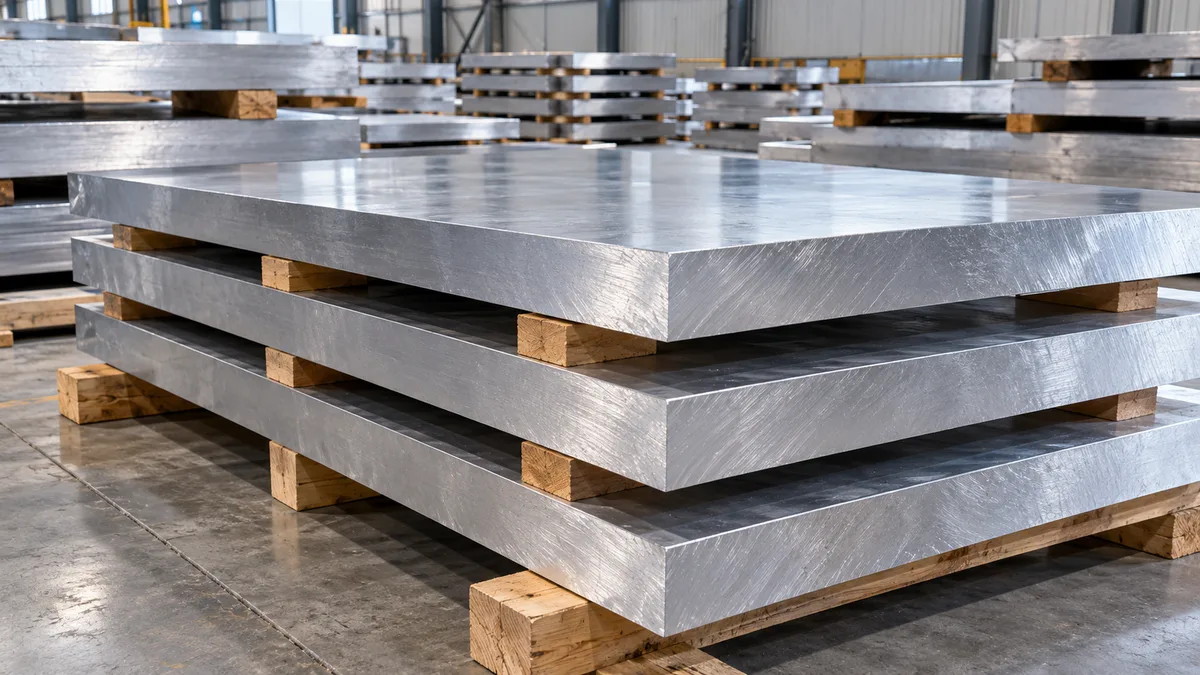
For decades 5083-H131 has been the standard weldable aluminium armour, but newer plates now give more ballistic and blast protection per kilogram. This guide compares the main options (higher-magnesium 5xxx such as 5059, scandium- and zirconium-modified 5xxx, 7039, 2139 and 7085) and explains how to choose between them using the military specifications, threat levels and fabrication needs of a real vehicle.
Aluminium armour protects a vehicle by mass efficiency. An aluminium plate is about three times thicker than a steel plate of the same weight, so it is far stiffer in bending, needs fewer stiffeners and can form a self-supporting hull. That is why the hulls of many tracked and wheeled armoured vehicles, from personnel carriers to amphibious craft, are welded aluminium.
The baseline is 5083 in the strain-hardened H131 temper, specified in the US under MIL-DTL-46027. It welds well, resists corrosion and absorbs blast by deforming without cracking. Its weakness is moderate strength, which limits resistance to armour-piercing rounds. The 7xxx alloy 7039 stops projectiles better but is prone to stress-corrosion cracking and harder to weld.
New armour plates try to close that gap: more strength and ballistic resistance than 5083, while keeping as much weldability, toughness and corrosion resistance as possible. Three routes dominate: raising the magnesium content of 5xxx alloys (5059), adding scandium and zirconium to refine grain structure in 5xxx plate, and using high-strength 2xxx or 7xxx alloys (2139, 7085) where welding is limited or not needed.
Alloy options
Aluminium armour alloys compared
The table compares the main wrought aluminium armour alloys qualitatively. Exact properties depend on thickness, temper and specification revision, so design values must come from the governing specification and the mill certificate.
Alloy / temper
Family
Typical specification
Weldability
Corrosion resistance
Ballistic resistance vs 5083
Typical role
5083-H131
Al-Mg (non-heat-treatable)
MIL-DTL-46027
Excellent
Excellent
Baseline
Welded hulls, floors, structure
5456-H116 / H131
Al-Mg
MIL-DTL-46027
Excellent
Very good
Slightly higher
Hulls and decks
5059-H131 / H136
High-Mg Al-Mg with Zn, Zr
MIL-DTL-46027 (later revisions)
Very good
Very good
Higher
Lighter welded hulls, blast floors
Sc/Zr-modified 5xxx
Al-Mg with Sc and Zr
Development and national specifications
Very good
Good to very good
Higher (alloy-specific)
Candidate replacement for 5083 and 5059
7039-T64
Al-Zn-Mg
MIL-DTL-46063
Limited
Fair (stress-corrosion sensitive)
Much higher
Turret and glacis plates
2139-T8
Al-Cu-Mg-Ag
MIL-DTL-32341
Weldable in specified thicknesses
Fair to good
Much higher
High-threat structure and appliqué
7085, 7056, 7075 (appliqué)
Al-Zn-Mg-Cu
MIL-DTL-32375
Not for welding
Requires protection
Highest of the aluminium grades
Bolt-on appliqué panels
MIL-DTL-46027 covers weldable 5083, 5456 and 5059 plate; MIL-DTL-32341 states that weldability has been established only for 2139 in certain thicknesses, with its other alloys limited to appliqué use; MIL-DTL-32375 covers unweldable appliqué plate. Always check the current revision.
Higher-magnesium 5xxx
5059: the established step up from 5083
5059 contains more magnesium than 5083, plus zinc and zirconium. Zirconium forms fine Al3Zr dispersoids that pin grain boundaries, and the higher magnesium raises strain-hardening response. The result is markedly higher strength in H131 and H136 tempers, and a US Army Research Laboratory programme evaluated 5059-H131 and H136 as a direct alternative to 5083-H131 in ballistic tests.
Because it is still a non-heat-treatable 5xxx alloy, 5059 welds with the same processes and similar filler metals as 5083 (5183 or 5556 type), and the heat-affected zone does not lose strength through over-ageing as it does in 7xxx alloys. Its main limits are higher cost and a narrower supply base. Like all alloys above about 3 % magnesium, it must be kept out of sustained service above roughly 65 °C, where long exposure can sensitise grain boundaries to intergranular corrosion.
Scandium-modified 5xxx
Scandium and zirconium modified Al-Mg plate
Adding a few tenths of a percent of scandium together with zirconium produces Al3(Sc,Zr) particles that are extremely effective at stopping recrystallisation and refining grain size. In Al-Mg alloys this raises yield strength substantially without losing the corrosion resistance and weldability of the 5xxx family. Patent literature for Al-Mg armour plate also allows small scandium and zirconium additions and reports V50 ballistic gains over a 5083-H131 baseline when tested to MIL-DTL-46027 procedures.
Under ballistic and blast loading these fine-grained plates show strong strain-rate hardening: the faster they are loaded, the stronger they behave, and deformation spreads across many narrow shear bands rather than concentrating in one. That combination of higher dynamic strength and preserved ductility is why developers claim protection approaching 7039 with blast behaviour closer to 5xxx.
Treat these claims carefully. Sc-modified armour plates are often proprietary, specified under national or company standards rather than a published military specification, and their ballistic data depend on the projectile, test range and acceptance criteria used. Before adopting one, ask for third-party test reports against your threat, weld procedure qualification and corrosion test results (for example ASTM G66 and G67 for 5xxx alloys).
High-strength grades
7039, 2139 and 7085: maximum protection, more constraints
7039-T64
The traditional high-strength aluminium armour. Far better against armour-piercing rounds than 5083, but sensitive to stress-corrosion cracking and exfoliation, and weld zones lose strength. Used for turret and glacis plates with careful design and coatings.
2139-T8
An Al-Cu-Mg-Ag alloy developed for armour, with high strength, good toughness and better stress-corrosion behaviour than 7039. Weldable in the thicknesses established by MIL-DTL-32341.
7085 and 7056
Thick-section aerospace 7xxx alloys used as unweldable appliqué armour to MIL-DTL-32375. Bolted onto a welded 5xxx hull to defeat higher threats.
Al-Li plate (2195, 2060)
Lower density and higher stiffness. Covered alongside 2139 in MIL-DTL-32341 for appliqué use; mainly of interest where weight savings justify cost.
A common modern architecture combines both groups: a welded hull in 5083, 5059 or a Sc-modified 5xxx for structure, blast and corrosion resistance, plus bolt-on 7xxx, 2139 or ceramic appliqué panels that are sized to the mission threat and can be replaced after damage. See our page on multi-ply composite armour plate.
Protection levels
STANAG 4569 levels and plate thickness
NATO STANAG 4569 and its test procedure AEP-55 define protection levels for logistic and light armoured vehicles. Kinetic energy levels rise from ball rounds at level 1 to 7.62 mm armour-piercing rounds at level 3 and 14.5 mm AP at level 4. Mine-blast levels (2a, 2b, 3a, 3b, 4a, 4b) are defined by charge mass and whether it detonates under a wheel or the hull centre.
What drives thickness
Effect
Practical note
Threat calibre and type
AP cores need far more aluminium than ball rounds
Higher threats are usually met with appliqué rather than thicker hull plate
Angle of impact
Sloped plate presents a longer path and can deflect rounds
Thickness tables always quote the obliquity used in testing
Alloy and temper
Stronger alloys need less thickness for the same V50
Compare only at the same threat, range and angle
Blast charge
Floor and belly plates must deform without rupture
Ductility and weld quality matter as much as strength
Ballistic limit figures (V50, the velocity at which half the rounds penetrate) are only comparable when the projectile, obliquity and test standard match. Treat any single thickness-versus-threat chart as a guide to be confirmed by tests on the actual plate lot and weld procedure.
Fabrication
Cutting, welding and forming armour plate
Cutting: waterjet and plasma or laser cutting are used; waterjet avoids a heat-affected edge. Saw-cut and machined edges are preferred at weld preparations.
Welding 5xxx armour: MIG with 5183 or 5556 filler, or friction-stir welding for long straight seams. Weld procedures are qualified by ballistic shock and tensile tests per the governing specification.
Welding 2139: only in qualified thicknesses and with approved procedures; 7xxx appliqué grades are bolted, not welded.
Forming: strain-hardened armour plate has limited ductility; generous bend radii and forming across the rolling direction reduce cracking.
Corrosion protection: 5xxx hulls are usually painted with chemical agent resistant coatings; 7xxx and 2xxx plates need conversion coating and primer, and isolation from steel fasteners.
Inspection: ultrasonic inspection of plate (for example to ASTM B594 or AMS-STD-2154 classes) and radiography or ultrasonic testing of welds.
Supply and ordering
How Metline supplies armour plate
Metline supplies aluminium armour plate in 5083, 5456 and 5059 and in high-strength grades on request, to the specification on your drawing, with cutting and machining of blanks and parts to drawing. Each delivery carries an EN 10204 3.1 mill certificate; 3.2 certification with third-party inspection, ultrasonic reports and ballistic test documentation can be arranged where the programme requires them.
Define the requirementAlloy and temper (or the protection level you need), specification and revision, thickness, plate size and quantity.
Agree testingMechanical, corrosion, ultrasonic and, if required, ballistic acceptance tests and who witnesses them.
ProcessingCut-to-size plate or parts cut and machined to drawing.
Documents and exportMill certificates, test reports and any export control paperwork required by the destination.
ShippingPlates interleaved and packed in seaworthy cases; delivered on EXW, FOB, CIF or DAP terms.
US Army Research Laboratory – Ballistic performance testing of aluminum alloy 5059-H131 and 5059-H136 for armor applications (ARL-TR-4427)
NATO STANAG 4569 / AEP-55 – Protection levels for occupants of armoured vehicles
FAQ
New aluminium armour plate: frequently asked questions
What is the best aluminium alloy for armour plate?
There is no single best grade. 5083-H131 and 5059 suit welded hulls that need blast and corrosion resistance; 7039, 2139 and 7085 give higher ballistic resistance but with welding and corrosion limits. Most vehicles combine a welded 5xxx hull with bolt-on high-strength appliqué.
Is 5059 better than 5083 for armour?
5059 is stronger than 5083 in comparable H131 tempers and gives better ballistic protection at the same thickness, while keeping similar weldability and corrosion resistance. It costs more and is made by fewer mills.
What do scandium additions do in aluminium armour?
Scandium with zirconium forms very fine particles that refine grain size and stop recrystallisation, raising strength and strain-rate hardening in Al-Mg plate without losing weldability. Such plates are often proprietary, so ask for independent ballistic, weld and corrosion test reports.
Can 7039 aluminium armour be welded?
It can be welded, but the weld zone loses strength and the alloy is sensitive to stress-corrosion cracking, so welding is restricted and carefully controlled. Many designs use 7xxx plate as bolted appliqué instead.
Which specification covers weldable aluminum armor plate?
In the US, MIL-DTL-46027 covers weldable 5083, 5456 and 5059 armor plate. MIL-DTL-32341 covers 2139 and related alloys, MIL-DTL-46063 covers 7039, and MIL-DTL-32375 covers unweldable appliqué plate.
Can you cut armour plate to drawing?
Yes. Plate can be supplied cut to size or as parts cut and machined to your drawing, with mill certificates and agreed inspection.
What certificates come with armour plate?
Every lot comes with an EN 10204 3.1 mill certificate showing chemistry and mechanical properties. Ultrasonic reports, corrosion tests, ballistic acceptance results and 3.2 third-party certification can be arranged when the order calls for them.
Specifying aluminium armour plate?
Tell us the threat level or alloy, specification, thicknesses and quantities. We will propose suitable plate and documentation.