Milling
Climb-mill with sharp, high-rake cutters and flood coolant. Light finishing passes reduce burrs, which soft Al-Mg alloys tend to raise.



5A02 square bar is a solid, four-sided extrusion in a 2.5 % magnesium aluminium alloy, chosen for brackets, keys, stiffeners, frames and machined blocks that must survive salt air and seawater. It is supplied in O and H112 tempers to GB/T 3191 and corresponds closely to AMg2, 5251 and 5052. Metline supplies 5A02 square bar in standard and custom sizes, cut to length and certified, to customers worldwide.
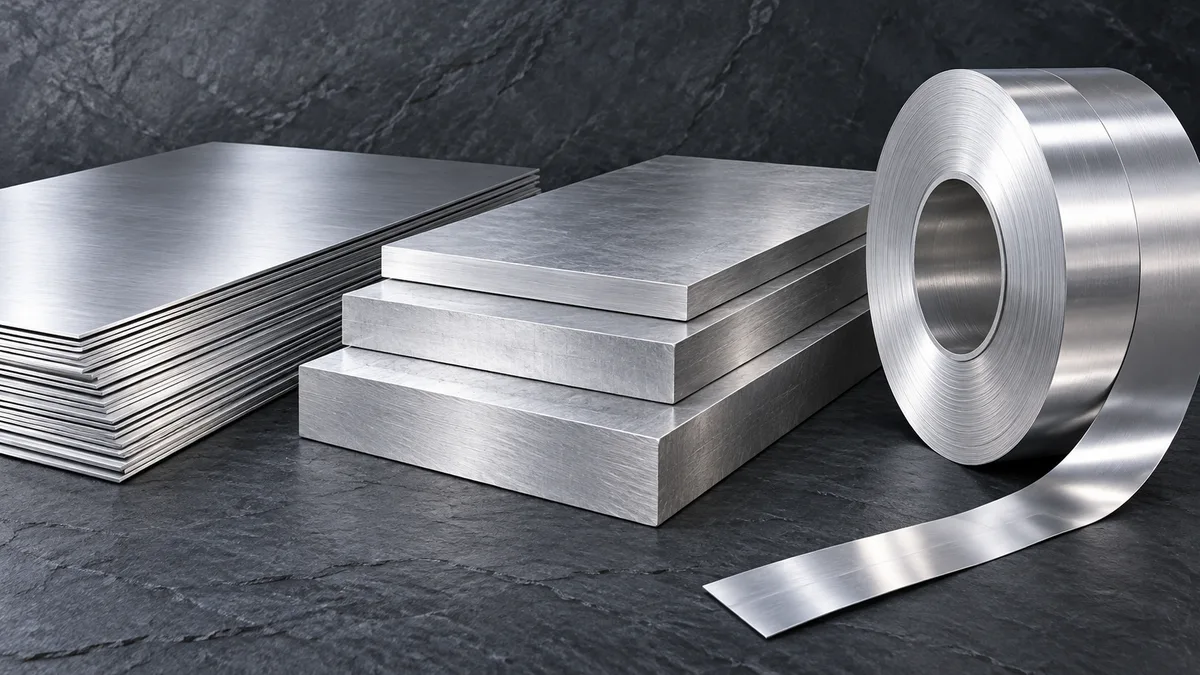
Square bar offers flat, square reference faces on all four sides. Fabricators use it as stock for machined blocks, as a weld-on stiffener or doubler, as the frame of a hatch or grating, and as keys and locating pieces in deck machinery. In marine work the bar often ends up welded to plate or tube, so the alloy needs to be weldable and should match the corrosion behaviour of the surrounding structure.
5A02 fits that brief for lightly to moderately loaded parts. It is an aluminium-magnesium alloy with 2.0 – 2.8 % magnesium and a small manganese or chromium addition, specified in GB/T 3190. It has no heat-treated temper to lose during welding, accepts ordinary ER5356 filler, and pairs naturally with 5xxx hull and superstructure plate so that there is no galvanic difference between bar and plate.
Strength is modest: typical tensile strength is roughly 170 – 220 MPa in the as-supplied tempers. For a heavily loaded stiffener, a higher-magnesium alloy such as 5083 or a heat-treated 6082-T6 bar is a better match. For trim, brackets, fittings, grating frames and other secondary items, 5A02 square bar is economical and durable.
| Element | Limit (%) |
|---|---|
| Magnesium (Mg) | 2.0 – 2.8 |
| Manganese (Mn) or chromium (Cr) | 0.15 – 0.40 |
| Silicon (Si) | ≤ 0.40 |
| Iron (Fe) | ≤ 0.40 |
| Copper (Cu) | ≤ 0.10 |
| Titanium (Ti) | ≤ 0.15 |
| Others, each / total | ≤ 0.05 / ≤ 0.15 |
| Aluminium (Al) | Remainder |
Magnesium in solid solution provides most of the strength and the corrosion resistance. Iron and silicon are held at 0.40 % each so that the bar stays ductile and takes a clean anodised finish. The copper limit of 0.10 % is what separates genuine marine 5xxx alloys from general-purpose grades that pit more readily in seawater.
| Temper | Tensile strength Rm | Proof strength Rp0.2 | Elongation | Notes |
|---|---|---|---|---|
| O / H112, GB/T 3191 (25 – 150 mm) | ≤ 225 MPa | — | ≥ 10 % | Standard requirement |
| O, typical | 170 – 200 MPa | 70 – 90 MPa | 20 – 25 % | Fully soft; best for bending |
| H112, typical | 180 – 220 MPa | 80 – 110 MPa | 15 – 22 % | As extruded; best for machining |
For stiffness calculations, the elastic modulus of all 5xxx alloys is about one third that of steel. A square aluminium bar therefore needs roughly 1.3 times the side length of a steel bar to match its bending stiffness, while still weighing less than half as much.
| System | Grade | Bar standard |
|---|---|---|
| China | 5A02 (LF2) | GB/T 3191; tolerances GB/T 14846 |
| Russia / CIS | AMg2 (1520) | GOST 21488 |
| USA | 5052 (A95052) | ASTM B221 / B211 |
| Europe | EN AW-5251 or EN AW-5052 | EN 755-2; square bar tolerances EN 755-4 |
| Japan | A5052 | JIS H4040 |
Equivalents are close, not identical. Where a drawing names a specific standard, we certify to that standard.
Weight per metre = side² (mm) × 2.68 / 1,000.
| Side (mm) | kg per metre | kg per 3 m bar | kg per 6 m bar |
|---|---|---|---|
| 10 | 0.268 | 0.80 | 1.6 |
| 12 | 0.386 | 1.16 | 2.3 |
| 15 | 0.603 | 1.81 | 3.6 |
| 20 | 1.07 | 3.22 | 6.4 |
| 25 | 1.68 | 5.03 | 10.1 |
| 30 | 2.41 | 7.24 | 14.5 |
| 35 | 3.28 | 9.85 | 19.7 |
| 40 | 4.29 | 12.86 | 25.7 |
| 50 | 6.70 | 20.10 | 40.2 |
| 60 | 9.65 | 28.94 | 57.9 |
| 70 | 13.13 | 39.40 | 78.8 |
| 80 | 17.15 | 51.46 | 102.9 |
| 100 | 26.80 | 80.40 | 160.8 |
| 120 | 38.59 | 115.78 | 231.6 |
| 150 | 60.30 | 180.90 | 361.8 |
| 200 | 107.20 | 321.60 | 643.2 |
The table gives the side-length tolerances usually applied to extruded 5A02 square bar (GB/T 14846 ordinary grade, matching EN 755-4 for the easier-to-extrude alloy group). Corner radii are held to about 1 mm on small bars and up to about 2.5 mm on 80 – 120 mm bars; twist is limited to roughly 1 – 2 mm per metre depending on size.
| Side length (mm) | Permitted deviation (mm) |
|---|---|
| over 8 to 18 | ±0.22 |
| over 18 to 25 | ±0.25 |
| over 25 to 40 | ±0.30 |
| over 40 to 50 | ±0.35 |
| over 50 to 65 | ±0.40 |
| over 65 to 80 | ±0.45 |
| over 80 to 100 | ±0.55 |
| over 100 to 120 | ±0.65 |
| over 120 to 150 | ±0.80 |
| over 150 to 180 | ±1.00 |
| over 180 to 220 | ±1.15 |
Climb-mill with sharp, high-rake cutters and flood coolant. Light finishing passes reduce burrs, which soft Al-Mg alloys tend to raise.
Use carbide-tipped saw blades with a negative or neutral hook and lubrication to avoid loading the teeth.
MIG with ER5356 is fastest for fillet welds to plate; TIG for small fittings. Keep joints clean and dry to avoid porosity.
O temper bends cold to tight radii. H112 bends to moderate radii; anneal locally if cracking appears on the outside face.
Brushed, anodised or painted. For painting, use a chromate-free etch primer suited to aluminium before the marine topcoat.
Use aluminium, stainless with isolating washers, or coated fasteners. Seal faying surfaces to keep seawater out of crevices.
| Need | Recommended grade | Reason |
|---|---|---|
| Light load, welded, in seawater | 5A02 or 5052 | Ductile, very good corrosion resistance, no weld-zone strength loss |
| Higher load, welded, in seawater | 5083 H112 | About 40 % stronger with excellent seawater resistance |
| Precision machined, above waterline | 6082-T6 or 6061-T6 | Heat-treated strength and clean machining |
| Warm locations near engines | 5A02 or 6xxx | High-magnesium grades can sensitise above about 65 °C |
Mainly secondary structure and fittings: hatch and door frames, grating frames, brackets, keys, rubbing strips and ladder or railing parts, especially where they are welded to 5xxx plate.
For lightly loaded members, yes. For primary stiffeners or frames, class rules normally call for higher-strength approved grades such as 5083 plate and 6082 or 6005A extrusions.
Yes. It takes clear sulphuric anodising well, which adds salt-spray resistance. Colour anodising works but is less vivid than on 6xxx alloys.
About 6.70 kg per metre, so a 6 m bar weighs about 40.2 kg.
H112 for machined parts, because it cuts more cleanly; O for parts that will be bent or formed cold.
Tell us size, temper, length, quantity and destination; we will reply with availability, certification and a delivered price.





