Welding
ER5183 for structural joints in both alloys, ER5356 acceptable for 5086. Clean joints immediately before welding and qualify procedures on the actual alloy.



Square bar in 5086 or 5059 gives marine fabricators a weldable, seawater-resistant section for brackets, chocks, stiffeners and machined blocks. 5086 is the economical, widely produced option; 5059 offers about twice the extruded yield strength for weight-critical, class-built craft. Metline supplies both in the extruded tempers listed by IACS, cut to length and certified, to yards worldwide.
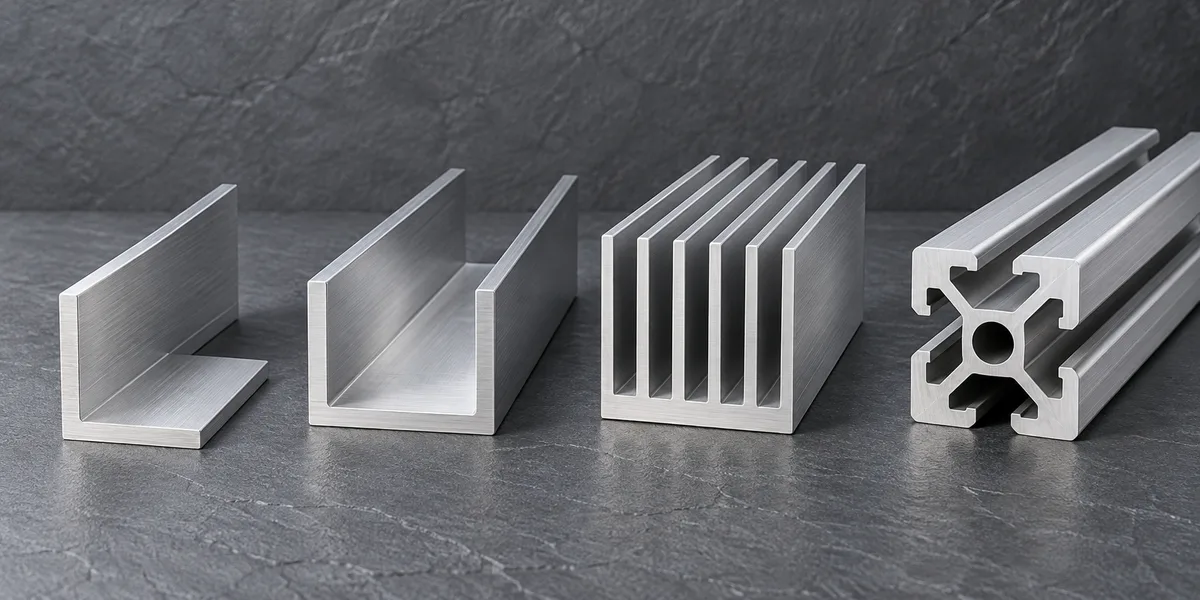
Square bar is the shipyard's raw material for chocks, foundation pads, doubler blocks, hatch-coaming stiffeners and machined brackets. Making it from the same alloy family as the hull keeps welded joints simple and corrosion behaviour uniform.
5086 contains about 4 % magnesium with manganese and chromium. It is listed in ASTM B221 and IACS UR W25, welds easily with ER5356 or ER5183 and resists seawater uncoated. Its extruded strength is modest, so it suits pads, chocks and parts sized by stiffness or bearing area rather than by high stress.
5059 contains 5 – 6 % magnesium with zinc and zirconium and is the strongest established marine 5xxx alloy. Extruded 5059-H112 has a minimum yield of 200 MPa, against 95 MPa for 5086-H112, and keeps more strength next to welds. Designers specify it for fittings on 5059-plated hulls or wherever a smaller, lighter section must carry the load. It is normally extruded to order.
| Element (wt %) | 5059 | 5086 |
|---|---|---|
| Silicon (Si) | 0.45 | 0.40 |
| Iron (Fe) | 0.50 | 0.50 |
| Copper (Cu) | 0.25 | 0.10 |
| Manganese (Mn) | 0.6 – 1.2 | 0.20 – 0.7 |
| Magnesium (Mg) | 5.0 – 6.0 | 3.5 – 4.5 |
| Chromium (Cr) | 0.25 | 0.05 – 0.25 |
| Zinc (Zn) | 0.40 – 0.90 | 0.25 |
| Titanium (Ti) | 0.20 | 0.15 |
| Zirconium (Zr) | 0.05 – 0.25 | — |
| Others, each / total | 0.05 / 0.15 | 0.05 / 0.15 |
| Aluminium (Al) | Remainder | Remainder |
Single figures are maximums. For 5059, zirconium 0.05 – 0.25 % is excluded from the "others" total.
| Alloy | Temper | Yield Rp0.2 min (MPa) | Tensile Rm (MPa) | Elongation A50 / A5 min (%) |
|---|---|---|---|---|
| 5086 | O | 95 | 240 – 315 | 14 / 12 |
| 5086 | H111 | 145 | 250 | 12 / 10 |
| 5086 | H112 | 95 | 240 | 12 / 10 |
| 5059 | H112 | 200 | 330 | — / 10 |
IACS UR W25 Rev.4 Table 3, extruded products 3 – 50 mm. ASTM B221 gives the same limits for 5086. Values above 50 mm are agreed against a recognised standard.
For welded design, assume the heat-affected zone falls towards the annealed condition. With 5086 that is close to the H112 figures above; with 5059 the loss is larger in absolute terms but the remaining strength is still the highest of the group.
| Standard | Scope |
|---|---|
| IACS UR W25 and class rules | Extruded 5059 and 5086 (and 5083, 5383) for hull and marine structure |
| ASTM B221 / B221M | Extruded bar, rod and profiles; includes 5086 tempers O, H111 and H112 |
| ASTM B928 / B928M | High-magnesium marine products, including extruded profiles, with corrosion testing |
| EN 755-2 | Mechanical properties of extruded bar, tube and profiles |
| EN 755-3 / -4 / -6 | Dimensions and tolerances of round, square and hexagonal extruded bar |
| EN 573-3 | Chemical composition |
EN 755-4 controls the side length, corner radius, squareness, straightness, twist and cut length of extruded square bar; ANSI H35.2 does the same for ASTM orders. Limits widen as the section gets larger. Where bars will be machined to final size, standard extruded tolerances are normally adequate; where they are welded as-supplied into structure, check twist and straightness on long lengths.
| System | 5059 | 5086 |
|---|---|---|
| Aluminum Association / ASTM | 5059 | 5086 |
| UNS | A95059 | A95086 |
| European (EN 573-3) | EN AW-5059 / AlMg5.5MnZnZr | EN AW-5086 / AlMg4 |
| German Werkstoff | — | 3.3545 |
| Japan (JIS) | — | A5086 |
| Marine rules | IACS UR W25, rolled and extruded | IACS UR W25, rolled and extruded |
Weight per metre = side² × density. At 2.66 g/cm³ (5086) that is 0.00266 × a² kg per metre; 5059 is fractionally lighter.
| Size (mm) | kg per metre | 3 m bar (kg) | 6 m bar (kg) |
|---|---|---|---|
| 10 | 0.266 | 0.80 | 1.6 |
| 12 | 0.383 | 1.15 | 2.3 |
| 16 | 0.681 | 2.04 | 4.1 |
| 20 | 1.06 | 3.19 | 6.4 |
| 25 | 1.66 | 4.99 | 10.0 |
| 30 | 2.39 | 7.18 | 14.4 |
| 40 | 4.26 | 12.77 | 25.5 |
| 50 | 6.65 | 19.95 | 39.9 |
| 60 | 9.58 | 28.73 | 57.5 |
| 75 | 14.96 | 44.89 | 89.8 |
| 80 | 17.02 | 51.07 | 102.1 |
| 100 | 26.60 | 79.80 | 159.6 |
| 120 | 38.30 | 114.91 | 229.8 |
| 150 | 59.85 | 179.55 | 359.1 |
ER5183 for structural joints in both alloys, ER5356 acceptable for 5086. Clean joints immediately before welding and qualify procedures on the actual alloy.
Both machine adequately with sharp, polished, high-rake tools and good coolant. Expect long chips in O temper 5086.
Saw or waterjet for best edges; plasma-cut edges to be welded should be dressed back.
5086-O / H111 bends readily. 5059 needs larger radii and more allowance for springback.
Use non-conductive washers and sleeves where bars meet steel, stainless or bronze.
Do not use either alloy for structure held above about 65 °C for long periods.
| Property | 5086-H112 | 5083-H112 | 5059-H112 | 6082-T6 |
|---|---|---|---|---|
| Min yield (UR W25, extruded) | 95 MPa | 110 MPa | 200 MPa | 260 MPa |
| Min tensile | 240 MPa | 270 MPa | 330 MPa | 310 MPa |
| Seawater immersion | Excellent | Excellent | Excellent | Needs protection |
| Strength after welding | Largely retained | Largely retained | Highest of 5xxx group | Large loss in HAZ |
6082-T6 looks stronger on paper, but its heat-affected zone loses about half its strength and it needs protection when immersed. For welded, wetted parts, the 5xxx alloys usually give the more reliable result.
Yes. 5086 is listed in IACS UR W25 for extruded products in O, H111 and H112 and is widely used for chocks, pads and fittings on aluminium vessels.
In the extruded H112 condition, 5059 has a minimum yield of 200 MPa against 95 MPa for 5086, and a minimum tensile strength of 330 MPa against 240 MPa.
About 0.00266 × (side in mm)² kg per metre. A 40 mm bar weighs about 4.26 kg/m.
They can take a clear protective anodic film, though it is slightly grey on high-magnesium alloys. Most marine parts are left bare or painted.
Where the producing mill holds approval for the product, yes. Mention the classification society when you enquire.
Send alloy, size, temper and quantity. Metline will reply with availability, certificates and a delivered price.





