Stamping
Aluminium has lower formability limits and higher springback than mild steel. Generous radii, optimised draw beads and simulation with the actual 6181 forming-limit curve keep splits and wrinkles under control.



6181 (EN AW-6181, AlSi1Mg0.8) is a copper-lean 6xxx body sheet alloy with more silicon and magnesium than 6016, giving higher strength after paint baking while keeping good hemming and corrosion behaviour. It is supplied in pre-aged T4P for outer and inner panels and in high-strength grades for structural parts. Metline supplies 6181 sheet and coil worldwide with mill, EDT or Ti/Zr pre-treated surfaces.
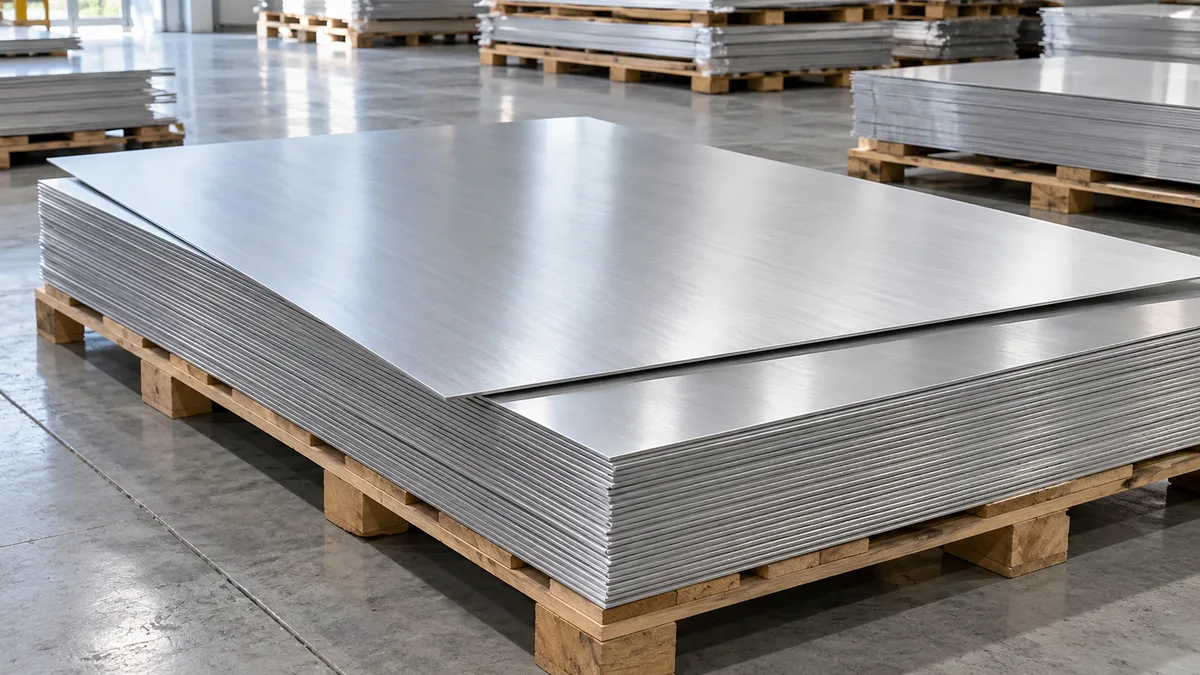
6181 is a European-registered Al-Mg-Si alloy with silicon of 0.8 – 1.2 % and magnesium of 0.6 – 1.0 %. That is a richer solute content than 6016, so more strengthening Mg-Si precipitates form in the paint bake. Copper is held to 0.10 % or less, which keeps the alloy's resistance to filiform corrosion close to that of 6016.
The result is a sheet that slots between 6016 and copper-bearing 6111: higher bake-hardened strength than 6016 for better dent resistance or down-gauging, with better hemming and corrosion margins than 6111. Many body sheet specifications list 6181 as a high-strength (HS) option for outer panels, roofs and structural inners.
A related alloy, 6181A, has slightly different silicon and iron windows and is used for extrusions and sheet in some programmes; the two are not automatically interchangeable, so the drawing should name one.
Limits per EN 573-3 for EN AW-6181, which match the Aluminum Association registration.
| Element | 6181 (wt %) |
|---|---|
| Silicon (Si) | 0.8 – 1.2 |
| Iron (Fe) | 0.45 max |
| Copper (Cu) | 0.10 max |
| Manganese (Mn) | 0.15 max |
| Magnesium (Mg) | 0.6 – 1.0 |
| Chromium (Cr) | 0.10 max |
| Zinc (Zn) | 0.20 max |
| Titanium (Ti) | 0.10 max |
| Others, each / total | 0.05 / 0.15 |
| Aluminium (Al) | Remainder |
Body sheet properties are specified as ranges in the OEM or purchase specification. The table shows typical requirements for a high-strength 6181 T4P grade in the 0.7 – 1.5 mm range; the paint-bake test is usually 2 % pre-strain followed by a laboratory bake such as 185 °C for 20 minutes.
| Property | T4P as delivered | After pre-strain and bake (T6B / T8X test state) |
|---|---|---|
| Proof strength Rp0.2 | about 115 – 170 MPa | typically about 220 – 270 MPa |
| Tensile strength Rm | about 230 – 260 MPa (typical) | — |
| Elongation A50 | ≥ 20 % | — |
| Strain-hardening exponent n (10 – 20 %) | ≥ 0.23 | — |
| Plastic strain ratio r (10 %) | ≥ 0.5 | — |
Older catalogue data sometimes quote a 6181 T4P tensile strength of 250 MPa or more as a minimum. Treat that as a grade-specific requirement to be confirmed, not a general property of the alloy.
6xxx body sheet is delivered soft enough to stamp and gains most of its in-service strength in the paint shop. After the body is e-coated, the bake oven (typically 170 – 190 °C for 20 – 30 minutes) acts as an artificial ageing treatment: fine Mg-Si precipitates form and the yield strength of the panel rises. Strain from stamping adds a further work-hardening increment. This is the bake-hardening or paint-bake response, and it is why a door skin can be pressed easily yet resist dents on the road.
| Condition | What it means | Why it matters for 6181 |
|---|---|---|
| T4 | Solution heat-treated and naturally aged at room temperature | Natural ageing continues for weeks; formability slowly falls and bake response weakens |
| T4P (T4 pre-aged) | Solution treated, then given a short pre-ageing treatment (roughly 70 – 100 °C) immediately after quenching | Stabilises properties during storage and gives a stronger, faster bake response |
| T6B / T8X test state | T4P sheet pre-strained about 2 % and baked in the laboratory (for example 185 °C for 20 minutes) | Simulates the painted panel; used to verify dent resistance |
| T6 | Fully artificially aged to peak strength | For structural parts that need maximum strength and little forming |
Suffix letters such as T4Pa or T6Bb are supplier or OEM sub-codes for a specific pre-ageing or bake cycle. Always state the cycle and test method in the order.
Body sheet is ordered not just by alloy and temper but by surface texture, pre-treatment and lubricant, because these decide how the coil behaves in the press shop, the adhesive line and the paint shop. The codes below are the ones most purchase specifications use; your OEM specification may use its own names for the same options.
| Option | Code | What it does | Where it is used |
|---|---|---|---|
| Mill finish | MF | Roll-ground surface straight from cold rolling, with a fine directional pattern | Inner panels and structural parts |
| Electro-discharge textured | EDT | Surface printed from work rolls textured by spark erosion; a random, isotropic micro-pattern holds lubricant and gives an even paint appearance | Visible outer panels: bonnets, doors, roofs, tailgates |
| Ti/Zr conversion pre-treatment | P / TiZr | Thin titanium-zirconium conversion layer applied on the finishing line; stabilises the oxide for durable adhesive bonding | Bonded and riveted body structures |
| Cleaned only | NP | Degreased and pickled surface, no pre-treatment film | Parts pre-treated by the customer |
| Dry lubricant (hot-melt) | DO | Wax-type lubricant that is solid at room temperature; clean handling and good deep-drawing performance | Complex outer panels and automated lines |
| Wet oil (electrostatic) | EO | Thin, even film of forming oil laid down electrostatically, typically about 0.5 – 1.5 g/m² per side | General stamping |
Lubricant type and coating weight must be compatible with your adhesives, sealers and pre-treatment chemistry. Confirm both with the paint shop before the first trial coil of 6181.
Body sheet tolerances are tighter than general-purpose sheet because blanks feed automated presses and lasers. The schedule below is typical for cut sheet and coil in the 0.7 – 1.5 mm range used for closures; the governing figures are those of your order standard (EN 485-4, ASTM B209 or GB/T 33227) or the OEM specification, whichever is tighter.
| Thickness (mm) | Width 800 – 1600 mm | Width 1600 – 1800 mm | Width 1800 – 2400 mm |
|---|---|---|---|
| 0.70 – 1.00 | ±0.03 | ±0.05 | ±0.08 |
| 1.00 – 1.20 | ±0.04 | ±0.06 | ±0.09 |
| 1.20 – 1.50 | ±0.05 | ±0.07 | ±0.10 |
Aluminium has lower formability limits and higher springback than mild steel. Generous radii, optimised draw beads and simulation with the actual 6181 forming-limit curve keep splits and wrinkles under control.
Outer panels are hemmed around inner panels at doors, bonnets and tailgates. Good flat-hem performance depends on low iron-particle content and a fine grain; roller hemming is common for tight radii.
Bodies are joined by self-piercing rivets, clinching, adhesive bonding, resistance spot welding with special electrodes, laser and friction stir welding. Ti/Zr pre-treated surfaces give the most durable adhesive joints.
T4-type sheet ages at room temperature. Use coils within the shelf life agreed with the supplier, and store them cool and dry.
With phosphate or zirconium pre-treatment and e-coat, 6xxx panels perform well. Copper-bearing alloys need good coating integrity to avoid filiform corrosion at edges.
Press-shop offcuts are segregated by alloy and returned for closed-loop recycling into new body sheet.
Because 6181 has a high solute content, it is somewhat more sensitive to natural ageing than 6016; use T4P coils within the agreed shelf life to keep forming and bake response consistent.
| Property | 6016 | 6181 | 6111 | 6014 |
|---|---|---|---|---|
| Si / Mg (nominal) | about 1.2 / 0.4 % | about 1.0 / 0.8 % | about 0.9 / 0.75 % | about 0.5 / 0.6 % |
| Copper | 0.20 % max | 0.10 % max | 0.50 – 0.9 % | 0.25 % max |
| Bake-hardened strength | Moderate | Moderate–high | Highest | Moderate |
| Hemming | Excellent | Very good | Good | Excellent |
| Typical use | Outer panels | Outer and structural | Outer and structural (NA) | Outer panels, high bake response |
6181 is the usual step up from 6016 when a programme needs more dent resistance without accepting the corrosion sensitivity of a copper-rich alloy.
Solution heat-treated, quenched and immediately pre-aged at a low temperature. Pre-ageing stabilises the sheet during storage and gives a faster, stronger paint-bake response than plain T4.
6181 has less silicon but much more magnesium (0.6 – 1.0 % against 0.25 – 0.6 %), so it reaches higher strength after baking. Both are copper-lean and resist filiform corrosion well.
No. They are related, but their silicon and iron limits differ. Order the alloy named on the drawing.
Tensile properties, n and r values, post-bake proof strength, and on request hemming, roping (paint-brush lines), forming-limit curve and high-strain-rate data.
Mill finish or EDT texture, with optional Ti/Zr pre-treatment and dry lubricant or electrostatic oil.
Yes. Metline supplies 6181 sheet and coil worldwide with mill certificates and sealed export packing.
Send the grade, surface, size and volume. We will reply with availability, certification and delivered pricing.





