Tensile and hardness
Specimens from prolongations or sacrificial parts; hardness on every part or by sampling.



6061 forgings combine the alloy's good strength, corrosion resistance and machinability with the refined grain flow of a forged part, which gives better fatigue and impact performance than a casting or a part machined from bar. In vehicles, 6061-T6 is the classic alloy for forged wheels and is widely used for suspension, steering and brake components. Metline supplies 6061 die forgings, open-die forgings, rolled rings and forged bar, heat-treated and tested to ASTM, AMS or EN requirements, to customers worldwide.
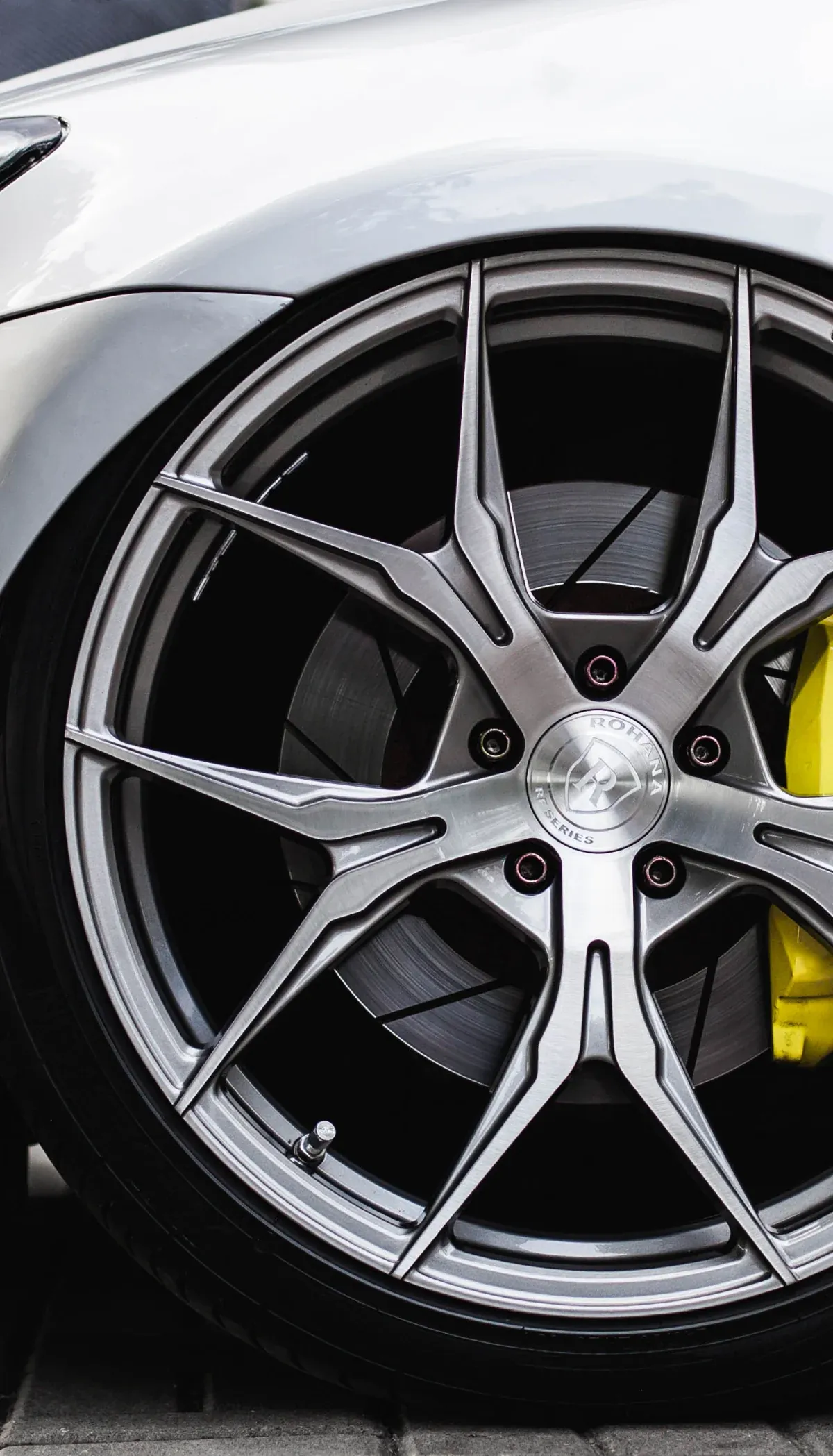
Forging shapes a heated billet between dies so that the metal's grain follows the outline of the part. A forged control arm or wheel spoke has continuous grain flow around radii and through load paths, no internal shrinkage porosity, and a fine, uniform structure. The practical result is higher fatigue strength and toughness than a cast part of the same alloy family and shape.
6061 is one of the most forged aluminium alloys because it works well at forging temperature, responds predictably to solution treatment and ageing, and resists corrosion without coatings. After T6 heat treatment it delivers a minimum of about 260 MPa tensile and 240 MPa yield strength in die forgings, with typical values near 310 MPa and 275 MPa.
For vehicle makers, forged 6061 is a way to cut unsprung mass. Replacing a steel or cast-iron suspension part with a forged aluminium part typically saves around 40 – 50 % of its weight, which improves ride, handling and energy use. In Europe 6082 is often preferred for suspension forgings because of its slightly higher strength; in North America and Asia, 6061 is the more common choice, particularly for wheels.
Forgings use the same registered composition as other 6061 products. Forging stock is usually cast and homogenised billet or extruded bar; extruded stock gives a finer starting structure for highly stressed parts.
| Element | Minimum | Maximum | Role |
|---|---|---|---|
| Silicon (Si) | 0.40 | 0.80 | Forms Mg2Si with magnesium |
| Iron (Fe) | — | 0.70 | Impurity |
| Copper (Cu) | 0.15 | 0.40 | Adds strength; slightly lowers corrosion resistance |
| Manganese (Mn) | — | 0.15 | Grain control |
| Magnesium (Mg) | 0.80 | 1.20 | Main strengthening element |
| Chromium (Cr) | 0.04 | 0.35 | Controls grain structure, improves stress-corrosion resistance |
| Zinc (Zn) | — | 0.25 | Impurity |
| Titanium (Ti) | — | 0.15 | Grain refiner |
| Others, each / total | — | 0.05 / 0.15 | |
| Aluminium (Al) | Remainder |
Registered limits from the Aluminum Association and EN 573-3 (EN AW-6061). Some published forging tables show copper up to 0.6 % or manganese of 0.15 – 0.40 %; these do not match 6061 and should be questioned if seen on a certificate.
ASTM B247 sets minimum properties for 6061 die forgings, hand (open-die) forgings and rolled rings. Properties depend on the direction of the test specimen relative to grain flow: values along the grain (longitudinal) are higher than across it, especially for elongation.
| Condition | Tensile strength | Yield strength (0.2 %) | Elongation | Hardness |
|---|---|---|---|---|
| 6061-T6 die forging, specified minimum (ASTM B247, ≤ 100 mm) | 260 MPa / 38 ksi | 240 MPa / 35 ksi | about 7 % (with grain) | — |
| 6061-T6 forging, typical | 310 MPa / 45 ksi | 275 MPa / 40 ksi | 12 – 17 % | about 95 HB |
| 6061-T4 forging, typical | 240 MPa / 35 ksi | 145 MPa / 21 ksi | about 20 % | about 65 HB |
| Forged wheel, typical OEM target | about 290 – 330 MPa | about 260 – 300 MPa | 7 – 10 % | 90 – 100 HB |
Wheel and suspension forgings are usually bought to OEM drawings that specify their own minimums and specimen locations, often above the ASTM B247 values. Hand forgings and thick sections have lower transverse minimums.
The T652 temper adds a small cold compression after quenching to relieve residual stress, which reduces distortion when large forgings are machined.
| Forging type | Typical automotive use | Notes on size |
|---|---|---|
| Closed-die (impression) forgings | Wheels, control arms, knuckles, brackets, caliper bodies | Near-net shape; size limited by press capacity and part plan area |
| Open-die (hand) forgings and blocks | Prototype parts, low-volume motorsport and tooling | Machined to final shape; suitable when die cost is not justified |
| Rolled rings | Wheel rim blanks, flanges, bearing housings | Seamless rings with circumferential grain flow |
| Forged bar and shafts | Drive shafts, steering columns, pins | Better grain structure than standard extruded bar |
| Forged discs | Wheel centres, pulleys, brake components | Pancake forgings for machining |
Specimens from prolongations or sacrificial parts; hardness on every part or by sampling.
Macro-etched sections confirm grain flow follows the part outline and that there are no laps or flow-through defects.
Volumetric inspection to ASTM B594 or AMS-STD-2154 for safety-critical forgings.
Fluorescent penetrant inspection for surface cracks and laps.
Finished wheels pass cornering fatigue, radial fatigue and impact tests such as SAE J328, SAE J175 or ISO 3006, or JWL in Japan.
Heat lot, forging lot and heat-treatment batch are linked on the EN 10204 3.1 certificate.
Engine blocks, cylinder heads and intake manifolds are not forged; they are cast from Al-Si casting alloys. Forged pistons use 4032 or 2618 rather than 6061, because those alloys keep strength and dimensional stability at piston temperatures.
| Property | 6061-T6 forging | 6082-T6 forging | 6151-T6 forging | A356-T6 casting |
|---|---|---|---|---|
| Typical tensile strength | about 310 MPa | about 330 – 350 MPa | about 330 MPa | about 260 – 280 MPa |
| Typical yield strength | about 275 MPa | about 300 MPa | about 295 MPa | about 190 – 210 MPa |
| Fatigue performance | High | High | High | Moderate |
| Corrosion resistance | Good | Good | Good | Good |
| Typical use | Wheels, general chassis | Suspension arms (Europe) | Intricate die forgings | Cast wheels, knuckles |
A forged 6061 wheel is often around 20 % lighter than a cast A356 wheel of equal strength, because the higher fatigue strength allows thinner spokes and rims. 6082 forgings offer a little more strength for suspension arms; the choice usually follows the OEM's regional standard.
ASTM B247 requires about 260 MPa (38 ksi) tensile and 240 MPa (35 ksi) yield strength for 6061-T6 die forgings up to 100 mm thick, with elongation depending on specimen direction. Typical production values are higher, around 310 MPa tensile and 275 MPa yield.
Both are solution treated and quenched. T4 is aged at room temperature and is softer and more ductile; T6 is artificially aged for maximum strength. Most finished automotive forgings are T6; T4 is used when a part will be formed or straightened before final ageing.
6061 forges well, reaches high strength after T6 treatment, resists corrosion and machines and finishes cleanly. Its fatigue strength allows a lighter wheel than a cast A356 design of the same rating.
Both work. 6082 gives slightly higher strength and is the common European choice; 6061 is more common in North America and Asia. The OEM specification and supply region usually decide.
Safety-critical forgings are commonly tested to ASTM B594 or AMS-STD-2154. Tell us the acceptance class on your drawing and it will be included in the inspection plan.
Yes. Metline supplies 6061 forgings worldwide with EN 10204 3.1 certificates, export packing and EXW, FOB, CIF or DAP terms.
Send the drawing, temper, annual volume and test requirements. Our team will reply with feasibility, certification and delivered terms.





