Solution treatment
The section is heated to dissolve zinc, magnesium and copper, then quenched rapidly in water.



7175-T73511 extrusions combine the stress-corrosion resistance of the over-aged T73 condition with the better toughness of a high-purity 7075-type alloy. Metline supplies 7175 extruded bars, rods and profiles to SAE AMS 4344, in thicknesses from 6.35 to 50.8 mm, to aerospace manufacturers worldwide.
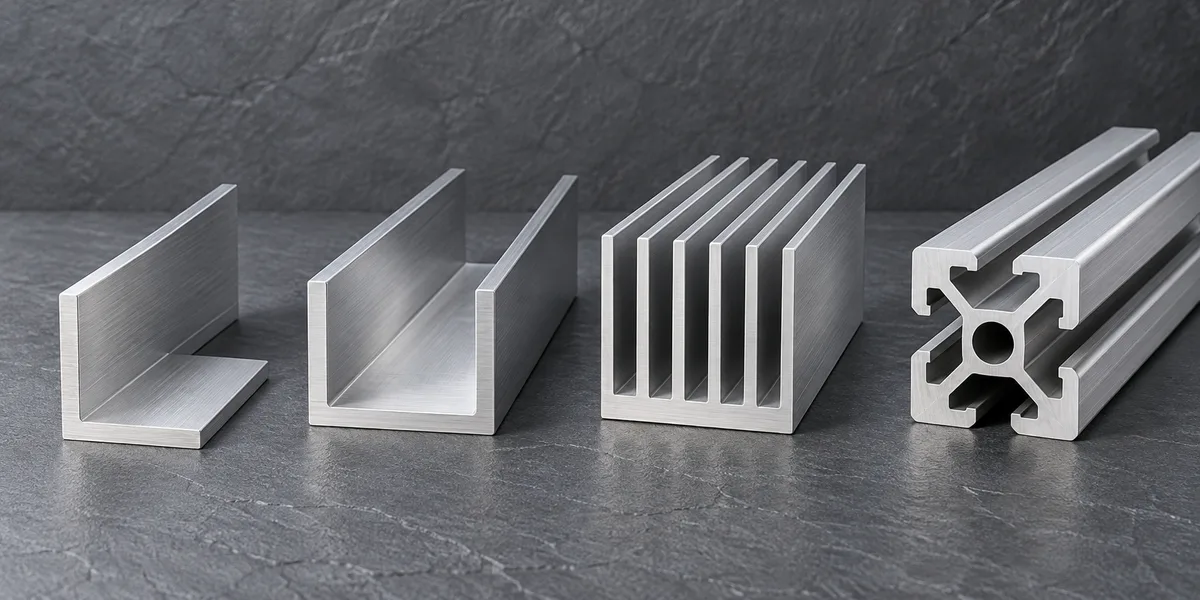
7175 is 7075 with iron and silicon held to low levels. In extrusions it is supplied in T73511: solution heat-treated, stretched to relieve quench stress, straightened, and over-aged to the T73 level that gives the highest resistance to stress-corrosion cracking among the common 7xxx tempers.
The purity gain matters most for fatigue and toughness. Iron- and silicon-rich particles are the usual starting points for fatigue cracks in 7075, and they lower the energy needed to grow a crack. With fewer of them, 7175 extrusions perform better in damage-tolerance tests and show higher elongation in the transverse direction.
Typical uses are machined fittings, frames, chords and brackets made from extruded bar or profiles where a 7075-T73511 part is not tough enough, or where the designer wants extra fatigue margin without moving to a different alloy family. The AMS 4344 specification covers extruded bars, rods and profiles from 0.250 to 2.000 in (6.35 – 50.8 mm) in nominal thickness.
Registered limits for 7175 (UNS A97175). AMS 4344 gives the nominal chemistry as 5.6 Zn - 2.5 Mg - 1.6 Cu - 0.23 Cr.
| Element | Minimum | Maximum | Comment |
|---|---|---|---|
| Silicon (Si) | — | 0.15 | Lower than 7075 (0.40) for toughness |
| Iron (Fe) | — | 0.20 | Lower than 7075 (0.50); fewer fatigue-crack origins |
| Copper (Cu) | 1.2 | 2.0 | Strength and SCC resistance |
| Manganese (Mn) | — | 0.10 | Minor |
| Magnesium (Mg) | 2.1 | 2.9 | Forms MgZn2 with zinc |
| Chromium (Cr) | 0.18 | 0.28 | Grain control |
| Zinc (Zn) | 5.1 | 6.1 | Main strengthening element |
| Titanium (Ti) | — | 0.10 | Grain refiner |
| Others, each / total | — | 0.05 / 0.15 | |
| Aluminium (Al) | Remainder |
Data sheets showing 7175 with silicon up to 0.80 %, zinc of 5.0 – 6.0 % or properties such as 90 – 120 MPa tensile strength are wrong; those values describe a 6xxx alloy in the annealed condition.
AMS 4344 sets minimum tensile properties by thickness band. Typical values for 7175-T73511 are similar to or slightly above 7075-T73511, with better elongation and toughness. Use the specification minimums or MMPDS values for design.
| Property (approx. typical) | 7175-T73511 | 7075-T73511 | 7075-T6511 |
|---|---|---|---|
| Tensile strength | About 505 – 525 MPa | About 505 MPa | About 570 MPa |
| Yield strength (0.2 %) | About 435 – 455 MPa | About 435 MPa | About 505 MPa |
| Elongation | About 12 % | About 12 % | About 11 % |
| Fracture toughness | Higher | Baseline | Lower |
| SCC resistance | Very high | Very high | Low |
The section is heated to dissolve zinc, magnesium and copper, then quenched rapidly in water.
Stretched by a controlled permanent set, typically 1 – 3 %, to relieve quench stresses.
Minor straightening after stretching to meet straightness tolerances.
Two-step artificial ageing beyond peak strength. Strength is about 10 – 15 % below T6 but SCC resistance is much higher.
Conductivity and hardness are measured on each lot. Because over-ageing raises electrical conductivity, a conductivity reading within the specified window confirms the part has been aged correctly.
| Product | Range | Notes |
|---|---|---|
| Rectangular bar | 6.35 – 50.8 mm thick | Width per extrusion capacity |
| Round bar and rod | Diameters up to the specification limit | Machining stock |
| Angles, tees, channels, Z and J sections | Per drawing | Thickness 6.35 – 50.8 mm |
| Lengths | Mill lengths or cut to size |
Weight of 7175 rectangular bar per metre (density 2.80 g/cm³):
| Section (mm) | kg per metre | kg per 4 m bar |
|---|---|---|
| 10 × 50 | 1.40 | 5.6 |
| 12.7 × 76.2 | 2.71 | 10.8 |
| 16 × 80 | 3.58 | 14.3 |
| 20 × 100 | 5.60 | 22.4 |
| 25.4 × 101.6 | 7.23 | 28.9 |
| 30 × 120 | 10.08 | 40.3 |
| 38.1 × 152.4 | 16.26 | 65.0 |
| 50.8 × 203.2 | 28.90 | 115.6 |
Excellent machinability, similar to 7075-T73. Low residual stress from stretching keeps parts flat.
Bolted or riveted. Interference-fit fasteners and bushings are acceptable in T73 tempers.
Anodise or conversion coat and prime; seal faying surfaces.
Avoid long exposure above about 120 °C.
SAE AMS 4344, for extruded bars, rods and profiles 0.250 to 2.000 in (6.35 to 50.8 mm) in nominal thickness.
Strength is similar or slightly higher. The main gains are toughness, fatigue life and transverse ductility, thanks to the lower iron and silicon content.
T73511 is over-aged for very high resistance to stress-corrosion cracking. T6511 is stronger but much more susceptible to SCC in loaded parts.
No. They are joined by bolting or riveting.
Technically 7175 meets or exceeds 7075 properties in this temper, but any substitution on an aircraft part needs approval from the design authority.
Yes, with EN 10204 3.1 certificates and export packing.
Send the section, length, quantity and specification. We will confirm availability and a delivered price.





