6063-T4
Solution treated and naturally aged. Softer and more formable; used for parts that will be bent or stretch-formed and then aged.



6063 flat bar is extruded from the alloy with the best surface finish and extrudability in the 6xxx family, and is used in aircraft interiors, trim, electrical bonding strips and ground equipment where appearance and corrosion resistance matter more than high strength. Metline supplies 6063 flat, round, square and hex bar in T4, T5, T52 and T6, certified to AMS 4156, ASTM B221 or EN 755, to buyers worldwide.
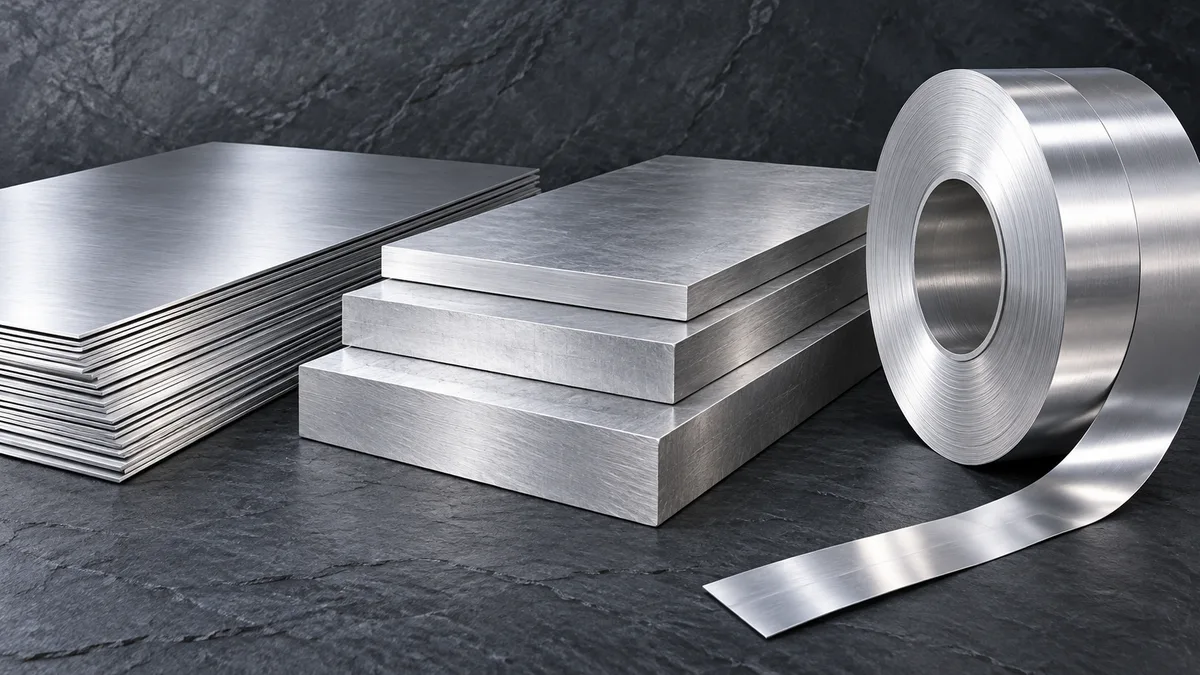
6063 is a low-alloy Al-Mg-Si grade designed for extrusion. It flows through dies at high speed, gives sharp corners and smooth faces, and anodises to an even, bright finish. The trade-off is strength: 6063-T6 has about three-quarters of the strength of 6061-T6.
That balance decides where it is used in aircraft. Primary and secondary structure goes to 2xxx, 7xxx and 6061 alloys. 6063 flat bar earns its place in non-structural and lightly loaded parts: cabin trim strips, threshold and kick plates, light-fitting and placard frames, seat and galley trim, cable-tray supports, electrical bonding and earthing straps, heat-sink bars for avionics and countless items of ground support equipment. SAE recognises this role in AMS 4156, which describes 6063-T6 extrusions as generally used where a good surface finish or intricate, hollow shapes are needed.
Flat bar is the most common 6063 bar form because it is extruded directly to size with a clean, square edge and needs little or no machining. Round, square and hex bar are also produced, mostly for turned or milled parts where finish and anodising quality outweigh strength.
Registered Aluminum Association limits, also used by ASTM B221, AMS 4156 and EN 573-3 (EN AW-6063, AlMg0.7Si). Each lot is certified with its actual analysis.
| Element | Minimum | Maximum | Role in the alloy |
|---|---|---|---|
| Silicon (Si) | 0.20 | 0.60 | Forms Mg2Si with magnesium |
| Iron (Fe) | — | 0.35 | Kept low for bright finish and extrudability |
| Copper (Cu) | — | 0.10 | Low, protects corrosion resistance |
| Manganese (Mn) | — | 0.10 | Residual |
| Magnesium (Mg) | 0.45 | 0.90 | Main strengthening element with Si |
| Chromium (Cr) | — | 0.10 | Residual |
| Zinc (Zn) | — | 0.10 | Impurity |
| Titanium (Ti) | — | 0.10 | Grain refiner |
| Others, each / total | — | 0.05 / 0.15 | |
| Aluminium (Al) | Remainder | About 97.5 – 99.4 % |
Specified minimums below are summarised from ASTM B221 and EN 755-2 for extruded bar; the exact values depend on thickness band and are printed on the certificate. Typical values are higher.
| Temper | Tensile strength (min) | Yield strength 0.2 % (min) | Elongation (min) | Typical hardness |
|---|---|---|---|---|
| O | ≤ 131 MPa (max) | — | 18 % | about 25 HB |
| T4 | 130 MPa | 65 – 69 MPa | 12 – 14 % | about 45 HB |
| T5 | 152 – 175 MPa | 110 – 130 MPa | 6 – 8 % | about 60 HB |
| T52 | 152 – 207 MPa (range) | 110 – 172 MPa (range) | 8 % | about 55 HB |
| T6 | 205 – 215 MPa | 170 – 172 MPa | 8 – 10 % | about 73 HB |
Typical 6063-T6 values are about 241 MPa tensile and 214 MPa yield with 12 % elongation. ASTM limits for T5 apply to thicknesses up to 12.7 mm; thicker T5 sections have slightly lower minimums.
Solution treated and naturally aged. Softer and more formable; used for parts that will be bent or stretch-formed and then aged.
Cooled from the extrusion press and artificially aged. The most economical temper with moderate strength and excellent finish.
Press-quenched and aged to a controlled, lower range. Chosen when consistent, moderate hardness is needed for bending or anodised trim.
Fully solution treated and aged, the highest standard strength and the temper covered by AMS 4156.
Annealed for maximum ductility in severe forming.
A higher-strength European variant (EN 755-2) with controlled chemistry; useful when T6 is just short of the strength target.
Aerospace orders usually cite AMS 4156 for 6063-T6 extrusions (covering bar, rod, profiles and tube; recent revisions limit size to 25.4 mm least thickness). Commercial and ground-equipment orders use ASTM B221 or EN 755. Older drawings may quote QQ-A-200/9, the cancelled federal 6063 extrusion standard, or the British designation H9.
| System | Designation / standard | Scope |
|---|---|---|
| SAE AMS | AMS 4156 | 6063-T6 extrusions |
| ASTM / ASME | ASTM B221 (SB-221) | Extruded bar, rod, wire, profiles and tube |
| US Federal (legacy) | QQ-A-200/9 | 6063 extrusions; cancelled for new design |
| UNS | A96063 | — |
| European | EN AW-6063 (AlMg0.7Si); EN 755-1/-2/-5 | Extruded flat bar (EN 755-5 tolerances) |
| British (legacy) | H9 (BS 1474) | Superseded by EN 755 |
| German Werkstoff | 3.3206 | — |
| Japan | A6063BE | JIS H4040 |
Popular metric flats include 3 × 10 up to 3 × 50 mm and 4 × 20 up to 4 × 50 mm; imperial flats are available by enquiry.
Flat bar weight per metre is thickness × width (mm) × 0.0027 kg. Reference weights:
| Size (mm) | kg per metre | kg per 6 m length |
|---|---|---|
| 3 × 10 | 0.081 | 0.49 |
| 3 × 20 | 0.162 | 0.97 |
| 3 × 25 | 0.203 | 1.22 |
| 3 × 40 | 0.324 | 1.94 |
| 3 × 50 | 0.405 | 2.43 |
| 4 × 25 | 0.270 | 1.62 |
| 4 × 40 | 0.432 | 2.59 |
| 5 × 25 | 0.338 | 2.03 |
| 5 × 50 | 0.675 | 4.05 |
| 6 × 30 | 0.486 | 2.92 |
| 6 × 50 | 0.810 | 4.86 |
| 8 × 40 | 0.864 | 5.18 |
| 10 × 50 | 1.350 | 8.10 |
| 10 × 100 | 2.700 | 16.20 |
| 12 × 60 | 1.944 | 11.66 |
| 20 × 100 | 5.400 | 32.40 |
Cross-section tolerances follow ANSI H35.2 (via ASTM B221 and AMS 4156) or EN 755-5 for flat bar. Straightness, twist and edge squareness are checked on every bundle; flat bar for visible trim is also inspected for die lines, pick-up and handling marks.
Fair: in T5 and T6 it machines cleanly with sharp tools, but softer tempers form long chips. For heavily machined parts, 6061 or 6082 is easier.
Very good by TIG and MIG with ER4043 or ER5356. The heat-affected zone softens towards T4 strength.
Bends well in T4 and T52; T6 needs larger radii. Age after forming to raise strength.
The main reason to choose 6063: even, bright clear and coloured finishes, and good hard anodising.
Very good in atmospheric service; anodise or prime for marine-exposed GSE.
Conductivity is higher than 6061, so 6063 flats serve as bonding straps and small busbars.
Old trade descriptions sometimes list 6063 for wing ribs or landing-gear parts. These are structural, fatigue-critical components normally made from 2xxx or 7xxx alloys, so treat such claims with caution and follow the drawing.
| Property | 6063-T6 | 6061-T6 | 6082-T6 |
|---|---|---|---|
| Typical tensile strength | 241 MPa | 310 MPa | 310 – 340 MPa |
| Typical yield strength | 214 MPa | 276 MPa | 260 – 300 MPa |
| Surface finish as extruded | Excellent | Good | Good |
| Anodising quality | Excellent | Very good | Good |
| Machinability | Fair | Very good | Very good |
| Electrical conductivity | about 53 % IACS | about 43 % IACS | about 40 – 45 % IACS |
Choose 6061 or 6082 when the bar carries load or will be heavily machined; stay with 6063 when finish, conductivity or forming matter most.
Not for primary structure. 6063-T6 has a typical tensile strength of about 241 MPa, so it is used for trim, interiors, electrical straps and ground equipment. Load-bearing parts use 6061, 2024 or 7075.
AMS 4156 covers 6063-T6 extrusions, including bar and flat bar. Commercial orders commonly use ASTM B221 or EN 755-2.
T5 is cooled from the press and aged; T6 is fully solution treated (or press-quenched to equal effect) and aged. T6 is stronger, with minimum tensile around 205 MPa against about 152 MPa for T5.
For a better surface finish, more even anodising, sharper extruded detail and higher electrical conductivity. Choose 6061 if strength or machining matters more.
Multiply thickness by width in millimetres by 0.0027 to get kg per metre. A 6 × 50 mm flat weighs about 0.81 kg per metre.
Yes. Metline supplies 6063 flat bar mill finish, anodised or film-protected, in full lengths or cut pieces, with an EN 10204 3.1 certificate, worldwide.
Send the size, temper, specification, finish and quantity. We will reply with availability, certification and a delivered price.





