Storage
Keep spools sealed until use, in a dry store at stable temperature. Moisture and oxide on the wire are the main causes of porosity.



5556 is the highest-strength member of the common aluminium-magnesium filler family. With about 5 % magnesium, 0.75 % manganese and a titanium grain refiner, it gives stronger welds than 5356 or 5183 in high-strength 5xxx and weldable 7xxx alloys. Metline supplies ER5556 and S Al 5556A MIG wire and TIG rod to AWS A5.10 and ISO 18273, with batch certificates, to buyers worldwide.
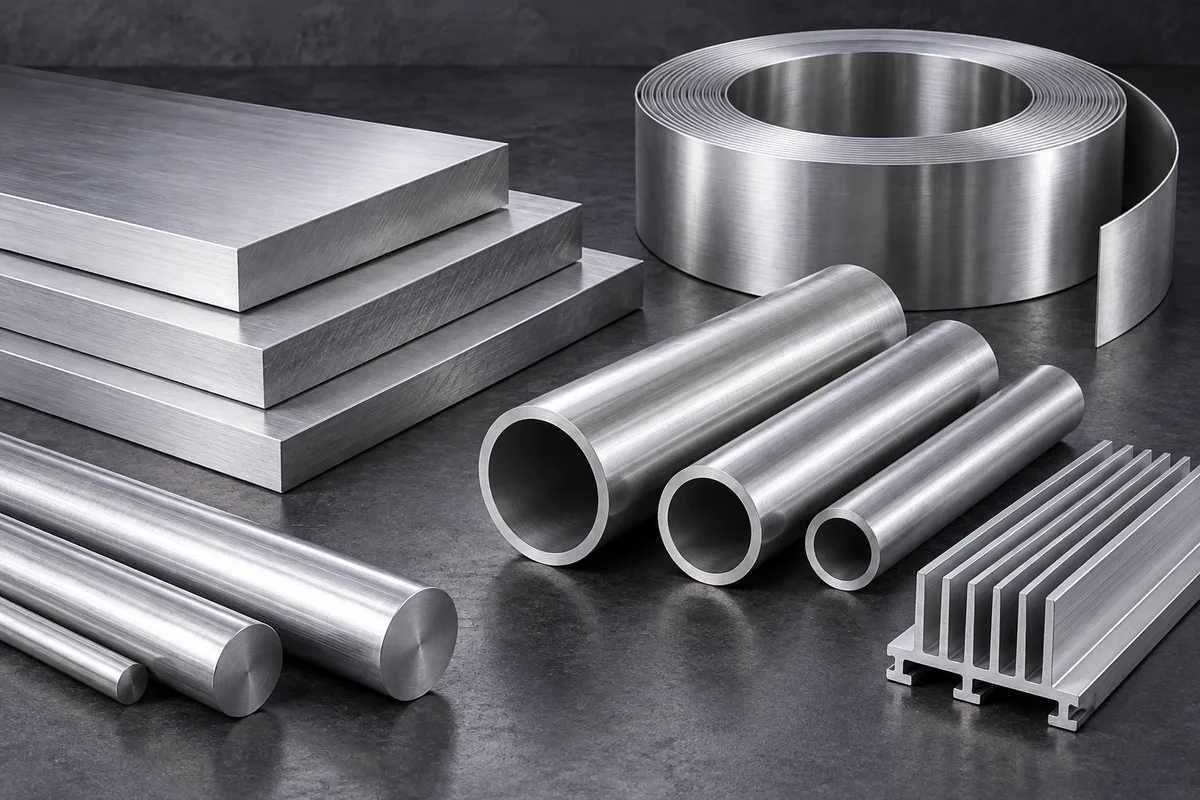
Filler choice decides the strength, ductility and corrosion behaviour of an aluminium weld. 5556 is selected when the joint must be as strong as possible in a non-heat-treated, welded condition, for example in 5083, 5456 and 5383 plate, or in weldable Al-Zn-Mg alloys such as 7005, 7020 and 7039.
In aerospace and defence work this means welded ground tanks and cryogenic equipment, armoured and protective vehicle hulls, heavy ground support equipment, shelters and naval aviation structures. 5556 is not used to weld heat-treatable airframe alloys such as 2024 or 7075, which are joined mechanically, and it is not chosen for parts that run hot.
Compared with ER5356, ER5556 gives higher as-welded tensile and shear strength. Compared with ER5183, it carries slightly more manganese and a deliberate titanium addition, which refines the weld grain and helps resist hot cracking.
| Element | ER5556 (AWS A5.10) | S Al 5556A (ISO 18273) |
|---|---|---|
| Silicon (Si) | 0.25 max | 0.25 max |
| Iron (Fe) | 0.40 max | 0.40 max |
| Copper (Cu) | 0.10 max | 0.10 max |
| Manganese (Mn) | 0.50 – 1.0 | 0.6 – 1.0 |
| Magnesium (Mg) | 4.7 – 5.5 | 5.0 – 5.5 |
| Chromium (Cr) | 0.05 – 0.20 | 0.05 – 0.20 |
| Zinc (Zn) | 0.25 max | 0.20 max |
| Titanium (Ti) | 0.05 – 0.20 | 0.05 – 0.20 |
| Beryllium (Be) | 0.0003 max | 0.0003 max |
| Aluminium (Al) | Remainder | Remainder |
The "A" grade holds a tighter magnesium and manganese window. Beryllium is limited because its fumes are hazardous. Check limits against the current editions of AWS A5.10 and ISO 18273.
| Property | Typical value | Notes |
|---|---|---|
| All-weld-metal tensile strength | About 290 – 310 MPa | As welded |
| All-weld-metal yield strength | About 145 – 160 MPa | As welded |
| Elongation | About 17 – 25 % | Depends on process and test |
| Melting range | About 575 – 635 °C | — |
| Density | About 2.66 g/cm³ | For metres-per-kilogram calculations |
| Electrical conductivity | About 29 % IACS | Relevant to MIG feeding and arc settings |
Joint strength in a real structure depends on the parent alloy and its heat-affected zone. Welding procedure qualification to AWS D1.2, ISO 15614-2 or ASME Section IX remains the basis for design values.
Some sources quote 380 MPa for 5556 weld metal; that figure is not typical of as-welded aluminium-magnesium deposits and should not be used for design.
| Diameter (mm) | Grams per metre | Metres per kg |
|---|---|---|
| 0.8 | 1.34 | 748 |
| 1 | 2.09 | 479 |
| 1.2 | 3.01 | 332 |
| 1.6 | 5.35 | 187 |
| 2 | 8.36 | 120 |
| 2.4 | 12.03 | 83 |
| 3.2 | 21.39 | 47 |
| 4 | 33.43 | 30 |
| 5 | 52.23 | 19 |
| Property | ER4043 | ER5356 | ER5183 | ER5556 |
|---|---|---|---|---|
| Main alloying | Si 5 % | Mg 5 % | Mg 4.8 %, Mn 0.75 % | Mg 5.1 %, Mn 0.75 %, Ti |
| Relative as-welded strength on 5083 | Low (not recommended) | Good | High | Highest |
| Hot-crack resistance on 6xxx | Excellent | Good | Good | Good |
| Service above 65 °C | Yes | No | No | No |
| Colour match after anodising | Poor (grey) | Good | Good | Good |
Keep spools sealed until use, in a dry store at stable temperature. Moisture and oxide on the wire are the main causes of porosity.
Remove oxide from joint faces with a stainless brush or solvent clean just before welding.
Use U-groove drive rolls, a PTFE or nylon liner and the correct contact tip to avoid shaving the soft wire.
Argon or argon-helium mixtures; helium additions give deeper penetration on thick plate.
They are the same alloy family. ER5556 is the AWS classification; S Al 5556A is the ISO 18273 classification, with a slightly tighter magnesium and manganese range.
When you need the highest possible as-welded strength, for example on 5456 plate or weldable 7xxx alloys. For most 5083 work ER5183 is sufficient.
It can, and it gives good strength, but ER4043 or ER5356 is more common on 6061. ER5556 should not be used where the joint will see service above 65 °C.
Aluminium filler wire is normally bought to AWS A5.10 or ISO 18273. Note that AMS 4190 covers a 5.2 % silicon wire (4043), not 5556, so it should not be cited for 5556.
In its sealed pack in a dry, temperature-stable store. Once opened, keep spools covered and use them promptly to avoid porosity from surface moisture and oxide.
Send the classification, diameter, packaging and quantity. We will reply with availability, certification and a delivered price.





