Anisotropy
Strength in the 45° direction can be noticeably lower than longitudinal strength. Check all directions in the specification, not just L.



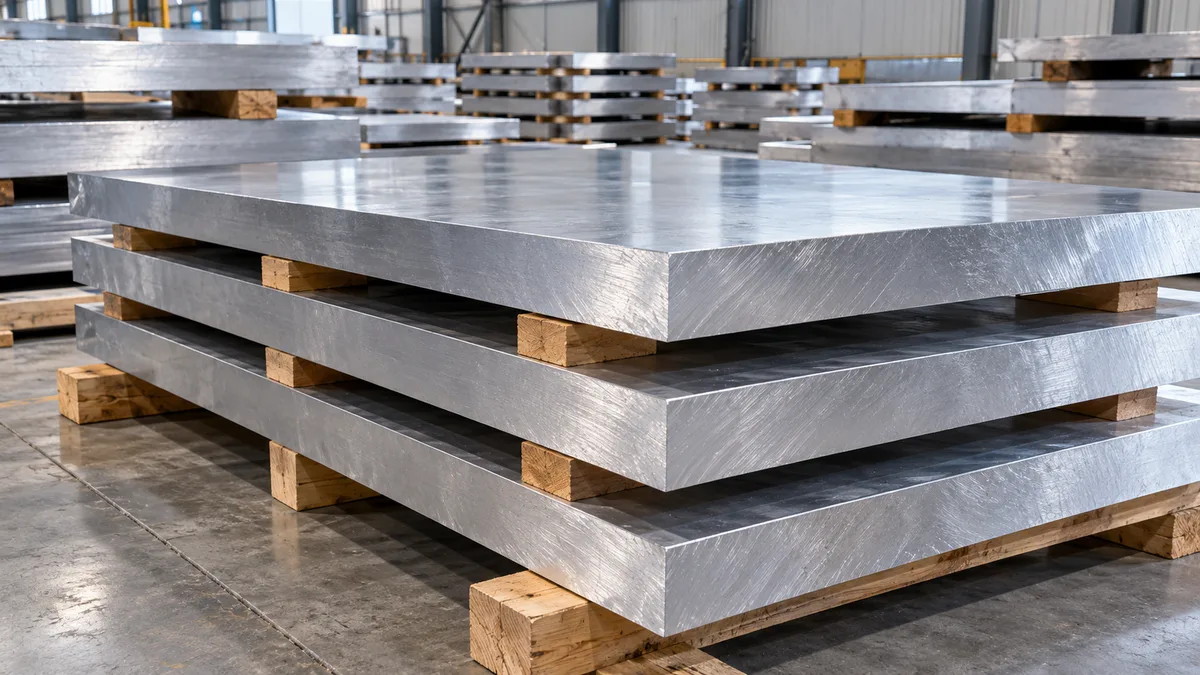
2090 is a second-generation aluminium-lithium alloy that is about 8 % lighter and 10 % stiffer than 7075, with comparable strength in the T8 tempers. It is supplied as 2090-T83 sheet to AMS 4251 and 2090-T81 plate to AMS 4303 for weight-critical airframe parts. Metline sources 2090 sheet and plate to order for aerospace and defence buyers worldwide, with full mill certification.
Each 1 % of lithium added to aluminium reduces density by about 3 % and raises the elastic modulus by about 6 %. No other alloying element gives both effects, which is why aluminium-lithium alloys have been developed for aircraft since the 1950s.
2090 was introduced in the 1980s as a direct, lighter replacement for 7075-T6 in sheet and thin plate. With around 2.2 % lithium and 2.7 % copper, plus zirconium for grain control, it reaches high strength after solution treatment, controlled stretching and artificial ageing. The stretch before ageing is essential: it creates dislocations on which the strengthening T1 phase nucleates, which is why the useful tempers are all T8-type.
The second-generation alloys also showed weaknesses: strong anisotropy, low short-transverse toughness and ductility in thick sections, and a tendency to lose toughness after long exposure to warm temperatures. Third-generation alloys such as 2195, 2196, 2198 and 2050 reduce lithium content and add silver, magnesium or manganese to overcome these issues, and they now dominate new programmes. 2090 remains specified on existing drawings, in thin sheet applications and in defence and space hardware designed around it.
Registered limits for alloy 2090. The AMS titles give the nominal composition as 2.7Cu-2.2Li-0.12Zr.
| Element | Minimum | Maximum | Role |
|---|---|---|---|
| Copper (Cu) | 2.4 | 3.0 | Forms T1 (Al2CuLi) and θ′ strengthening phases |
| Lithium (Li) | 1.9 | 2.6 | Lowers density and raises stiffness; forms δ′ (Al3Li) |
| Zirconium (Zr) | 0.08 | 0.15 | Suppresses recrystallisation, keeps a fine grain structure |
| Magnesium (Mg) | — | 0.25 | Impurity / minor |
| Silicon (Si) | — | 0.10 | Impurity |
| Iron (Fe) | — | 0.12 | Impurity; kept low for toughness |
| Zinc (Zn) | — | 0.10 | Impurity |
| Titanium (Ti) | — | 0.15 | Grain refiner |
| Manganese, Chromium (each) | — | 0.05 | Impurities |
| Others, each / total | — | 0.05 / 0.15 | |
| Aluminium (Al) | Remainder | About 93.2 – 95.6 % |
Published typical values for 2090 in the peak-aged T8 condition are about 550 MPa tensile strength, 520 MPa yield strength and 6 % elongation. Specified minimums in AMS 4251 and AMS 4303 are lower, vary with thickness, and are set separately for the longitudinal, long-transverse and 45° directions because of the alloy's anisotropy.
| Property | 2090-T83 sheet | 2090-T81 plate | 7075-T6 sheet (for comparison) |
|---|---|---|---|
| Specification | AMS 4251 (1.02 – 6.32 mm) | AMS 4303 | AMS 4045 / ASTM B209 |
| Typical tensile strength | about 530 – 550 MPa | slightly below T83 | 572 MPa |
| Typical yield strength | about 500 – 520 MPa | slightly below T83 | 503 MPa |
| Typical elongation | about 5 – 6 % | about 5 – 8 % | 11 % |
| Density | 2.59 g/cm³ | 2.59 g/cm³ | 2.81 g/cm³ |
| Modulus | about 76 GPa | about 76 GPa | 71.7 GPa |
Typical values compiled from Aluminum Association, ASM and producer data. Some supplier sheets list 2090 in an O temper with a strength of around 300 MPa; annealed 2090 is much softer than that, and O is not a normal delivery temper for aerospace use.
Strength in the 45° direction can be noticeably lower than longitudinal strength. Check all directions in the specification, not just L.
Thick plate has low through-thickness ductility and toughness. Avoid loading thick 2090 parts in the short-transverse direction.
Long service at raised temperatures can reduce toughness. Keep 2090 parts away from hot zones.
Riveting and bonding are normal. Fusion welding is possible with suitable filler but is rarely used for structure.
Machines like other 2xxx alloys. Segregate lithium-bearing chips: they must not be mixed with conventional aluminium scrap.
Isolate from carbon-fibre composites and steel fasteners with sealant and coatings, as for other aluminium alloys.
2090 is produced in campaigns by a small number of mills, so it is ordered rather than held as general stock.
About 8 % by density (2.59 against 2.81 g/cm³). Because 2090 is also about 10 % stiffer, stiffness-critical parts can save more weight than the density difference suggests.
Both are solution heat-treated, cold worked by stretching and artificially aged. T83 is the sheet temper in AMS 4251; T81 is the plate temper in AMS 4303.
Yes, on existing designs and in some defence and space hardware. New aircraft programmes mostly use third-generation Al-Li alloys such as 2050, 2196 and 2198.
It can be fusion welded with suitable filler, but structural parts are normally riveted or bonded. Friction stir welding is used on some Al-Li structures.
Lithium contaminates conventional aluminium scrap streams. Al-Li chips and offcuts are collected and recycled separately.
Send your specification, sizes and quantity. We will confirm availability and certification.





