


5052 H12 / H22 / H32 Aluminium Sheet for Industrial Ceiling Fan Blades
5052 aluminium sheet is a standard material for roll-formed and press-bent blades on industrial and high-volume low-speed (HVLS) ceiling fans. It combines about 210 – 260 MPa tensile strength in H22 and H32 with a fatigue strength higher than 6061-T6, good formability for airfoil bends and excellent resistance to humid, dusty and mildly corrosive factory air. Metline supplies 5052 sheet and coil cut to blade lengths for fan makers worldwide.
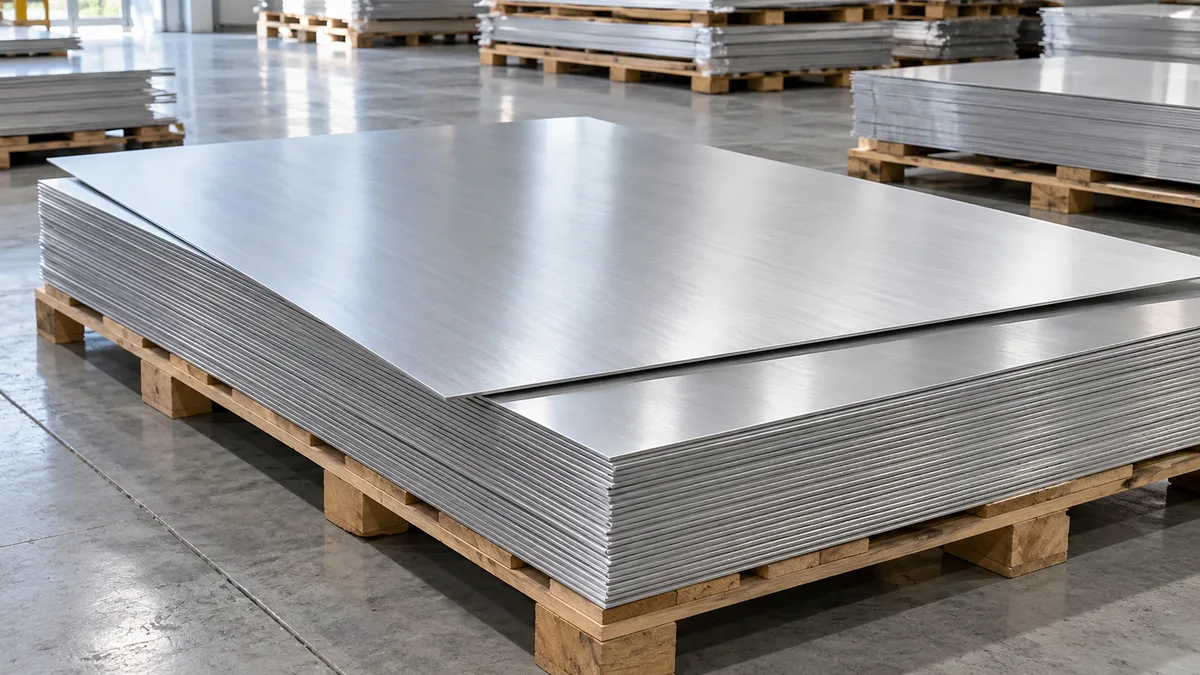
- Alloy
- 5052 (Al-2.5Mg-0.25Cr)
- Tempers
- H12 · H22 · H32 (H38, H112)
- Thickness
- about 1.5 – 3 mm typical
- Key property
- Fatigue strength ≈ 117 MPa (H32)
What a ceiling fan blade asks of its material
An industrial ceiling fan blade is a long cantilever, often 1 – 3.5 m from hub to tip on HVLS fans, rotating for thousands of hours a year. Each revolution flexes it slightly under gravity and aerodynamic load, so the governing property is not static strength but resistance to fatigue, together with low mass to keep hub loads and motor power down.
5052 fits that profile well. Among the common non-heat-treatable alloys it has one of the highest fatigue strengths: about 117 MPa at 5 × 10⁸ cycles in H32, compared with roughly 97 MPa for 6061-T6 and 69 MPa for 6063-T6 in published typical data. It gains its strength from magnesium and cold rolling rather than heat treatment, so bending the blade profile does not create soft heat-affected zones, and it keeps its properties without ageing.
Magnesium and chromium also give 5052 very good corrosion resistance in humid warehouses, livestock barns, food plants and coastal buildings, where fans often run in condensation, ammonia or salt-laden air. A light blade also matters for safety: less mass means lower energy if a blade ever comes loose, which is why fan designs combine light blades with mechanical retention and secondary safety cables.
5052 chemical composition (wt %)
| Element | Limit |
|---|---|
| Magnesium (Mg) | 2.2 – 2.8 |
| Chromium (Cr) | 0.15 – 0.35 |
| Silicon (Si) | 0.25 max |
| Iron (Fe) | 0.40 max |
| Copper (Cu) | 0.10 max |
| Manganese (Mn) | 0.10 max |
| Zinc (Zn) | 0.10 max |
| Others, each / total | 0.05 / 0.15 |
| Aluminium | Remainder |
Mechanical properties for blade design
| Temper | Tensile strength (MPa) | Yield min (MPa) | Elongation min, 1.5 – 3 mm (%) | Forming character |
|---|---|---|---|---|
| H12 (quarter hard) | 210 – 260 | 160 | 5 | Higher yield, less formable |
| H22 (strain-hardened, partially annealed) | 210 – 260 | 130 | 7 | Best bendability at this strength |
| H32 (strain-hardened, stabilised) | 210 – 260 | 130 | 7 | Standard choice; stable properties |
| H38 (hard) | 270 min | 210 | 4 | Flat stiff parts, limited bending |
| H112 (as fabricated, over 6 mm) | 190 min | 80 | 7 | Thick hub plates and brackets |
Ranges from EN 485-2; ASTM B209 values are similar (H32: 215 – 265 MPa, yield 160 MPa min).
Physical and fatigue data (typical, H32)
- Density
- 2.68 g/cm³
- Modulus of elasticity
- 70.3 GPa
- Fatigue strength (5 × 10⁸ cycles, R.R. Moore)
- about 117 MPa
- Typical tensile / yield
- 228 / 193 MPa
- Thermal expansion
- 23.8 µm/m·°C
Bent-sheet blades versus extruded blades
Industrial fan blades are made in two main ways. Sheet blades are roll-formed or press-brake bent from 5052 strip into a cambered airfoil, often with a folded leading edge, stiffening ribs or a closed hollow section riveted along its seam. Extruded blades are pushed through a die as a hollow airfoil profile, usually in 6063-T5/T6 or 6061-T6, and cut to length.
| Point | Bent 5052 sheet blade | Extruded 6063 / 6061 blade |
|---|---|---|
| Tooling cost | Low (roll-former or brake tools) | Extrusion die per profile |
| Design changes | Easy to change chord, length and twist | New die for a new profile |
| Fatigue performance | Very good (high 5052 fatigue strength) | Good; depends on alloy and section |
| Section stiffness | Moderate; ribs and folds add stiffness | High, closed hollow section |
| Aerodynamic accuracy | Good with roll-forming | Very precise, repeatable profile |
| Typical use | Medium industrial fans, custom and low-volume designs | Large HVLS fans in volume production |
Many manufacturers use both: extruded blades for their largest standard HVLS fans and 5052 sheet blades for smaller, custom or cost-sensitive models, along with 5052 for winglets, hub covers and guards. See our 6063 extrusion page if you are comparing the extruded route.
Sizes, surfaces and processing
Typical supply for fan blades
- Thickness
- about 1.5 – 3 mm for blades; thicker H112 plate for hubs and brackets
- Width
- about 1000 – 2000 mm sheet, or slit coil matched to blade development width
- Length
- about 3000 – 6000 mm, or cut to blade length
- Surface
- Mill finish, one- or two-side polished, or pre-treated for powder coating
- Film
- PE protective film on visible faces on request
- Standards
- ASTM B209, EN 485, JIS H4000; EN 10204 3.1 certificate
Design and fabrication tips
- Bend across the grain where possible, with inside radii of about 1 × thickness in H32 and slightly less in H22.
- Avoid sharp notches at bolt holes and rivet lines near the root, where bending stress and fatigue are highest; deburr all holes.
- Match blade weights within a set; consistent sheet thickness makes static and dynamic balancing much easier.
- Isolate dissimilar metals at steel hubs with washers, sleeves or coatings to prevent galvanic corrosion in humid buildings.
- Finish after forming: powder coat or anodise after bending to avoid cracking the film.
- Validate fatigue: test complete blade assemblies, including fasteners, for the design life; fan air performance is usually rated to AMCA 230 and electrical safety to standards such as UL 507 or IEC 60335.
5052 compared with other blade materials
| Material | Typical tensile (MPa) | Fatigue strength (MPa) | Corrosion | Comment |
|---|---|---|---|---|
| 5052-H32 sheet | 228 | about 117 | Very good | Best fatigue for bent-sheet blades |
| 3003-H14 sheet | 150 | about 62 | Very good | Cheaper, for small light-duty fans |
| 6061-T6 extrusion | 310 | about 97 | Good | Stiff hollow blades |
| 6063-T6 extrusion | 241 | about 69 | Good | Most common extruded blade alloy |
| Glass-fibre composite | varies | varies | Excellent | Moulded shapes; heavier tooling cost |
Aluminium values are typical Aluminum Association / ASM data, not specified minimums.
References and standards
- ASTM B209 – Standard Specification for Aluminum and Aluminum-Alloy Sheet and Plate
- EN 485-2 – Aluminium and aluminium alloys: sheet, strip and plate, mechanical properties
- ANSI/AMCA Standard 230 – Laboratory methods of testing air circulating fans for rating and certification
- ASM Handbook, Vol. 2 – Properties and selection: nonferrous alloys (5052 fatigue data)
5052 sheet for ceiling fan blades: FAQs
Which temper is best for bent fan blades?
H32 is the usual choice: stable properties and good bendability. H22 bends slightly more easily at the same tensile strength. H12 has higher yield but is less forgiving in tight bends.
Why not use 6061-T6 sheet for blades?
6061-T6 is stronger statically but less formable, and its fatigue strength is lower than 5052-H32. For bent-sheet blades 5052 is generally the better balance.
What thickness are industrial fan blades?
Most bent-sheet blades use about 1.5 – 3 mm, depending on blade length, chord and whether the section is closed or open.
Can 5052 blades be powder coated?
Yes. After pre-treatment 5052 takes powder coatings and anodising well. Coat after forming.
Do you supply sheet cut to blade size?
Yes. Sheet or slit coil can be cut to blade blanks, with protective film and export packing.
Making industrial fan blades?
Send temper, thickness, blank size and quantity. We reply with availability, certification and a delivered quote.





