Brazing strip and band
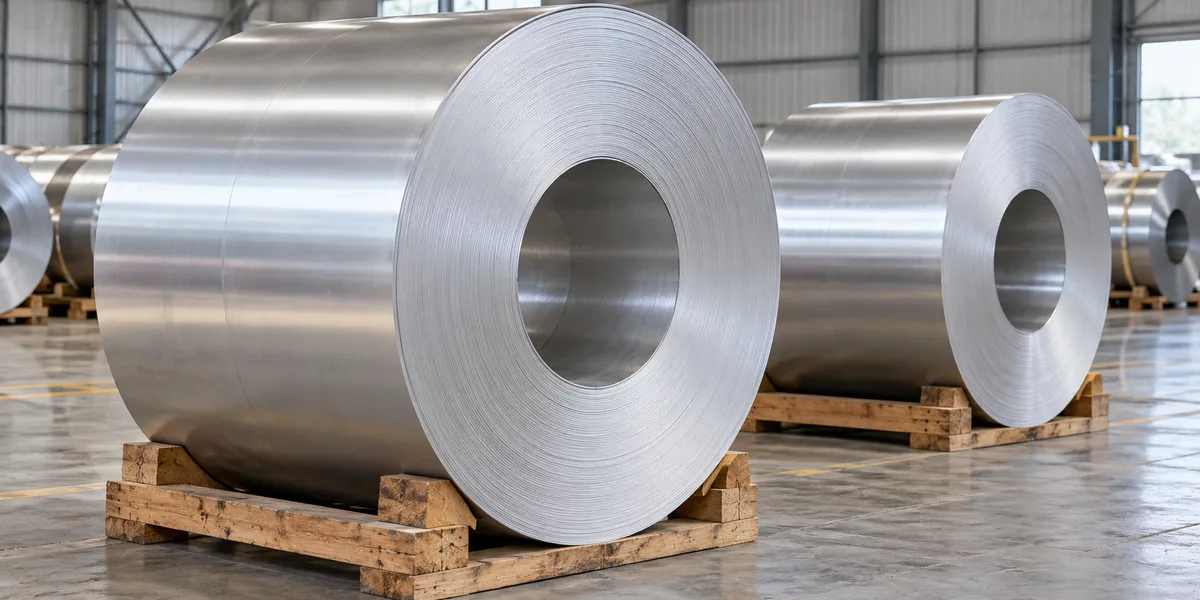
Strip around 0.5 – 1.2 mm thick for preplaced joints, slit to width.



Сил1С is a Russian aluminium-silicon alloy with roughly 10 – 12.5 % silicon, close to the Al-Si eutectic, used as a filler metal for brazing aluminium assemblies. It melts at around 577 °C, well below common aluminium base alloys, so it can flow into joints without melting the parts. It is supplied as strip, foil and sheet under aerospace OST documents, and its closest international counterpart is 4047 (BAlSi-4).
Aluminium is brazed with aluminium-silicon alloys because silicon lowers the melting point sharply. At about 12.6 % silicon the alloy reaches the eutectic, which melts at a single temperature of about 577 °C. Most structural aluminium alloys start to melt between roughly 580 and 650 °C, so a near-eutectic filler can be melted and drawn into a joint by capillary action while the parts stay solid.
Сил1С belongs to the Soviet and Russian "Сил" family of aluminium-silicon brazing alloys used in aviation and instrument making. Its silicon content, roughly 10 – 12.5 %, places it just below the eutectic, similar in purpose to 4047 in the Aluminum Association system and to the AWS A5.8 filler classification BAlSi-4.
It is important to understand what Сил1С is not. It is a filler metal, not a structural alloy. Some supplier pages list fuselage panels or highly loaded parts as applications; what they mean is brazed assemblies that use Сил1С in the joints. The strength of such an assembly depends on the base metal, joint design and brazing process, not on the filler alone.
The governing composition is set in the aerospace OST document for the grade. Silicon for Сил1С is commonly quoted at 10.0 – 12.5 % with low iron and other impurities; use the specification and the certificate for acceptance. Registered limits for the nearest Aluminum Association brazing alloys are shown for comparison.
| Element (%) | Сил1С (quoted) | 4047 | 4045 | 4343 |
|---|---|---|---|---|
| Silicon (Si) | 10.0 – 12.5 | 11.0 – 13.0 | 9.0 – 11.0 | 6.8 – 8.2 |
| Iron (Fe), max | Low (see specification) | 0.8 | 0.8 | 0.8 |
| Copper (Cu), max | Low (see specification) | 0.30 | 0.30 | 0.25 |
| Manganese (Mn), max | Low (see specification) | 0.15 | 0.05 | 0.10 |
| Magnesium (Mg), max | Low (see specification) | 0.10 | 0.05 | — |
| Zinc (Zn), max | Low (see specification) | 0.20 | 0.10 | 0.20 |
| Aluminium | Remainder | Remainder | Remainder | Remainder |
4047 and 4045 are the usual substitutes for Сил1С outside the GOST/OST system; 4343 has less silicon and a wider melting range and is mainly used as cladding on brazing sheet.
| Property | Value for near-eutectic Al-Si filler | Comment |
|---|---|---|
| Solidus | About 577 °C | Al-Si eutectic temperature |
| Liquidus | A few degrees to around 20 °C above solidus, depending on Si | Closer to the eutectic gives a narrower range |
| Typical brazing temperature | About 585 – 605 °C | Comparable to the 582 – 604 °C range given for BAlSi-4 |
| Density | About 2.65 – 2.66 g/cm³ | Silicon is lighter than aluminium |
| Thermal expansion | Lower than pure aluminium (around 20 µm/m·K) | Silicon reduces expansion |
| Fluidity | Very high near the eutectic | Good capillary flow into narrow joints |
Because the filler melts only slightly below many base alloys, temperature control is critical. Base alloys with low solidus temperatures, such as many 2xxx and 7xxx grades and high-magnesium 5xxx alloys, cannot be brazed with Al-Si fillers at all. Suitable base metals include 1xxx, 3xxx (for example 3003 and АМц), and many 6xxx alloys such as 6061 and 6063.
Strip around 0.5 – 1.2 mm thick for preplaced joints, slit to width.
Thin foil, from about 0.1 mm, cut into shims and preforms placed between parts before furnace brazing.
Sheet cut to drawing for large-area joints and stamped preforms.
Alongside the filler itself, aluminium brazing commonly uses clad brazing sheet (a 3xxx core with a 4343 or 4045 layer), brazing rod and wire, rings and flux. Choose the form by how the filler can be positioned: preplaced foil and preforms for furnace brazing, rod or wire for hand torch work.
Common faults are base-metal erosion from excess temperature or time, voids from poor clearance or contamination, and distortion of thin parts. Fixturing and a defined temperature profile matter more than the exact filler grade once the composition is in the right range.
Brazed joints made with Al-Si fillers have good corrosion resistance in normal atmospheres when flux residues are removed, and the joint can be anodised, although the silicon-rich fillet turns grey rather than clear.
When ordering, buyers outside Russia and the CIS often face a practical choice: source Сил1С to the original OST document, or qualify 4047 or 4045 filler to the same brazing procedure. Where the drawing or repair manual names Сил1С explicitly, the substitution needs approval from the design authority. Where the requirement is functional (a filler that wets 3xxx or 6xxx parts in the 585 – 605 °C range), a brazing trial with 4047 strip or foil, followed by sectioning of the joint, is usually the quickest way to confirm it. Keep a record of the filler lot, temperature profile and section results with the qualification.
It is an aluminium-silicon filler metal for brazing aluminium parts, supplied as strip, foil or sheet and melted into the joint at around 585 – 605 °C.
4047 (AWS BAlSi-4) is the closest; 4045 is used where slightly less silicon is acceptable. Confirm the substitution against your brazing procedure and specification.
Melting starts at about 577 °C, the aluminium-silicon eutectic temperature, and is complete a few degrees higher because its silicon content is close to the eutectic.
No. It has limited ductility and is designed as a filler metal. The strength of a brazed assembly comes from the base metal and joint design.
1xxx and 3xxx alloys and many 6xxx alloys such as 6061 and 6063. Most 2xxx, 7xxx and high-magnesium 5xxx alloys melt too low or wet poorly and are not brazed with Al-Si fillers.
Send the grade, form, size and quantity. We will reply with availability, certification and delivery.





