Welding process
MIG for most structural joints; TIG for thin sheet and repairs. Friction stir welding is also well suited to 5xxx plate panels.



5A05 is a high-magnesium (about 5 %) aluminium alloy from the GB/T 3190 standard, close to Russian AMg5 and sitting between 5083 and 5456 in strength. As O-temper sheet and H112 plate it is used for welded hull, deck and bulkhead structure on vessels built to Chinese and CIS specifications. Metline supplies 5A05 plate cut to size with mill certificates, and can offer 5083 or 5383 where a class-approved Western grade is required.
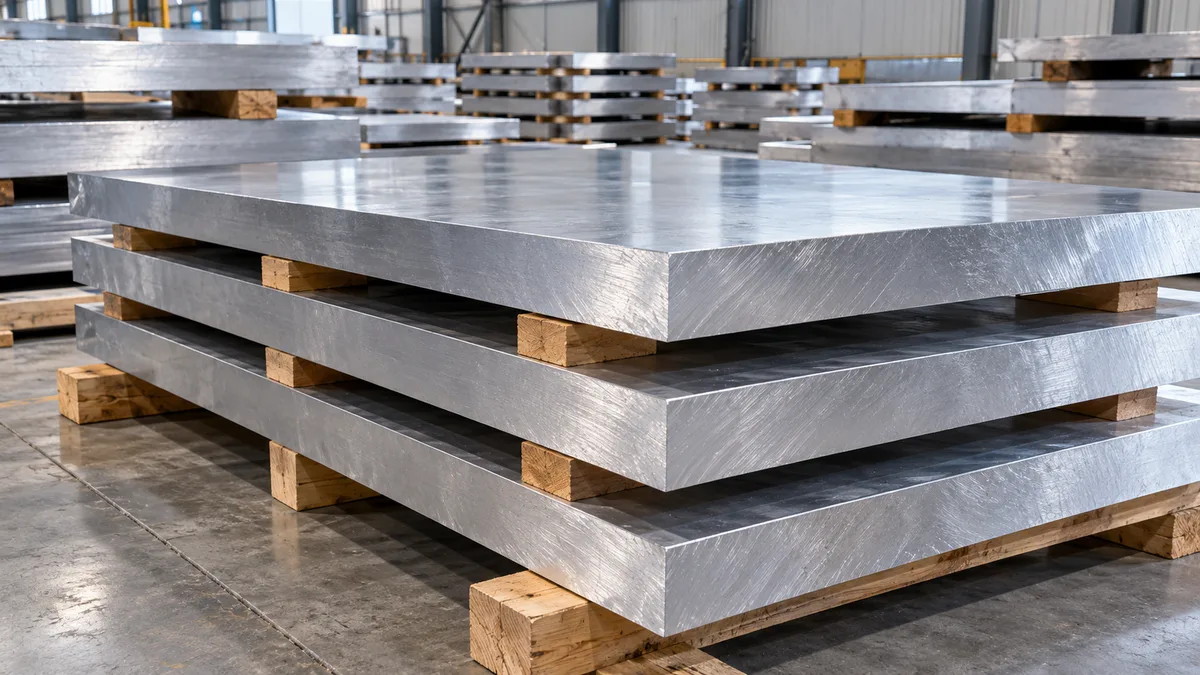
Hull plating, decks, bulkheads and superstructures on aluminium vessels are almost always built from rolled 5xxx plate. The reason is simple: magnesium-strengthened aluminium keeps most of its strength after welding and resists seawater without paint. The more magnesium, the stronger the plate, up to the point where corrosion sensitivity starts to rise. 5A05, with 4.8 – 5.5 % magnesium, sits high in that range.
The grade comes from China's GB/T 3190 composition standard and descends from the Soviet AMg5 alloy. It is used by shipyards building to GB, CCS and GOST-based designs for patrol boats, ferries, fishing vessels, workboats and the superstructures of steel ships. Its strength in the annealed and as-rolled conditions is comparable to 5083, and welded joints retain nearly all of the parent-metal strength because there is no precipitation-hardened temper to destroy.
Like every alloy with more than about 3 % magnesium, 5A05 must be kept cool in service. Long exposure above roughly 65 °C allows the beta phase (Al3Mg2) to form along grain boundaries, which then makes the plate prone to intergranular corrosion and stress-corrosion cracking. Engine-room casings, exhaust surroundings and dark decks in tropical sun need a design check, or a lower-magnesium or specially tempered grade.
Values below are the GB/T 3190 limits. Some trading sheets list a chromium range and higher manganese under 5A05; check your mill certificate against the governing standard rather than a catalogue.
| Element | Limit (%) | Function |
|---|---|---|
| Magnesium (Mg) | 4.8 – 5.5 | Solid-solution strengthening; principal alloying element |
| Manganese (Mn) | 0.30 – 0.60 | Adds strength and controls grain size |
| Silicon (Si) | ≤ 0.50 | Impurity |
| Iron (Fe) | ≤ 0.50 | Impurity |
| Copper (Cu) | ≤ 0.10 | Kept low for seawater resistance |
| Zinc (Zn) | ≤ 0.20 | Impurity |
| Others, each | ≤ 0.05 | |
| Aluminium (Al) | Remainder | About 93.5 – 95 % |
Minimum values below are those commonly quoted from GB/T 3880.2 for 5A05. Proof strength drops slightly in thicker H112 plate because the as-rolled structure receives less work through the section.
| Temper | Thickness (mm) | Tensile strength Rm | Proof strength Rp0.2 | Elongation |
|---|---|---|---|---|
| O | 3 – 6 | 275 – 350 MPa | ≥ 145 MPa | ≥ 16 % |
| H112 | > 6 – 10 | ≥ 275 MPa | ≥ 125 MPa | ≥ 16 % |
| H112 | > 10 – 25 | ≥ 265 MPa | ≥ 115 MPa | ≥ 14 % |
Typical values for guidance; certified results are on the mill test certificate.
| System | Grade | Comment |
|---|---|---|
| China | 5A05 (LF5) | Plate to GB/T 3880; ship plate also covered by GB/T 22641 |
| Russia / CIS | AMg5 (1550) | Close chemistry; plate to GOST 21631 |
| Aluminum Association | 5083 / 5456 (nearest) | 5083 has 4.0 – 4.9 % Mg, 5456 has 4.7 – 5.5 % Mg; neither is an exact match |
| Europe | EN AW-5083 (nearest approved grade) | Use for EN-based class approvals |
For vessels classed by DNV, ABS, Lloyd's Register, Bureau Veritas or similar societies, the rules list approved alloys and tempers. 5A05 can be accepted where a society approves it, but 5083-H116, 5083-H321 and 5383 are the grades most often specified for international work.
5A05 weighs about 2.65 kg per m² per mm of thickness:
| Thickness (mm) | kg per m² | 1250 × 2500 mm (kg) | 1500 × 3000 mm (kg) | 2000 × 6000 mm (kg) |
|---|---|---|---|---|
| 3 | 7.95 | 24.8 | 35.8 | 95 |
| 4 | 10.60 | 33.1 | 47.7 | 127 |
| 5 | 13.25 | 41.4 | 59.6 | 159 |
| 6 | 15.90 | 49.7 | 71.5 | 191 |
| 8 | 21.20 | 66.2 | 95.4 | 254 |
| 10 | 26.50 | 82.8 | 119.2 | 318 |
| 12 | 31.80 | 99.4 | 143.1 | 382 |
| 15 | 39.75 | 124.2 | 178.9 | 477 |
| 20 | 53.00 | 165.6 | 238.5 | 636 |
| 25 | 66.25 | 207.0 | 298.1 | 795 |
| 30 | 79.50 | 248.4 | 357.8 | 954 |
| 40 | 106.00 | 331.2 | 477.0 | 1272 |
| 50 | 132.50 | 414.1 | 596.2 | 1590 |
MIG for most structural joints; TIG for thin sheet and repairs. Friction stir welding is also well suited to 5xxx plate panels.
ER5183 or ER5556 gives weld metal strength matched to a 5 % Mg parent. ER5356 is acceptable for lower-stress joints.
Welded joints in O and H112 plate retain close to full parent strength, which simplifies design compared with 6xxx extrusions.
O-temper sheet forms well; H112 plate can be rolled to hull curvature. Avoid hot forming in the 65 – 200 °C range for long periods.
Plasma, waterjet or sawing. Remove the heat-affected edge of plasma cuts on critical welds.
Remove oxide with a stainless brush and degrease just before welding; keep plates dry and covered to avoid hydrogen porosity.
| Grade | Mg (%) | Typical min. Rm (plate) | Typical min. Rp0.2 | Main markets |
|---|---|---|---|---|
| 5083 H116 | 4.0 – 4.9 | 305 MPa | 215 MPa | Global, class-approved |
| 5A05 H112 | 4.8 – 5.5 | 265 – 275 MPa | 115 – 125 MPa | China, CIS |
| 5A06 H112 | 5.8 – 6.8 | 295 – 315 MPa | 135 – 155 MPa | China, CIS |
| 5456 H116 | 4.7 – 5.5 | 315 MPa | 230 MPa | USA, naval |
The H116 and H321 tempers of 5083 and 5456 are produced with controlled strain-hardening and tested for resistance to exfoliation and intergranular corrosion under ASTM B928. That testing is the main reason they are preferred for international hull plate.
The closest grade is Russian AMg5. In Aluminum Association terms it falls between 5083 (4.0 – 4.9 % Mg) and 5456 (4.7 – 5.5 % Mg), but neither is an exact match.
It is used in vessels built to Chinese and CIS rules. For international class work, check the society's list of approved alloys; 5083 and 5383 in H116 or H321 are the usual choices.
ER5183 or ER5556, which contain enough magnesium to match the parent plate's strength. ER5356 is acceptable for lightly loaded joints.
Long service above about 65 °C can sensitise high-magnesium alloys and make them prone to intergranular corrosion. Use a lower-magnesium grade or a sensitisation-resistant temper in hot areas.
About 26.5 kg per m², or roughly 83 kg for a 1250 × 2500 mm plate.
Send your plate list, thickness and class requirements. We will reply with availability, certification and a delivered price.





