5A05-O
Fully annealed. Maximum ductility for bending, rolling into cylinders, spinning and drawing. The usual condition for sheet up to about 4.5 mm used in tanks and formed parts.



5A05 is an aluminium-magnesium alloy with about 5 % magnesium, registered in the Chinese GB/T system and practically identical to the Russian grade AMg5. It gives plate and sheet that are strong for a non-heat-treatable alloy, weld well and resist seawater and fuel. Metline supplies 5A05 in O and H112 tempers, cut to size and certified, to customers worldwide.
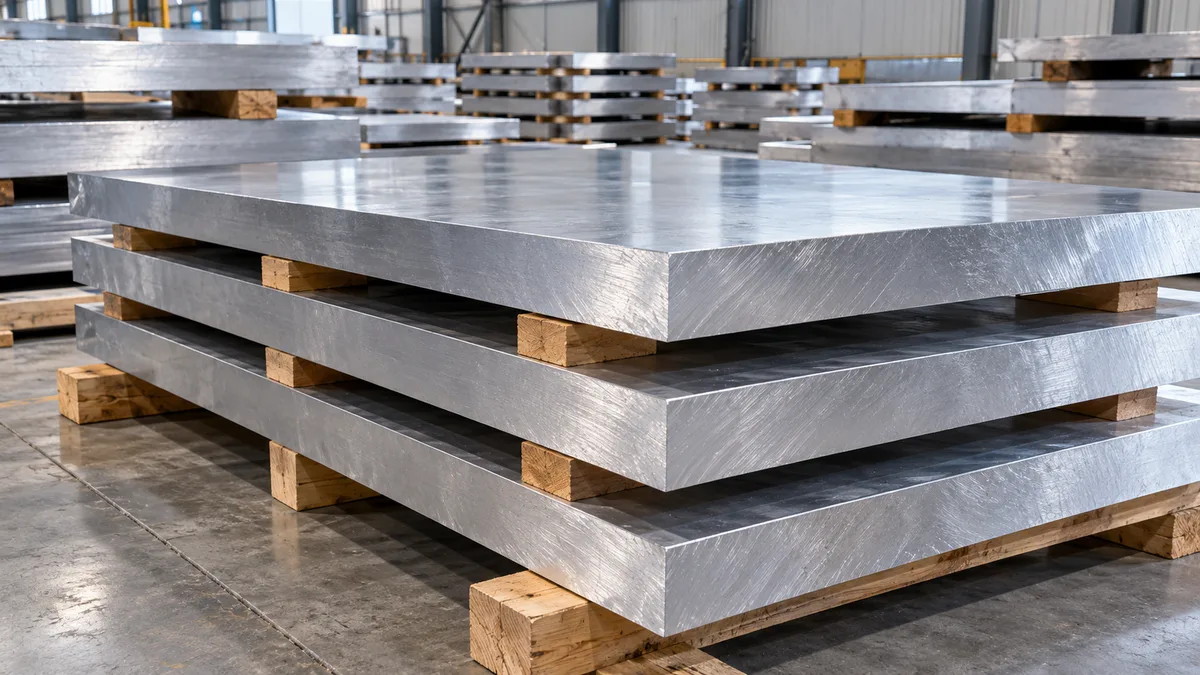
5A05 belongs to the 5xxx family, where magnesium in solid solution provides the strength. With 4.8 – 5.5 % magnesium and a small manganese addition it sits between 5052 and 5A06 in strength, and it cannot be hardened by heat treatment: strength comes from the alloy content and, in H tempers, from rolling.
The grade is registered in GB/T 3190 and has its origin in the Soviet AMg5 alloy, which is why it appears on drawings from Chinese, Russian and CIS design offices for welded tanks, pipework and marine structure. In annealed condition it has a tensile strength of about 275 MPa, roughly 40 % higher than 5052-O, while keeping enough ductility for rolling, bending and deep forming.
Buyers usually meet 5A05 in two situations: a drawing or legacy specification names it directly, or a designer needs a weldable Al-Mg plate with more strength than 5052 but is working to GB or GOST documents rather than ASTM. In both cases the alloy is supplied as rolled sheet (O temper) or hot-rolled plate (H112), and it is often cross-checked against 5083 and 5056 when Western equivalents are needed.
Limits follow GB/T 3190. The Russian AMg5 (GOST 4784) range is almost the same. Each Metline lot ships with a mill certificate reporting the actual analysis.
| Element | Minimum | Maximum | Role in the alloy |
|---|---|---|---|
| Magnesium (Mg) | 4.8 | 5.5 | Solid-solution strengthening; main source of strength |
| Manganese (Mn) | 0.30 | 0.60 | Adds strength and controls grain structure |
| Silicon (Si) | — | 0.50 | Impurity |
| Iron (Fe) | — | 0.50 | Impurity; limited for ductility |
| Copper (Cu) | — | 0.10 | Kept low to protect corrosion resistance |
| Zinc (Zn) | — | 0.20 | Impurity |
| Others, each / total | — | 0.05 / 0.10 | |
| Aluminium (Al) | Remainder | About 93 – 95 % |
Compared with 5083 (4.0 – 4.9 % Mg), 5A05 carries more magnesium and no chromium addition. Compared with 5056 (4.5 – 5.6 % Mg), the ranges overlap closely, which is why 5056 is the nearest Western match on chemistry.
The values below are the minimums commonly quoted for GB/T 3880 sheet and plate. H112 plate is hot-rolled with only light cold work, so its properties vary a little with thickness. Design to the minimums on the mill certificate, not to typical laboratory values.
| Temper | Typical thickness | Tensile strength (min) | Yield strength 0.2 % (min) | Elongation (min) |
|---|---|---|---|---|
| O (annealed) | 0.5 – 4.5 mm | 275 MPa | 145 MPa | 16 % |
| H112 (as hot-rolled) | 4.5 – 10 mm | 275 MPa | 125 MPa | 16 % |
| H112 (as hot-rolled) | 10 – 50 mm | 255 – 265 MPa | 105 – 115 MPa | 13 – 14 % |
Thickness bands and exact minimums depend on the edition of GB/T 3880.2 and on the order specification; the certificate for each lot states the values tested.
Fully annealed. Maximum ductility for bending, rolling into cylinders, spinning and drawing. The usual condition for sheet up to about 4.5 mm used in tanks and formed parts.
As hot-rolled with slight strain hardening and tested mechanical properties. The standard condition for plate from about 4.5 mm upward, for welded structures and machined parts.
Strain-hardened and stabilised tempers can be produced to order where a higher yield strength is needed in thin sheet. Confirm properties against the drawing before ordering.
Because 5xxx alloys with more than about 3 % magnesium can become sensitive to intergranular corrosion after long exposure above roughly 65 °C, 5A05 is not recommended for continuous service at elevated temperature. For hot service, a lower-magnesium alloy such as 5454 is the usual choice.
5A05 has no exact Aluminum Association equivalent. The table shows the formal designation and the nearest grades used in other systems; any substitution should be approved by the designer after comparing chemistry and properties.
| System | Designation | Note |
|---|---|---|
| China (GB) | 5A05 (formerly LF5) | Sheet and plate to GB/T 3880; chemistry to GB/T 3190 |
| Russia / CIS (GOST) | AMg5 (АМг5), 1550 | Practically identical chemistry; sheet to GOST 21631 |
| Aluminum Association | Nearest: 5056, 5083 | 5056 matches magnesium range; 5083 is the common plate substitute |
| European (EN) | Nearest: EN AW-5083 / EN AW-5019 | Close in properties, not identical in chemistry |
5A05 weighs 2.65 kg per square metre for every millimetre of thickness, about 2 % lighter than 6061. Reference weights:
| Thickness (mm) | kg per m² | 1250 × 2500 mm (kg) | 1500 × 3000 mm (kg) |
|---|---|---|---|
| 1 | 2.65 | 8.3 | 11.9 |
| 1.5 | 3.97 | 12.4 | 17.9 |
| 2 | 5.30 | 16.6 | 23.8 |
| 3 | 7.95 | 24.8 | 35.8 |
| 4 | 10.60 | 33.1 | 47.7 |
| 5 | 13.25 | 41.4 | 59.6 |
| 6 | 15.90 | 49.7 | 71.5 |
| 8 | 21.20 | 66.2 | 95.4 |
| 10 | 26.50 | 82.8 | 119.2 |
| 12 | 31.80 | 99.4 | 143.1 |
| 16 | 42.40 | 132.5 | 190.8 |
| 20 | 53.00 | 165.6 | 238.5 |
| 25 | 66.25 | 207.0 | 298.1 |
| 30 | 79.50 | 248.4 | 357.8 |
| 40 | 106.00 | 331.2 | 477.0 |
| 50 | 132.50 | 414.1 | 596.2 |
Welds well by TIG and MIG. Use a 5xxx filler with matching or higher magnesium (5356, 5183 or the GB equivalent SAlMg5) to keep joint strength and corrosion resistance. Welds in O-temper plate retain almost the full base-metal strength.
O-temper sheet bends tightly and rolls into cylinders easily. H112 plate forms satisfactorily with larger radii. Expect more springback than with 5052 because of the higher yield strength.
Like most soft Al-Mg alloys, 5A05 machines with long, gummy chips. Use sharp, polished carbide tools with high rake and good chip evacuation. For heavily machined parts, 5083 or a heat-treatable 6xxx plate usually gives a better result.
Very good resistance to seawater, marine air and many hydrocarbons, which is why it is used for fuel and liquid tanks. Avoid prolonged service above about 65 °C.
Can be anodised for protection; the film is clear to slightly grey. Polishes well. Paint systems for marine aluminium apply directly after suitable pre-treatment.
Like other Al-Mg alloys it keeps or gains toughness at low temperature, so it can be considered for cold-service vessels after design review.
| Property | 5052-O | 5A05-O | 5083-O | 5A06-O |
|---|---|---|---|---|
| Magnesium content | 2.2 – 2.8 % | 4.8 – 5.5 % | 4.0 – 4.9 % | 5.8 – 6.8 % |
| Tensile strength (min) | 170 MPa | 275 MPa | 275 MPa | 315 MPa |
| Yield strength (min) | 65 MPa | 145 MPa | 125 MPa | 155 MPa |
| Weldability | Excellent | Very good | Excellent | Good |
| Formability | Excellent | Good | Good | Fair |
| Standards system | ASTM / EN | GB / GOST | ASTM / EN | GB / GOST |
If you are free to choose, 5083 is the most widely available plate in this strength class and has class-society approvals for shipbuilding. 5A05 is the right choice when the drawing or tender calls for it, or when an existing structure in 5A05 is being repaired or extended. For higher strength in the same family, step up to 5A06 plate.
The Russian AMg5 (1550) is practically identical. There is no exact ASTM or EN equivalent; 5056 is closest in chemistry and 5083 is the usual plate substitute, subject to the designer's approval.
No. It is a non-heat-treatable alloy. Strength comes from magnesium in solid solution and from cold work in H tempers. Heat treatment is only used to anneal it to the O temper.
Yes. Its corrosion resistance in seawater is very good and it welds well, so it is used for marine structure built to GB or GOST drawings. For classed vessels, 5083 or 5086 with class approval is usually specified.
Only moderately. It is soft and gummy, giving long chips. Sharp, high-rake tools help, but parts that need extensive machining are better made from 5083 or 6061-T651.
About 2.65 kg per m² per millimetre of thickness. A 1500 × 3000 × 10 mm plate weighs roughly 119 kg.
Yes. Metline ships 5A05 sheet and plate worldwide from Mumbai with EN 10204 3.1 certificates and seaworthy packing, on EXW, FOB, CIF or DAP terms.
Send the temper, thickness, size, quantity and destination, and we will confirm availability, certification and a delivered price.





