Filler wire
Use a high-magnesium filler such as ER5183 or ER5556 (or the matching Al-Mg6 wire). Lower-magnesium fillers produce welds weaker than the parent plate.



5A06 is the strongest common non-heat-treatable aluminium-magnesium alloy, with 5.8 – 6.8 % magnesium, and the Chinese counterpart of Russian AMg6. In O and H112 tempers it gives welded hull, deck and tank structure higher strength than 5083 while keeping good seawater resistance. Metline supplies 5A06 sheet and plate cut to size, with certificates, to shipyards and fabricators worldwide.
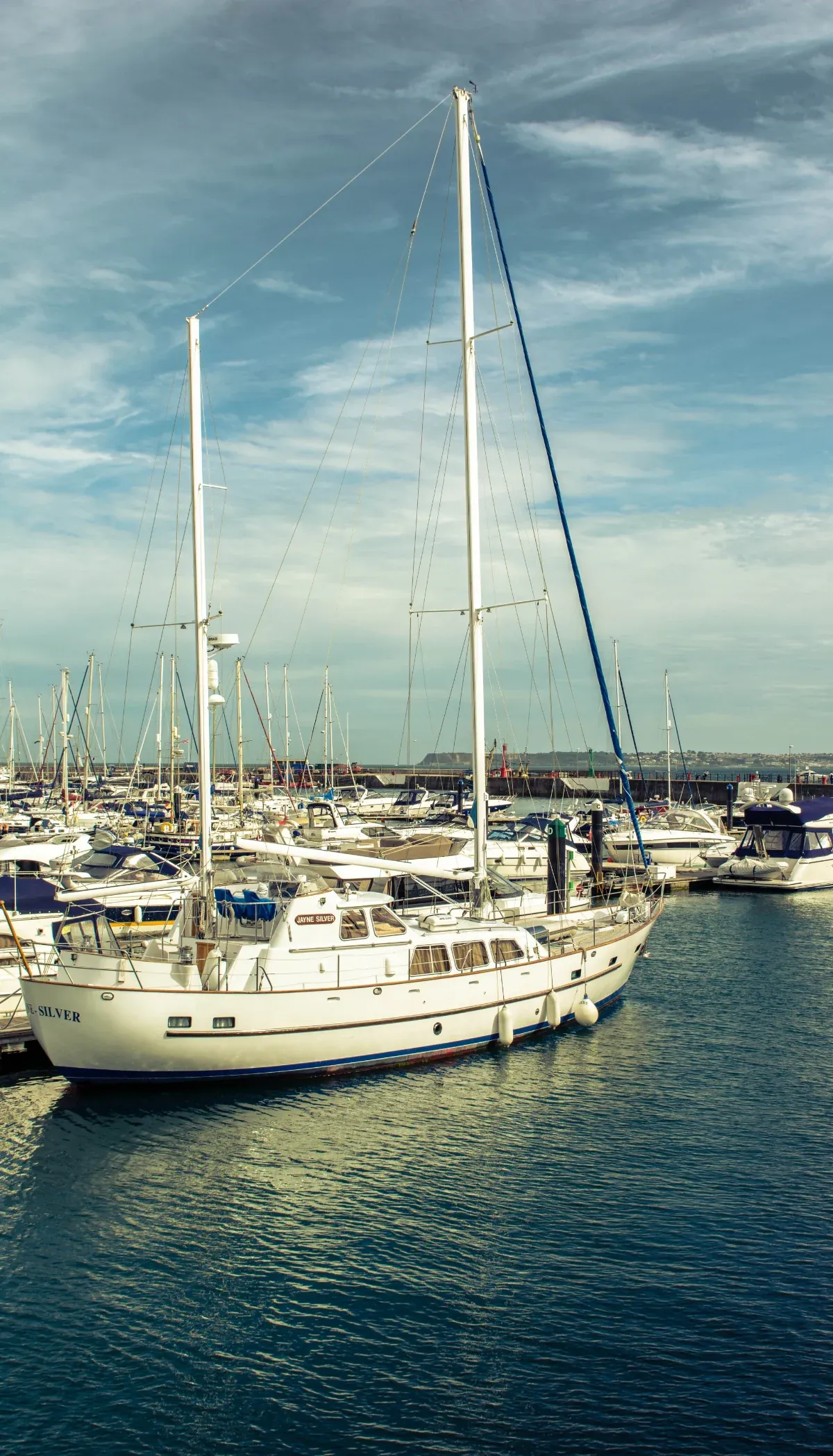
Designers of welded aluminium structures face a basic trade-off. Heat-treated alloys such as 6082 are strong as supplied but lose roughly half their strength next to every weld. Non-heat-treatable 5xxx alloys start weaker but keep their strength through welding. 5A06 pushes the 5xxx side of that trade-off as far as it practically goes: its high magnesium content gives annealed plate a minimum tensile strength of about 315 MPa, which welded joints largely retain.
The alloy is defined in GB/T 3190 and descends from the Soviet AMg6, which was developed for welded hulls, rocket tanks and pressure vessels. A small titanium addition refines the grain, and a trace of beryllium (a few thousandths of a per cent) limits oxidation of the magnesium-rich melt during casting and welding. In Chinese and CIS shipbuilding, 5A06 is used for hull plating on fast craft, high-strength decks, tanks and armour-style protective panels.
The price of all that magnesium is a higher sensitivity to temperature. Above about 65 °C, sustained exposure lets the beta phase precipitate at grain boundaries, which can lead to intergranular corrosion and stress-corrosion cracking in seawater. 5A06 should therefore be kept away from hot machinery spaces unless the design has been checked, and it should not be cold-worked heavily before service.
| Element | Limit (%) | Role |
|---|---|---|
| Magnesium (Mg) | 5.8 – 6.8 | Principal strengthening element |
| Manganese (Mn) | 0.50 – 0.80 | Strength and grain control |
| Titanium (Ti) | 0.02 – 0.10 | Grain refinement, helps weld soundness |
| Beryllium (Be) | 0.0001 – 0.005 | Reduces magnesium oxidation in the melt and weld pool |
| Silicon (Si) | ≤ 0.40 | Impurity |
| Iron (Fe) | ≤ 0.40 | Impurity |
| Copper (Cu) | ≤ 0.10 | Kept low for corrosion resistance |
| Zinc (Zn) | ≤ 0.20 | Impurity |
| Aluminium (Al) | Remainder | About 91.5 – 93 % |
Limits per GB/T 3190. The actual cast analysis is reported on each mill certificate.
The figures below are the minimums commonly quoted for 5A06 sheet and plate under GB/T 3880.2. Strength falls a little as H112 plate gets thicker.
| Temper | Thickness (mm) | Tensile strength Rm | Proof strength Rp0.2 | Elongation |
|---|---|---|---|---|
| O | 3 – 50 | 315 – 375 MPa | ≥ 155 MPa | ≥ 16 % |
| H112 | 6 – 10 | ≥ 315 MPa | ≥ 155 MPa | ≥ 16 % |
| H112 | > 10 – 25 | ≥ 305 MPa | ≥ 145 MPa | ≥ 12 % |
| H112 | > 25 – 50 | ≥ 295 MPa | ≥ 135 MPa | — |
| System | Grade | Notes |
|---|---|---|
| China | 5A06 (LF6) | Plate GB/T 3880; ship plate GB/T 22641; bar GB/T 3191 |
| Russia / CIS | AMg6 (1560) | Practically the same alloy; plate to GOST 21631 |
| Aluminum Association | No direct equivalent | 5456 and 5083 have less magnesium; 5059 reaches similar strength by a different route |
| Europe | EN AW-5083 or EN AW-5059 (nearest approved grades) | For EN- or class-based specifications |
Western class societies list 5083, 5383, 5059, 5086, 5456 and 5754 among their rolled marine alloys. If your vessel is classed outside China or the CIS, confirm with the society before substituting 5A06, or order 5059 or 5383 where higher-than-5083 strength is needed.
| Thickness (mm) | kg per m² | 1250 × 2500 mm (kg) | 1500 × 3000 mm (kg) | 2000 × 6000 mm (kg) |
|---|---|---|---|---|
| 3 | 7.92 | 24.8 | 35.6 | 95 |
| 4 | 10.56 | 33.0 | 47.5 | 127 |
| 5 | 13.20 | 41.2 | 59.4 | 158 |
| 6 | 15.84 | 49.5 | 71.3 | 190 |
| 8 | 21.12 | 66.0 | 95.0 | 253 |
| 10 | 26.40 | 82.5 | 118.8 | 317 |
| 12 | 31.68 | 99.0 | 142.6 | 380 |
| 15 | 39.60 | 123.8 | 178.2 | 475 |
| 20 | 52.80 | 165.0 | 237.6 | 634 |
| 25 | 66.00 | 206.2 | 297.0 | 792 |
| 30 | 79.20 | 247.5 | 356.4 | 950 |
| 40 | 105.60 | 330.0 | 475.2 | 1267 |
| 50 | 132.00 | 412.5 | 594.0 | 1584 |
Use a high-magnesium filler such as ER5183 or ER5556 (or the matching Al-Mg6 wire). Lower-magnesium fillers produce welds weaker than the parent plate.
High-Mg alloys are prone to porosity if oxide and moisture are present. Brush, degrease and weld promptly; control shielding gas flow.
Joints in O-temper plate retain close to the annealed parent strength; design codes still apply a weld-zone allowance.
Cold forming is possible in O temper. Avoid heavy cold work before service, which increases susceptibility to stress corrosion.
Machines more freely than lower-Mg 5xxx alloys because it is harder; use sharp carbide tools and coolant.
Do not hold at 65 – 200 °C during fabrication (for example during paint curing) for longer than necessary.
| Grade | Mg (%) | Min. Rm, annealed plate | Min. Rp0.2 | Sensitisation risk |
|---|---|---|---|---|
| 5083 O | 4.0 – 4.9 | 275 MPa | 125 MPa | Moderate |
| 5A05 O | 4.8 – 5.5 | 275 MPa | 145 MPa | Moderate to high |
| 5A06 O | 5.8 – 6.8 | 315 MPa | 155 MPa | High |
| 5059 O / H111 | 5.0 – 6.0 (with Zn, Zr) | 330 MPa | 160 MPa | Lower than Mg content suggests |
5A06 gives about 15 % more tensile strength than 5083 in the annealed condition. 5059 offers similar or higher strength with better resistance to sensitisation and is widely class-approved, which makes it the usual high-strength choice for international projects.
Yes. Annealed 5A06 plate has a minimum tensile strength of about 315 MPa against about 275 MPa for 5083-O, thanks to its higher magnesium content.
Russian AMg6 is practically the same alloy. There is no direct Aluminum Association equivalent; 5083 and 5456 contain less magnesium.
A trace of beryllium, at most 0.005 %, reduces oxidation of the magnesium-rich melt and weld pool. It is far below levels of concern in the finished plate.
Yes, on vessels built to rules that approve it. Keep service temperatures below about 65 °C and use high-magnesium filler wire.
About 15.8 kg per m², so a 1500 × 3000 mm sheet weighs about 71 kg.
Send thickness, sizes, quantity and destination, and we will reply with availability, certification and a delivered price.





