Forming
Bend and flare in O or T4. Copper-bearing 6xxx alloys age at room temperature, so form T4 material promptly.



6011 is a heat-treatable Al-Mg-Si alloy with relatively generous limits on copper, iron and zinc. That makes it tolerant of recycled scrap while still reaching structural strength after ageing. Metline supplies 6011 extruded tubes, trim and custom profiles in T4, T5 and T6 to drawing, with mill certificates, to automotive and transport manufacturers worldwide.
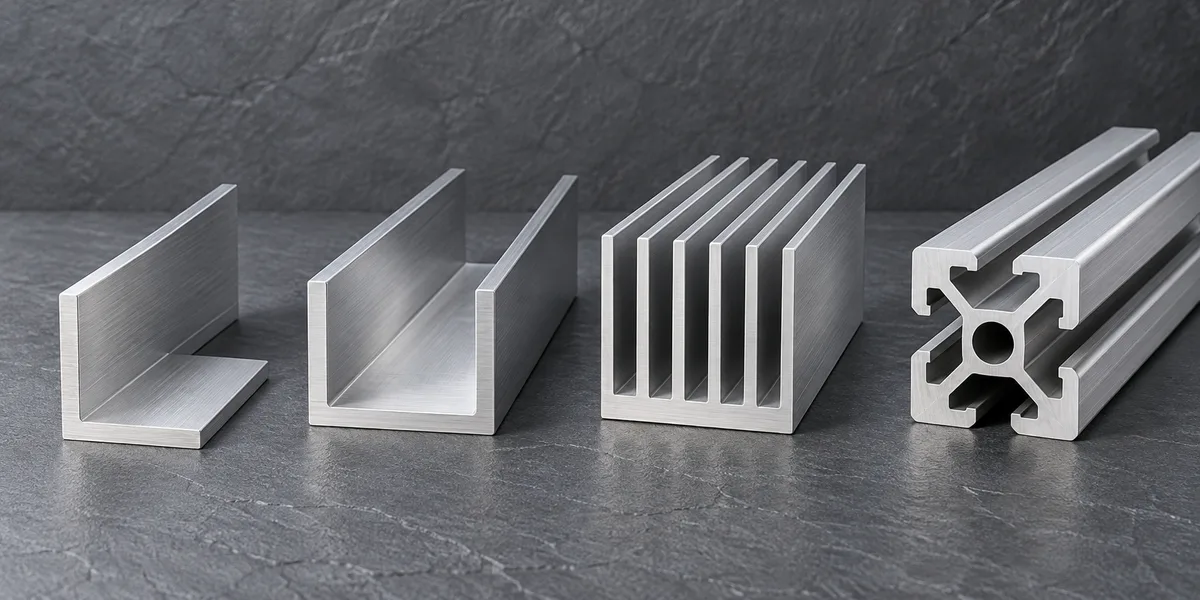
Most 6xxx extrusion alloys keep copper, iron and zinc low. 6011 is different: its registration allows copper of 0.40 – 0.9 %, iron up to 1.0 % and zinc up to 1.5 %. The copper adds strength and speeds age hardening, while the wide impurity limits let the alloy absorb mixed scrap. It is therefore a practical choice where recycled content matters and the part is painted or otherwise protected.
In automotive use, 6011 appears in tubes, trim profiles and secondary structural sections. It is less common than 6063, 6005A or 6082, so it is normally specified where a design, a regional standard or a recycling target calls for it. Because copper and zinc lower corrosion resistance compared with lean 6xxx alloys, parts are usually painted, e-coated or used in protected locations.
Many published data sheets for 6011 show a lean, copper-free chemistry. That is not the registered alloy. If your drawing simply says "6011", it should be supplied to the registered limits below; if your customer actually expects a lean alloy, 6063 or 6060 may be what is wanted, and it is worth confirming before ordering.
Registered limits per the Aluminum Association (Teal Sheets). The mill certificate reports the actual analysis of each lot. Check the current Teal Sheet or your OEM specification for any regional variant.
| Element | Minimum | Maximum | Comment |
|---|---|---|---|
| Silicon (Si) | 0.6 | 1.2 | Forms Mg2Si |
| Magnesium (Mg) | 0.6 | 1.2 | Main strengthening element |
| Copper (Cu) | 0.40 | 0.9 | Adds strength and ageing response |
| Iron (Fe) | — | 1.0 | Wide limit, scrap tolerant |
| Manganese (Mn) | — | 0.8 | Grain control |
| Chromium (Cr) | — | 0.30 | |
| Nickel (Ni) | — | 0.20 | |
| Zinc (Zn) | — | 1.5 | Wide limit, scrap tolerant |
| Titanium (Ti) | — | 0.20 | |
| Others, each / total | — | 0.05 / 0.15 | |
| Aluminium (Al) | Remainder |
A certified reference material for 6011 (NIST SRM 1258) analyses at roughly 0.84 % Cu and 1.0 % Zn, consistent with these limits.
6011 is not covered by the common property tables in EN 755-2, so mechanical properties are set by the order or OEM specification and verified by tensile tests on each lot. As a guide, T6 strength sits in the structural 6xxx class, above 6063 and comparable to medium-strength alloys, while T4 and O are used for forming.
| Temper | Condition | Use |
|---|---|---|
| O | Annealed, softest | Severe bending, flaring and end forming |
| T4 | Solution treated, naturally aged | Forming followed by ageing |
| T5 | Press-quenched and aged | Thin-walled trim and tubes at lower cost |
| T6 | Solution treated and aged | Highest strength for load-bearing sections |
Ask for minimum tensile, yield and elongation values to be stated on the purchase order. We test and report them on the EN 10204 3.1 certificate.
The achievable section depends on the die and the alloy's extrudability; send a drawing so we can confirm wall, tolerance and length.
| Profile | Outer size guide (mm) | Wall guide (mm) |
|---|---|---|
| Square tube | about 10 × 10 to 150 × 150 | about 0.8 – 5 |
| Round tube | about 10 – 250 OD | about 0.8 – 5 |
| Rectangular tube | about 10 × 20 to 200 × 300 | about 0.8 – 5 |
| T profile | about 30 × 30 to 120 × 120 | about 3 – 8 |
| U profile | about 10 × 10 to 100 × 200 | to drawing |
Bend and flare in O or T4. Copper-bearing 6xxx alloys age at room temperature, so form T4 material promptly.
MIG and TIG with ER4043 filler is the safer choice; copper raises hot-cracking sensitivity compared with lean 6xxx alloys.
Painting, powder coating and e-coating are preferred. Anodising works but gives a duller, slightly yellowish film.
Lower bare corrosion resistance than 6063 or 6005A. Protect parts exposed to road salt.
Machines well in T6; copper improves chip breaking.
Wide impurity limits allow use of mixed post-consumer scrap; keep it separate from bright-trim scrap.
| Property | 6011 | 6063 | 6005A | 6061 |
|---|---|---|---|---|
| Copper | 0.40 – 0.9 % | 0.10 % max | 0.30 % max | 0.15 – 0.40 % |
| Zinc limit | 1.5 % | 0.10 % | 0.20 % | 0.25 % |
| Scrap tolerance | High | Low | Medium | Medium |
| Bare corrosion resistance | Fair | Very good | Good | Good |
| Anodised appearance | Fair | Excellent | Good | Good |
| Availability | Specialist | Very wide | Wide | Very wide |
Pick 6011 when the specification or recycled-content target calls for it. For bright or anodised trim, use 6063 or 6463; for structural profiles with good corrosion resistance, 6005A or 6061 are easier to source.
It allows much more copper (0.40 – 0.9 %), iron (up to 1.0 %) and zinc (up to 1.5 %) than most 6xxx alloys. That adds strength and makes it tolerant of recycled scrap.
Less so than lean alloys such as 6063 or 6005A because of its copper and zinc. Painted, powder-coated or e-coated parts perform well.
The registered 6011 chemistry contains 0.40 – 0.9 % copper. Copper-free tables are incorrect; confirm the intended alloy before ordering.
O, T4, T5 and T6. O and T4 are for forming; T5 and T6 for finished parts.
The minimum tensile, yield and elongation values stated on your order or OEM specification, verified by tensile tests and shown on the EN 10204 3.1 certificate.
Send the drawing, temper and required properties. Our team will reply with feasibility and a delivered price.





