O
Annealed for maximum formability: tight bends, flaring and swaging of tubes.



6A02 extrusions are heat-treatable Al-Mg-Si-Cu profiles with medium strength, good corrosion resistance and very good formability in T4. They are used for aircraft stringers, frames, tubes and fittings on programmes built to GB and HB standards. Metline supplies 6A02 tubes, angles, channels, T-sections, flats and custom profiles in O, T4 and T6, certified and shipped worldwide.
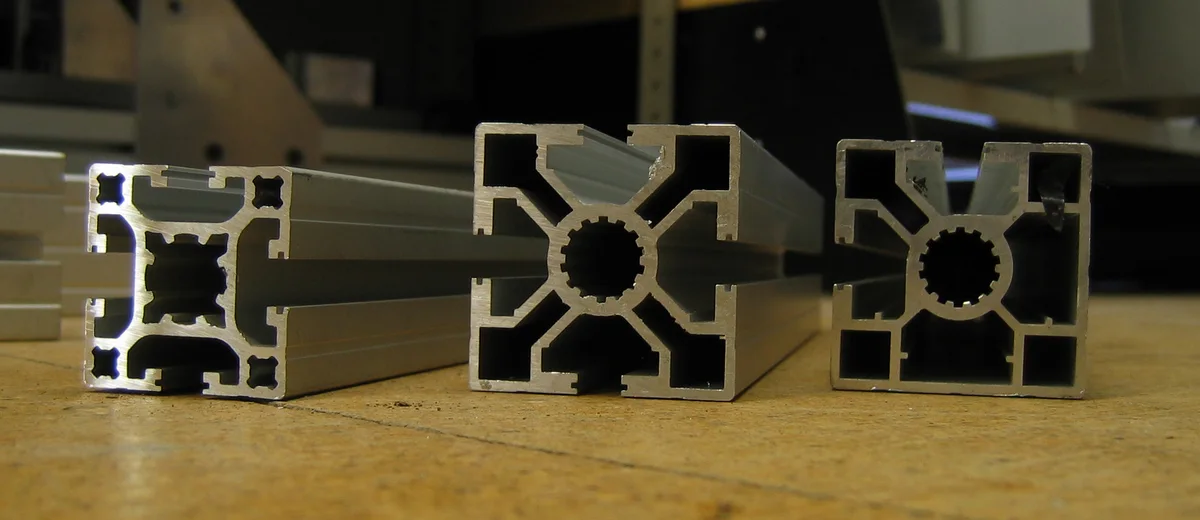
6A02 extrudes readily into thin-walled and hollow sections thanks to its high hot plasticity. After extrusion it can be solution heat-treated and aged to T6, or left in T4 for bending and stretch forming before final ageing.
The alloy's composition, magnesium and silicon with 0.2–0.6 % copper and a manganese or chromium addition, gives a T6 strength a little above 6061 while keeping good corrosion resistance. This balance suits secondary aircraft structure: stringers and stiffeners in lightly loaded areas, floor and seat-track supports, ducting, frames for equipment racks and many types of tube.
For extrusions, the T4-then-form route is one of 6A02's main advantages. Profiles are stretched, bent or roll-formed to contour while soft, then artificially aged so that the finished part reaches T6 strength. This avoids the springback and cracking that come with forming fully hardened sections.
Limits per GB/T 3190. An earlier version of this page listed chromium at 0.45–0.90 % and titanium at 0.15–0.40 %; those values are not correct for 6A02 and have been replaced.
| Element | Minimum | Maximum | Role |
|---|---|---|---|
| Silicon (Si) | 0.50 | 1.20 | Forms Mg2Si; aids hot workability |
| Iron (Fe) | — | 0.50 | Impurity |
| Copper (Cu) | 0.20 | 0.60 | Raises strength more than in 6061 |
| Manganese (Mn) or chromium (Cr) | 0.15 | 0.35 | Either element may be used for grain control |
| Magnesium (Mg) | 0.45 | 0.90 | Main strengthening element with Si |
| Zinc (Zn) | — | 0.20 | Impurity |
| Titanium (Ti) | — | 0.15 | Grain refiner |
| Others, each / total | — | 0.05 / 0.10 | |
| Aluminium (Al) | Remainder |
Minimum values commonly specified for extruded 6A02 bar and profiles at room temperature. Thin-walled sections and thick bars may carry different limits; the certificate reports the tested values for your order.
| Temper | Tensile strength Rm | Yield strength Rp0.2 | Elongation A |
|---|---|---|---|
| O | ≤ 145 MPa | — | ≥ 16 % |
| T4 | ≥ 180 MPa | — | ≥ 14 % |
| T6 | ≥ 295 MPa | ≥ 230 MPa | ≥ 10 % |
Earlier material quoted a density of 2.78 g/cm³, which is typical of 2xxx alloys; 6A02 is about 2.70 g/cm³.
Annealed for maximum formability: tight bends, flaring and swaging of tubes.
Solution treated and naturally aged. Good strength with enough ductility to stretch-form and bend.
Solution treated and artificially aged for full strength. The standard delivery temper for straight profiles.
Heat-treated to T6 by the user from O or F material; same target properties as T6.
Strain-hardened tempers such as H32 do not apply to a heat-treatable alloy like 6A02, even though they sometimes appear in supplier lists.
| Shape | Indicative size range |
|---|---|
| Round tube | OD about 6 – 360 mm, wall 0.5 – 30 mm |
| Square and rectangular tube | Side about 6 – 220 mm, wall 0.5 – 20 mm (rectangular up to about 6:1) |
| Flat bar | Thickness 0.5 – 10 mm, width 10 – 300 mm |
| Angles (equal and unequal) | Legs about 6 – 200 mm, wall 0.5 – 20 mm |
| Channels and T-sections | Width about 10 – 200 mm, wall 0.5 – 20 mm |
| Hexagonal and octagonal sections | Across flats about 6 – 150 mm |
| Custom profiles | To customer drawing; die design reviewed per order |
Ranges are indicative. Achievable wall thickness depends on circumscribing circle and shape complexity, and is confirmed against your drawing.
| Specification | Scope |
|---|---|
| GB/T 3190 | Chemical composition |
| GB/T 6892 | Extruded profiles for general engineering |
| GB/T 3191 | Extruded bars |
| GB/T 4436 / GB/T 14846 | Dimensional tolerances for tubes and profiles |
| Aviation drawings | HB and GJB material and product standards as called up by the design authority |
| System | Designation | Comment |
|---|---|---|
| GB/T 3190 | 6A02 | Current national designation |
| Former designation | LD2 | Still seen on older drawings |
| GOST 4784 | AV (АВ) | Russian equivalent, very close in composition |
| Nearest AA grades | 6151, 6061 | Similar Mg-Si-Cu-Cr base; not identical |
| Nearest EN grade | EN AW-6061 | Used as a substitute on European drawings |
Bend and stretch-form in O or T4. Age to T6 within the time window your process allows, since natural ageing reduces formability over days.
Machines cleanly in T6 with sharp carbide tools and coolant.
TIG or MIG with 4043 or 5356 filler. Weld zones fall to roughly T4-level strength.
Accepts sulphuric and boric-sulphuric anodising, chemical conversion coatings and aerospace primers.
6A02 is not suitable for engine intakes, exhausts or other hot parts, and primary wing and fuselage structure normally uses 2xxx and 7xxx extrusions.
T4 is solution treated and naturally aged, with minimum tensile strength around 180 MPa and good formability. T6 is artificially aged to about 295 MPa minimum tensile and 230 MPa yield.
Yes. Bend or stretch-form in O or T4 temper, then age to T6. Bending T6 sections requires generous radii and risks cracking.
They are close but not identical: 6A02 has a wider silicon range, more copper and may use manganese instead of chromium. Treat 6061 as a possible substitute only with design approval.
Yes. Send the drawing; we review the shape, wall thickness and tolerances and confirm whether a new die is needed.
An EN 10204 3.1 certificate with chemistry and mechanical test results for each lot.
Send the drawing, temper and quantity. We will reply with availability, certification and a delivered price.





