T6
Solution heat-treated at about 515–530 °C, water quenched and artificially aged. The standard delivery temper for aerospace forgings.



6A02 (formerly LD2) is a heat-treatable aluminium-magnesium-silicon-copper forging alloy with excellent hot plasticity, good corrosion resistance and medium strength in T6. It is specified on drawings made to GB, HB and GJB standards, and is close to 6151 and 6061 in other systems. Metline supplies 6A02 die forgings, free forgings, rings and forged bar to HB 5204 and GJB 2351, certified and shipped worldwide.
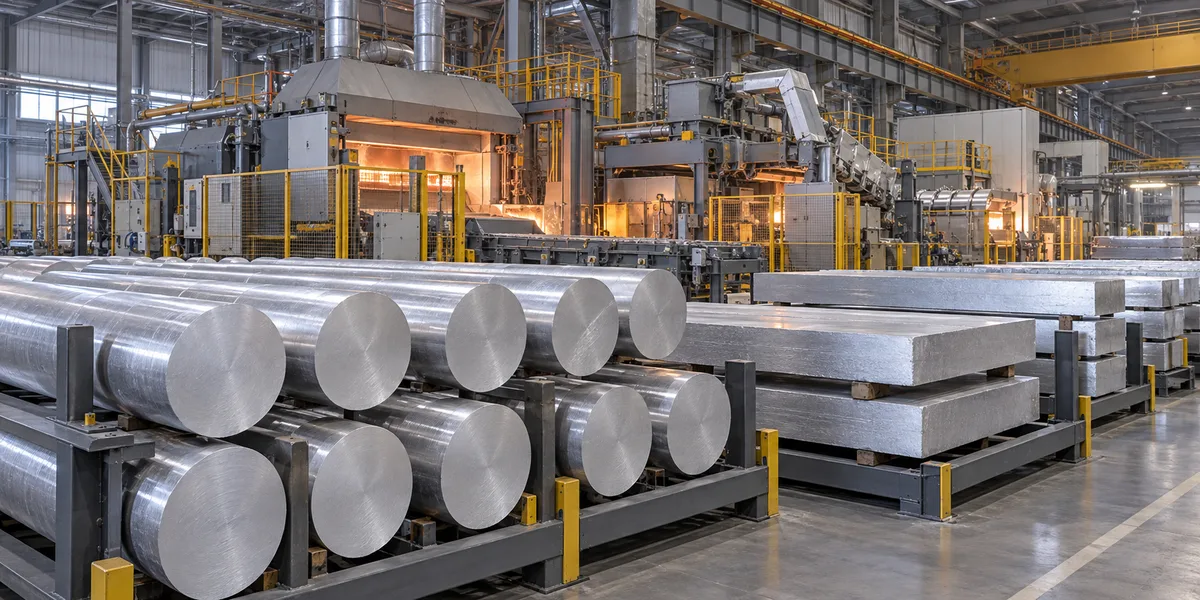
6A02 belongs to the 6xxx family. Its magnesium and silicon form Mg2Si, while 0.2–0.6 % copper adds strength beyond 6061-level and either manganese or chromium controls grain growth. The alloy is valued above all for its plasticity when hot, which lets it be forged into complex shapes at modest pressure.
In T6 temper 6A02 offers medium strength, good fatigue behaviour and better corrosion resistance than the 2xxx forging alloys. It also stays ductile at low temperatures. These qualities made it a standard choice for moderately loaded aircraft forgings, engine accessory housings and helicopter parts, especially where complex shapes with thin webs are required.
For buyers working in other standards, 6A02 sits between 6061 and 6151: it has a little more copper than 6061 and less silicon and chromium than 6151. It is not formally identical to any AA alloy, so substitution must be approved by the design authority.
Limits per GB/T 3190. The certificate for each lot reports the actual analysis.
| Element | Minimum | Maximum | Role |
|---|---|---|---|
| Silicon (Si) | 0.50 | 1.20 | Forms Mg2Si; aids hot workability |
| Iron (Fe) | — | 0.50 | Impurity |
| Copper (Cu) | 0.20 | 0.60 | Raises strength more than in 6061 |
| Manganese (Mn) or chromium (Cr) | 0.15 | 0.35 | Either element may be used for grain control |
| Magnesium (Mg) | 0.45 | 0.90 | Main strengthening element with Si |
| Zinc (Zn) | — | 0.20 | Impurity |
| Titanium (Ti) | — | 0.15 | Grain refiner |
| Others, each / total | — | 0.05 / 0.10 | |
| Aluminium (Al) | Remainder |
Forging standards set minimums by direction: longitudinal (L, along the grain flow), long-transverse (LT) and short-transverse (ST). Values below are the minimums commonly quoted for T6 forgings under the two main aviation standards; always confirm against the current edition named on your drawing.
| Standard and product | Direction | Tensile strength Rm | Yield Rp0.2 | Elongation A | Hardness |
|---|---|---|---|---|---|
| GJB 2351, free and die forgings, T6 | L | ≥ 275 MPa | — | ≥ 10 % | ≈ 85 HB |
| HB 5204, die forgings, T6 | L | ≥ 295 MPa | ≥ 215 MPa | ≥ 12 % | ≈ 85 HB |
| HB 5204, die forgings, T6 | LT | ≥ 265 MPa | — | ≥ 4 % | — |
Solution heat-treated at about 515–530 °C, water quenched and artificially aged. The standard delivery temper for aerospace forgings.
Solution treated and naturally aged; more ductile. Used where parts are formed or straightened before final ageing.
Supplied for customers who carry out their own heat treatment after rough machining.
Quench delay and water temperature have a strong effect on thick forgings. For sections over about 75 mm, ask for properties to be tested at mid-thickness, not only near the surface.
| Specification | Scope |
|---|---|
| HB 5204 | Aviation standard for aluminium alloy die forgings |
| GJB 2351 | Specification for aluminium alloy forgings for aerospace use |
| GB/T 3190 | Chemical composition of wrought aluminium alloys |
| GB/T 16865 / GB/T 228.1 | Tensile test specimens and methods |
| ASTM B594 or AMS-STD-2154 | Ultrasonic inspection, when called up by the buyer |
| System | Designation | Comment |
|---|---|---|
| GB/T 3190 | 6A02 | Current national designation |
| Former designation | LD2 | Still seen on older drawings |
| GOST 4784 | AV (АВ) | Russian equivalent, very close in composition |
| Nearest AA grades | 6151, 6061 | Similar Mg-Si-Cu-Cr base; not identical |
| Nearest EN grade | EN AW-6061 | Used as a substitute on European drawings |
| Type | Typical parts | Notes |
|---|---|---|
| Closed-die forgings | Housings, brackets, levers, fittings | Near-net shape to drawing |
| Free (open-die) forgings | Blocks, bars, step shafts | Machining allowance agreed per order |
| Rings | Flanges, casings, bearing housings | Seamless rolled or forged rings |
| Discs and hubs | Wheel hubs, covers, rotors | Upset for radial grain flow |
| Back-extruded tubes | Hollow cylinders and sleeves | Seamless, heavy wall |
Maximum sizes depend on shape and forging route and are confirmed against each drawing.
6A02 is not used for turbine blades or hot-section engine parts: like all aluminium alloys, it loses strength rapidly above about 150 °C.
| Property | 6A02-T6 | 6061-T6 | 6151-T6 | 2A50 / 2014-T6 |
|---|---|---|---|---|
| Typical tensile strength | ≈ 320 – 340 MPa | ≈ 310 MPa | ≈ 330 MPa | ≈ 420 – 485 MPa |
| Hot plasticity | Excellent | Good | Excellent | Good |
| Corrosion resistance | Good | Very good | Very good | Fair |
| Typical drawing standard | GB / HB / GJB | ASTM / AMS | AMS 4125 | GB / ASTM / AMS |
There is no exact match. The Russian grade AV is very close, and among AA alloys 6151 and 6061 are the nearest. Any substitution needs approval from the design authority.
LD2. Older drawings and specifications often still use it.
Die forgings to HB 5204 are commonly quoted at a minimum of 295 MPa tensile and 215 MPa yield in the longitudinal direction, with typical values somewhat higher.
It can be welded by TIG or MIG with 4043-type filler, but the heat-affected zone loses T6 strength. Forgings are usually joined mechanically.
Where the design authority allows it, we can offer 6061 or 6151 forgings to ASTM B247, AMS or EN 586 as an alternative.
Send the drawing, standard and quantity. We will reply with the forging route, certification and a delivered price.





