O (annealed)
Softest condition, used for cold heading and heavy forming before heat treatment.



6056 is one of the strongest 6xxx aluminium alloys: silicon, magnesium, copper, manganese and a little zinc give it peak-aged strength well above 6061, while keeping weldability and a lower density than 2xxx aircraft alloys. Metline supplies 6056 wire and drawn rod in O, T4 and T6 tempers for aerospace fasteners, pins and machined parts, to customers worldwide.
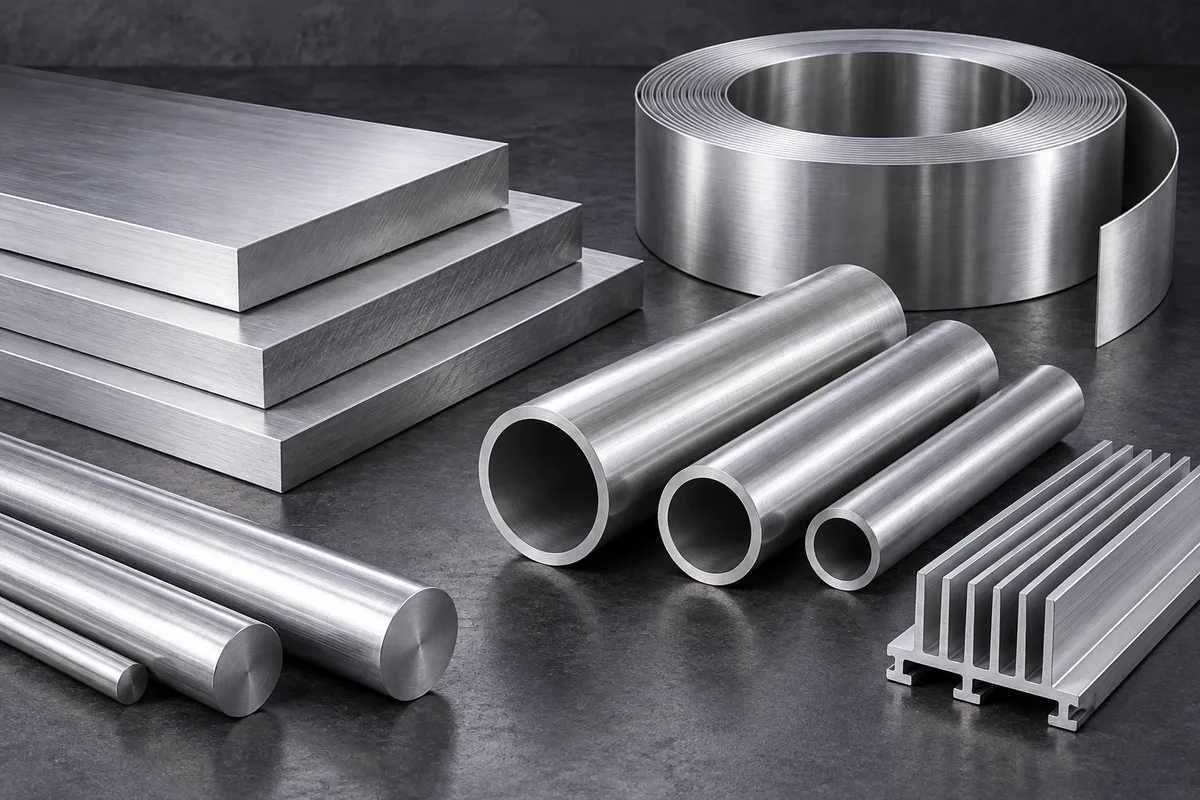
6056 is a European-developed Al-Si-Mg-Cu alloy. It was introduced for aircraft fuselage sheet and extruded stringers as a lighter, weldable alternative to 2024, and it is the alloy used with 6013 for laser-welded stringer panels on some modern airliners. Drawn into wire and rod, the same chemistry gives a high-strength 6xxx feedstock for cold-headed and machined parts.
Compared with 6061, 6056 contains more silicon, more copper and a deliberate manganese addition. The extra silicon and copper raise the amount of strengthening precipitate formed during ageing, so 6056-T6 is clearly stronger than 6061-T6. Manganese and zirconium control the grain structure, which keeps toughness acceptable at this strength.
The price of the extra copper is a known sensitivity to intergranular corrosion in the peak-aged T6 condition. For sheet that will see moisture, airframe makers use an over-aged temper (T78) that restores corrosion resistance at a small loss of strength. For wire and fasteners, the normal answer is a protective finish such as anodising or a conversion coating, plus a sealant on installation.
Limits below are the registered values for EN AW-6056 (Aluminum Association 6056). The mill certificate reports the actual analysis of each cast.
| Element | Minimum | Maximum | Role in the alloy |
|---|---|---|---|
| Silicon (Si) | 0.7 | 1.3 | Excess silicon above the Mg2Si balance raises strength |
| Iron (Fe) | — | 0.50 | Impurity |
| Copper (Cu) | 0.50 | 1.1 | Adds strength; increases intergranular corrosion sensitivity |
| Manganese (Mn) | 0.40 | 1.0 | Grain structure control, toughness |
| Magnesium (Mg) | 0.6 | 1.2 | Forms strengthening precipitates with silicon |
| Chromium (Cr) | — | 0.25 | Grain control |
| Zinc (Zn) | 0.10 | 0.7 | Small strength contribution |
| Titanium + Zirconium | — | 0.20 | Grain refinement |
| Others, each / total | — | 0.05 / 0.15 | |
| Aluminium (Al) | Remainder |
Softest condition, used for cold heading and heavy forming before heat treatment.
Solution heat-treated and naturally aged. Good ductility with moderate strength; parts can be formed and then artificially aged.
Solution heat-treated and artificially aged to peak strength. The usual finished condition for pins, fasteners and machined parts.
Aged beyond peak to improve intergranular corrosion resistance. Common for sheet; available for wire and rod on request.
Peak-aged 6056 reaches a tensile strength noticeably higher than 6061-T6, and closer to the 2xxx alloys than any common 6xxx grade. Exact minimum values depend on the specification, diameter and temper. Some published tables quote very high minimums for 6056 wire (above 500 MPa); these are not consistent with the alloy and should not be used for design. Design to the guaranteed values on your order specification and the mill certificate.
Tell us the governing specification. 6056 wire is often ordered to an airframe or fastener maker's own material specification.
Head in O or freshly quenched condition, then age to T6. Heading performance is lower than 6053 or 1100, so check the heading ratio with a trial.
Machines well in T6 with short chips and a good finish; similar to 6061 practice with sharp carbide tools.
Weldable by laser, TIG and MIG, which is one of its advantages over 2024. Filler choice (4xxx) is set by the welding procedure.
Anodise, apply a chromate-free conversion coating or prime parts. Avoid leaving peak-aged parts bare in wet service.
6056 is not a conductor alloy: its high alloy content gives much lower electrical conductivity than 6101 or 1350. For conductors, choose those alloys instead.
| Property | 6061-T6 | 6013-T6 | 6056-T6 | 2024-T4 |
|---|---|---|---|---|
| Relative strength | Moderate | High for 6xxx | High for 6xxx | High |
| Weldability | Good | Good | Good | Poor |
| Intergranular corrosion (peak aged) | Low risk | Some risk | Known risk | Higher risk |
| Density | 2.70 | About 2.71 | About 2.72 | 2.78 |
| Main aerospace use | General parts, tube, fittings | Fuselage sheet | Fuselage sheet, stringers, parts | Skins, rivets, fittings |
6056-T6 is clearly stronger than 6061-T6 because it contains more silicon and copper. It is among the strongest 6xxx alloys, though still below 2024 and 7075.
In the peak-aged T6 condition it can suffer intergranular corrosion in wet, salty environments. Over-ageing (as in the T78 sheet temper) or a protective finish such as anodising or a conversion coating controls this.
Yes. It is weldable by laser, TIG and MIG, which is why it is used for laser-welded fuselage panels. Most high-strength 2xxx and 7xxx alloys cannot be welded this way.
Chemistry is defined in EN 573-3 (EN AW-6056). Mechanical properties are usually set by the airframe or fastener maker's material specification or an EN aerospace standard named on the order.
No. Its high alloy content gives low conductivity. Use 1350 or 6101 for conductors.
Yes. 6056 rod and wire can be supplied in coils or straightened and cut to length, with mill test certificates, to customers worldwide.
Send the diameter, temper, quantity and specification. Our team will confirm availability, testing and a delivered price.





