6262-T9
The standard screw-machine temper: aged, then cold drawn for maximum strength and the cleanest chip break.



6262 wire is cold-drawn, heat-treated free-machining aluminium wire, made to AMS-QQ-A-225/10 and ASTM B211. Its lead and bismuth additions break chips on automatic lathes, so small fittings, pins and connector bodies can be turned quickly from coil. Metline supplies 6262 wire and small-diameter rod in T6, T8 and T9, in coils or straight lengths, with full certification, worldwide.
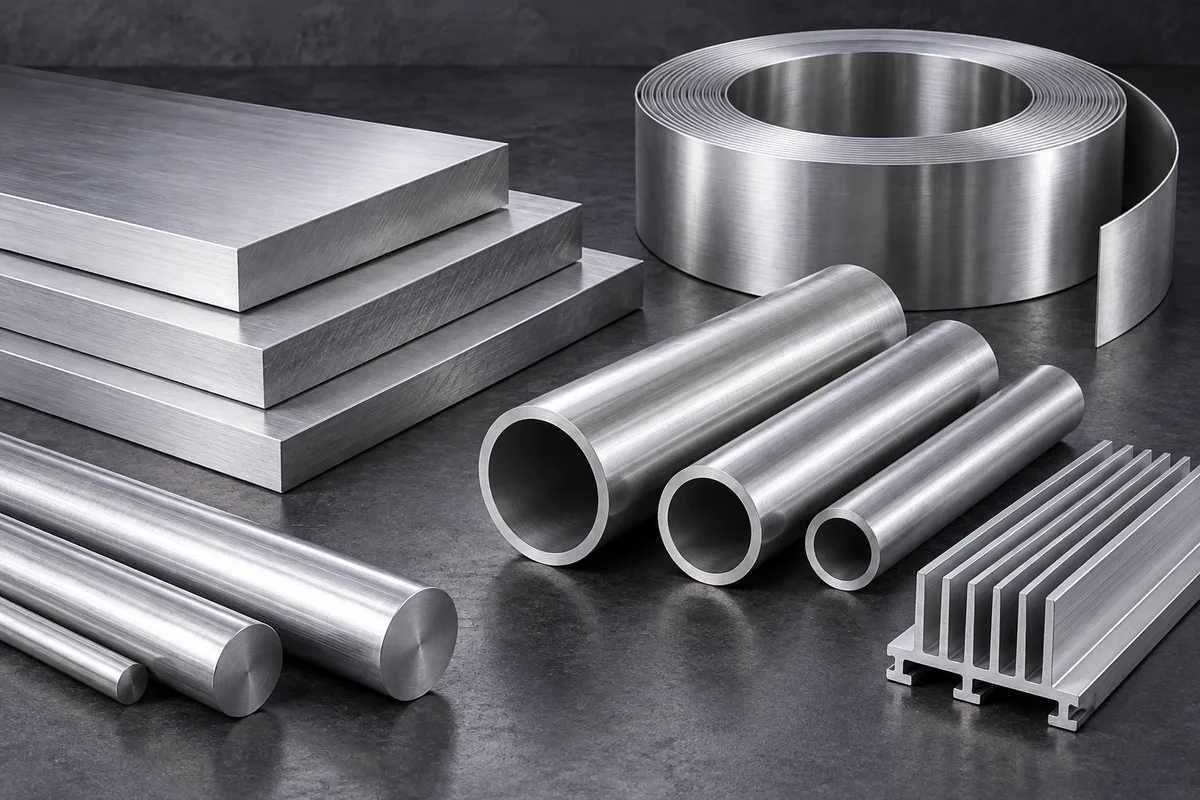
In the ASTM and AMS system, "wire" is drawn product under about 10 mm (0.375 in) in diameter, and "rod" is the same product above that size. 6262 wire is therefore the small-diameter end of the 6262 range: drawn through dies to close tolerances, heat-treated, and often cold-drawn again after ageing.
The point of 6262 wire is speed on coil-fed and bar-fed automatics. Lead and bismuth particles (0.4–0.7 % each) act as internal chip breakers, so parts as small as electrical contacts and instrument pins can be turned without tangled swarf. The base chemistry is that of 6061, so finished parts resist corrosion and anodise well.
AMS-QQ-A-225/10 is the aerospace specification for 6262 bar, rod and wire produced by rolling, drawing or cold finishing. It is the document most aircraft drawings cite for 6262 wire, while ASTM B211 is used for commercial and general engineering orders.
Registered limits used by AMS-QQ-A-225/10, ASTM B211 and EN 573-3.
| Element | Minimum | Maximum | Role |
|---|---|---|---|
| Silicon (Si) | 0.40 | 0.80 | Forms Mg2Si with magnesium |
| Iron (Fe) | — | 0.70 | Impurity |
| Copper (Cu) | 0.15 | 0.40 | Adds strength |
| Manganese (Mn) | — | 0.15 | Grain control |
| Magnesium (Mg) | 0.80 | 1.20 | Main strengthening element |
| Chromium (Cr) | 0.04 | 0.14 | Controls recrystallisation |
| Zinc (Zn) | — | 0.25 | Impurity |
| Titanium (Ti) | — | 0.15 | Grain refiner |
| Bismuth (Bi) | 0.40 | 0.70 | Free-machining: forms low-melting particles that break chips |
| Lead (Pb) | 0.40 | 0.70 | Free-machining, works with bismuth |
| Others, each / total | — | 0.05 / 0.15 | |
| Aluminium (Al) | Remainder |
An earlier version of this page showed a composition with zirconium, tin and 0.40–0.80 % copper. Those limits do not belong to 6262; the table above gives the registered values.
Typical values are for comparison. The specified minimums below are for cold-finished 6262 in the smaller diameter bands; the exact limits for your size are set by the specification and reported on the certificate.
| Temper | Tensile strength | Yield strength (0.2 %) | Elongation | Notes |
|---|---|---|---|---|
| O, typical | ≈ 125 MPa | ≈ 55 MPa | ≈ 25 % | For forming or later heat treatment |
| T6, minimum | 290 MPa (42 ksi) | 240 MPa (35 ksi) | 10 % | Typical ≈ 310 / 276 MPa |
| T8 | Between T6 and T9 | Between T6 and T9 | Per specification | Solution treated, cold worked, aged |
| T9, minimum (to 50 mm) | 360 MPa (52 ksi) | 330 MPa (48 ksi) | 5 % | Typical ≈ 400 / 380 MPa |
The standard screw-machine temper: aged, then cold drawn for maximum strength and the cleanest chip break.
Cold worked between solution treatment and ageing. Used where a specific strength-ductility balance is called for.
Solution treated and aged without final cold work. Slightly lower strength, slightly higher ductility.
Annealed wire for forming, or for customers who heat-treat finished parts themselves.
Some offers list 6262 wire in T4 or T6511. T6511 is an extruded-product temper for larger rod, and T4 wire is rarely stocked because the alloy is almost always used in aged condition. We quote to the temper your drawing requires.
| Specification | Scope |
|---|---|
| SAE AMS-QQ-A-225/10 | 6262 bar, rod and wire; rolled, drawn or cold finished (successor to federal QQ-A-225/10) |
| SAE AMS-QQ-A-225 | General requirements for the QQ-A-225 bar, rod and wire series |
| ASTM B211 / B211M | Cold-finished bar, rod and wire, including 6262 |
| EN 1301-1/-2/-3 | European drawn wire: delivery conditions, properties, tolerances |
| EN 573-3 | EN AW-6262 [AlMg1SiPb] composition |
| UNS | A96262 |
| Diameter (mm) | Weight (g/m) | Metres per kg |
|---|---|---|
| 1 | 2.1 | 468 |
| 1.5 | 4.8 | 208 |
| 2 | 8.5 | 117 |
| 2.5 | 13.4 | 75 |
| 3 | 19.2 | 52 |
| 4 | 34.2 | 29 |
| 5 | 53.4 | 19 |
| 6 | 76.9 | 13 |
| 8 | 136.7 | 7 |
| 10 | 213.6 | 5 |
| Wire grade | Main purpose | Typical tensile | Weldable |
|---|---|---|---|
| 6262-T9 | Free-machining turned parts | ≈ 400 MPa | No |
| 6061-T6 | General parts, formed wire | ≈ 310 MPa | Yes |
| 2024-T4 | High-strength fasteners | ≈ 470 MPa | No |
| 7075-T73 | High-strength, stress-corrosion-resistant fasteners | ≈ 505 MPa | No |
| 2117-T4 | Driven rivets | ≈ 295 MPa | No |
It is the specification for 6262 aluminium alloy bar, rod and wire produced by rolling, drawing or cold finishing. The original federal document has been taken over by SAE as AMS-QQ-A-225/10.
No. Its conductivity is about 44 % IACS and it is designed for machining. For conductors, use 1350 or 6101 conductor wire.
Both form low-melting particles that weaken the chip at the cutting edge, so chips break short. This allows fast, unattended turning on automatic lathes.
T9, which is aged and then cold drawn. Minimum tensile strength is about 360 MPa in smaller diameters, with typical values near 400 MPa.
Yes. Wire and small rod can be straightened and cut to bar-feeder lengths, or supplied in coils.
Send diameter, temper, specification and quantity. We will reply with availability, certification and a delivered price.





