Clean first
Remove oil with solvent, then brush with a stainless-steel brush used only on aluminium. Weld within a few hours, before the oxide re-forms thickly.



ER4043 is a 5 % silicon aluminium filler metal, supplied as MIG wire and TIG rod, that flows well and strongly resists hot cracking. It is the usual first choice for welding 6xxx extrusions, 3xxx sheet and aluminium-silicon castings, and the wrong choice for high-magnesium 5xxx plate or parts that must be colour-matched after anodising. This guide covers chemistry, compatible base metals, weld strength, settings and buying details.
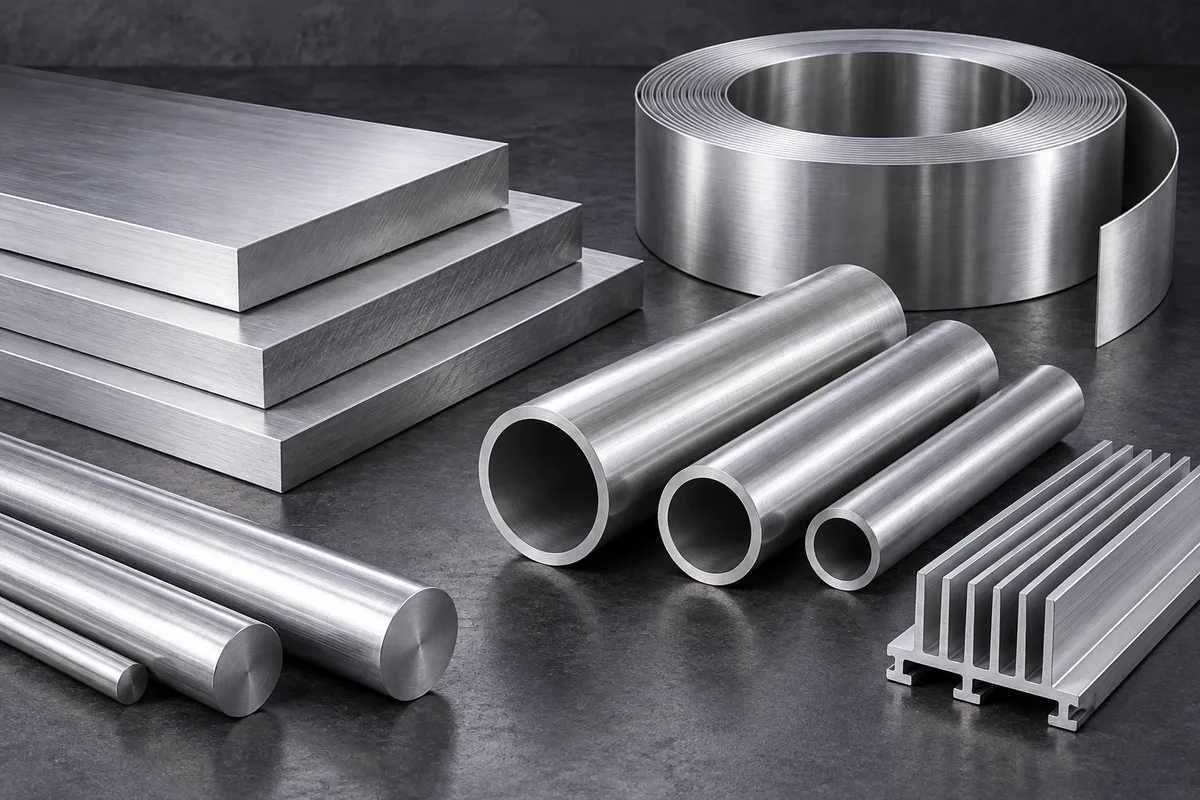
ER4043 is an aluminium-silicon filler metal classified under AWS A5.10 (ASME SFA-5.10) and ISO 18273 as S Al 4043, chemical symbol AlSi5. "ER" means it can be used as an electrode (MIG/GMAW wire) or as a rod (TIG/GTAW); the same alloy sold only as cut rod is designated R4043.
Silicon is the working ingredient. Adding about 5 % silicon lowers the melting point of the filler below that of most parent alloys and narrows the freezing range of the weld pool. The pool stays fluid longer, wets the joint edges well and, most importantly, the last liquid to freeze can feed shrinkage between grains instead of tearing apart. That is why 4043 is the classic remedy for solidification (hot) cracking in crack-sensitive alloys such as 6061, 6063 and 6082.
The trade-off is that the deposit is softer and less ductile than a 5xxx-series weld, it turns grey-black when anodised, and it reacts with high-magnesium parent metals to form brittle magnesium silicide. Knowing those three limits covers most filler selection mistakes made with 4043.
The limits below are the AWS A5.10 / ISO 18273 values for 4043. A certificate of conformance or analysis for each heat lot lists the actual composition; silicon usually sits around the middle of the range.
| Element | Limit (%) | Why it matters |
|---|---|---|
| Silicon (Si) | 4.5 – 6.0 | Lowers melting point, increases fluidity, reduces hot cracking |
| Iron (Fe) | 0.80 max | Impurity; excess forms coarse intermetallics |
| Copper (Cu) | 0.30 max | Kept low to protect corrosion resistance |
| Manganese (Mn) | 0.05 max | Impurity |
| Magnesium (Mg) | 0.05 max | Kept very low; 4043 has no Mg strengthening of its own |
| Zinc (Zn) | 0.10 max | Impurity |
| Titanium (Ti) | 0.20 max | Grain refiner for the weld deposit |
| Beryllium (Be) | 0.0003 max | Restricted for welder health in all AWS aluminium fillers |
| Others, each / total | 0.05 / 0.15 | |
| Aluminium (Al) | Remainder |
Filler selection charts from the Aluminum Association and AWS rate each filler against each parent alloy for crack resistance, strength, ductility, corrosion, elevated-temperature service and colour match. The summary below reflects that guidance for 4043. Where a combination is marked "check", it can work but needs a procedure qualification first.
| Parent alloy group | Typical grades | ER4043 suitability | Notes |
|---|---|---|---|
| 1xxx (pure) | 1050, 1060, 1100, 1350 | Good | 1100 or 1188 filler gives a closer conductivity and colour match |
| 3xxx (Al-Mn) | 3003, 3004, 3005 | Good | Common for HVAC, tanks and housings |
| 5xxx, Mg ≤ 2.5 % | 5005, 5050, 5052 | Good, with care | 5052 is borderline; 5356 is often preferred for strength |
| 5xxx, Mg > 2.5 % | 5083, 5086, 5154, 5454, 5456 | Avoid | Mg2Si forms in the fusion zone and makes it brittle; use 5356, 5183 or 5556 |
| 6xxx (Al-Mg-Si) | 6005A, 6061, 6063, 6082, 6351 | Very good | Lowest crack risk; first choice when PWHT or service above 65 °C is planned |
| 7xxx weldable | 7005, 7020 | Check | 5356 or 5183 is normally preferred for strength |
| 2xxx, 7xxx high strength | 2024, 7075, 7050 | Not recommended | These alloys are generally considered unweldable by arc processes |
| Castings (Al-Si) | A356, 356, 319, 355, 413 | Very good | Standard filler for casting repair and casting-to-wrought joints |
Always check the specific combination against the filler selection chart in AWS D1.2 or the supplier datasheet, and qualify the procedure for structural work.
With non-heat-treatable parent metals, the weld is usually as strong as the annealed parent. With heat-treatable 6xxx alloys, the heat-affected zone (HAZ) softens, and the joint fails there rather than in the filler. The design figure therefore depends on the parent alloy, not just on the wire.
| Joint | Condition | Tensile strength | Basis |
|---|---|---|---|
| 6061-T6 groove weld, 4043 | As welded | 165 MPa (24 ksi) minimum | AWS D1.2 / ASME IX qualification minimum |
| 6061-T6 groove weld, 4043 | As welded | About 185 MPa (27 ksi) typical | Published filler-maker test data |
| 6061-T6 welded with 4043, then solution treated and aged | Post-weld heat treated | About 300 MPa (44 ksi) typical | Possible because 4043 picks up Mg from the parent |
| 6063-T6 groove weld, 4043 | As welded | 117 MPa (17 ksi) minimum | AWS D1.2 qualification minimum |
| 3003-H14 groove weld, 4043 | As welded | 97 MPa (14 ksi) minimum | Equals the annealed parent |
Shear strength is where 4043 lags. Published data give minimum fillet-weld shear strengths of about 80 MPa (11.5 ksi) longitudinal and 103 MPa (15 ksi) transverse for 4043, against about 117 MPa (17 ksi) and 179 MPa (26 ksi) for 5356. A fillet joint designed for 5356 needs bigger welds if it is switched to 4043, so never substitute fillers on a structural drawing without the engineer's agreement.
| Format | Diameters | Packaging | Typical use |
|---|---|---|---|
| MIG wire, precision layer wound | 0.8, 0.9, 1.0, 1.2, 1.6 mm (0.030 – 1/16 in) | 0.5 kg (S100), 2 kg (S200), 7 kg (S300), 20 kg (S360) spools | Push, push-pull and robotic GMAW |
| MIG wire, bulk | 1.0 – 1.6 mm | Drums and large pay-off packs | High-volume automated lines |
| TIG rod, straight | 1.6, 2.0, 2.4, 3.2, 4.0 mm | 1 m (or 36 in) lengths, 5 kg or 10 lb tubes and boxes | Manual GTAW, thin sheet, repair |
| Larger rod / special sizes | On request | Agreed per order | Casting repair, oxy-fuel work, special processes |
Aluminium wire is soft compared with steel and is easily shaved or kinked in the feeder. Smaller diameters (0.8 – 0.9 mm) feed reliably only with a push-pull or spool gun; 1.0 mm and above can be pushed over short conduit with U-groove drive rolls, a PTFE or carbon liner and a contact tip about 0.1 mm oversize. Diameter tolerance is controlled to the AWS A5.10 and ISO 544 limits, and good wire has a consistent cast and helix so it leaves the tip straight.
These are indicative spray-transfer starting windows for flat-position work with argon shielding. Actual settings depend on the power source, joint, thickness and position; tune on test pieces and record the result in your welding procedure specification.
| Wire diameter | Current (A) | Voltage (V) | Shielding gas | Gas flow |
|---|---|---|---|---|
| 0.8 mm (0.030 in) | 60 – 175 | 15 – 24 | 100 % Ar | 15 – 20 L/min |
| 0.9 mm (0.035 in) | 70 – 185 | 15 – 26 | 100 % Ar | 15 – 20 L/min |
| 1.2 mm (3/64 in) | 125 – 260 | 20 – 29 | Ar, or Ar + 25 – 75 % He on thick sections | 18 – 25 L/min |
| 1.6 mm (1/16 in) | 170 – 300 | 24 – 30 | Ar + He for deep penetration | 20 – 30 L/min |
Remove oil with solvent, then brush with a stainless-steel brush used only on aluminium. Weld within a few hours, before the oxide re-forms thickly.
Use a push angle of about 10 – 15° so the gas shield runs ahead of the pool and the arc cleaning action works on the joint.
Aluminium crater cracks easily. Use a crater-fill function or pause and reverse briefly at the end of each weld.
AC with balance set toward penetration, pure argon, and a 2.4 mm rod for 3 mm sheet is a common starting point.
Sections over about 25 mm, or castings, benefit from preheat to around 100 °C; keep heat-treatable alloys below about 120 °C to protect strength.
Keep spools sealed until use and store indoors above the dew point. Moisture and hydrated oxide on the wire cause porosity.
| Property | ER4043 | ER4047 | ER4943 | ER5356 |
|---|---|---|---|---|
| Main alloying | Si 4.5 – 6.0 | Si 11.0 – 13.0 | Si 5.0 – 6.0, Mg 0.10 – 0.50 | Mg 4.5 – 5.5 |
| Melting range | 574 – 632 °C | 577 – 582 °C | Similar to 4043 | 571 – 635 °C |
| Hot-crack resistance on 6xxx | Very good | Excellent | Very good | Good |
| As-welded strength | Moderate | Moderate | Higher than 4043 | High |
| Fillet shear strength | Lowest | Higher than 4043 | Higher than 4043 | Highest |
| Ductility | Lower | Lowest | Lower | High |
| Colour after anodising | Dark grey | Very dark grey | Dark grey | Good match |
| Service above 65 °C | Yes | Yes | Yes | No |
| Typical role | General 6xxx, castings | Leak-tight joints, brazing, low distortion | Stronger 4xxx alternative | Structural, marine, anodised parts |
ER4943 was registered in 2010 as a 4043 with a small magnesium addition: it keeps the fluidity and crack resistance but gives noticeably higher as-welded and shear strength. ER4047 has twice the silicon, a near-eutectic narrow melting range and the least shrinkage, which suits leak-tight and thin-wall heat-exchanger work. For a full side-by-side discussion, read our 4043 vs 5356 comparison.
Avoid 4043 on marine hull plate in 5083 or 5086, on welded parts that will be bright-anodised for appearance, and wherever the design calls for the shear capacity of a 5xxx filler.
Both are approved for 6061. Choose 4043 when crack resistance, smooth bead appearance, service above 65 °C or post-weld heat treatment matter. Choose 5356 when the joint needs higher shear strength, more ductility or a better colour match after anodising.
No. On parent alloys with more than about 2.5 % magnesium, the silicon in 4043 combines with magnesium to form brittle Mg2Si in the weld, giving poor ductility and crack-prone joints. Use 5356, 5183 or 5556.
The silicon in the deposit does not anodise; it stays in the oxide as fine particles that look grey to black. The darkness increases with silicon content, which is why 4047 looks darker still. For a close colour match, use a 5xxx filler.
The filler cannot be hardened by itself, but when it dilutes with a 6xxx parent metal it picks up enough magnesium to respond to solution treatment and ageing. Small 6061 parts welded with 4043 and then fully heat treated can approach T6 strength.
Keep it in the sealed bag until use, in a dry, heated store above the dew point. Return part-used spools to a sealed bag or a heated cabinet. Moist or contaminated wire is a leading cause of porosity.
Yes. AlSi5 is the chemical symbol and S Al 4043 is the ISO 18273 designation for the same alloy. Older European documents use SG-AlSi5 (DIN 1732).
Send the diameter, packaging and quantity, and we will reply with availability, certification and delivered terms for your location.





