Cold heading
Head fasteners in the annealed or freshly quenched condition, then age to T6. Heading after full ageing risks cracking.



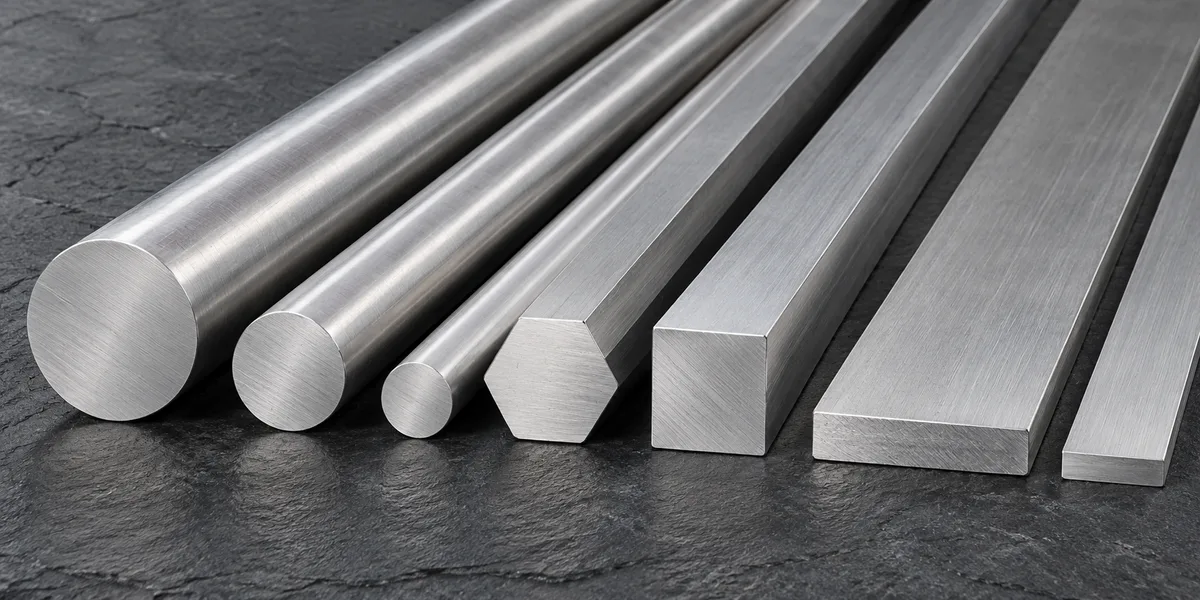
2031 is a British-origin heat-treatable aluminium alloy containing copper, nickel, magnesium, iron and silicon, designed to keep its strength at moderately raised temperatures. It is mainly produced as forging stock, extruded rod and tube, and can be drawn into wire and small rod for fasteners and machined parts. Metline supplies 2031 rod and wire in the solution-treated (T4/TB) and fully aged (T6/TF) conditions, certified to the standard on your order.
Most 2xxx alloys lose strength quickly above about 150 °C because their copper-magnesium precipitates coarsen. 2031 belongs to the small group of nickel-bearing aluminium alloys, alongside 2618 and the older "RR" and Hiduminium alloys, that were developed to resist this softening.
Nickel and iron combine with aluminium to form hard, thermally stable intermetallic particles. These particles do not dissolve during heat treatment and do not coarsen at service temperatures, so they continue to pin the structure when the normal age-hardening precipitates start to lose their effect. The result is an alloy with moderate room-temperature strength and better retention of strength and creep resistance near engines and other warm areas.
In British aerospace practice, 2031 is known through the BS H12 specification and trade names such as Hiduminium 56. Its main forms are forging stock and tube. Wire and small-diameter rod are produced by drawing extruded rod and are generally made to order.
| Element | Minimum | Maximum | Role |
|---|---|---|---|
| Silicon (Si) | 0.50 | 1.3 | Strengthening with Mg; improves fluidity |
| Iron (Fe) | 0.6 | 1.2 | Forms heat-resistant Al-Fe-Ni particles |
| Copper (Cu) | 1.8 | 2.8 | Age-hardening element |
| Manganese (Mn) | — | 0.50 | Grain control |
| Magnesium (Mg) | 0.6 | 1.2 | Age hardening with Cu and Si |
| Nickel (Ni) | 0.6 | 1.4 | Thermally stable intermetallics |
| Zinc (Zn) | — | 0.20 | Impurity |
| Titanium (Ti) | — | 0.20 | Grain refiner |
| Others, each / total | — | 0.05 / 0.15 | |
| Aluminium (Al) | Remainder |
Composition as published for alloy 2031 in BS and EN listings. Confirm the limits of the exact specification on your order, since older national documents differ slightly.
British specifications use TB for solution treated and naturally aged (equivalent to T4) and TF for solution treated and artificially aged (equivalent to T6). The minimums below are those published for forged and extruded 2031 up to about 150 – 200 mm; drawn wire is normally tested to the same temper requirements or to agreed values.
| Condition | Tensile strength (min.) | 0.2 % proof stress (min.) | Elongation (min.) |
|---|---|---|---|
| TB (T4), forged | 310 MPa | 160 MPa | 13 % |
| TB (T4), extruded | 310 MPa | 145 MPa | 13 % |
| TF (T6), forged | 385 MPa | 300 MPa | 6 % |
| TF (T6), extruded | 385 MPa | 285 MPa | 6 % |
Some sales sheets quote a T6 tensile strength above 500 MPa for 2031 wire. We have not found a recognised standard supporting that figure, so we certify against the minimums of the specification ordered and report the actual test values.
| System | Designation |
|---|---|
| Aluminium Association / EN | 2031 / EN AW-2031 |
| British Standard | BS H12 (forging stock and forgings); related legacy aerospace documents |
| Trade names | Hiduminium 56; Alcan GB-D15S (historic) |
| Wire and rod tolerances | EN 1301 (drawn wire) and EN 754 (cold-drawn rod) where no aerospace document applies |
Because 2031 wire is a made-to-order product, quantities, diameters and test plans should be fixed before production. Small trial lots are often useful for qualifying a heading or machining process.
Head fasteners in the annealed or freshly quenched condition, then age to T6. Heading after full ageing risks cracking.
Solution treat, quench rapidly and age. Users should follow the time and temperature in the governing specification and control quench delay.
The intermetallic particles give short chips and good surface finish in T6.
Copper and nickel reduce corrosion resistance. Anodise, conversion coat or seal fastener holes in assemblies.
| Alloy | Strength at room temperature | High-temperature retention | Typical choice for |
|---|---|---|---|
| 2031 | Moderate | Good | Legacy British parts, warm-zone fittings |
| 2618 / 2618A | Higher | Very good | Engine and Concorde-type structures, pistons |
| 2219 | Moderate–high | Good, also cryogenic | Welded parts, tanks |
| 2024 | High | Fair | General airframe parts and rivets |
A heat-treatable Al-Cu-Ni-Mg-Fe-Si alloy of British origin, known through BS H12 and the Hiduminium family, designed to retain strength at moderately raised temperatures.
They are British temper codes. TB is solution treated and naturally aged (like T4); TF is solution treated and artificially aged (like T6).
Published minimums for the TF condition are about 385 MPa tensile and 285 – 300 MPa proof stress with 6 % elongation. Actual values are reported on the certificate.
It can be headed in the soft condition, but general aircraft rivets use 2117, 2017, 2024 or 7050. 2031 is chosen when heat resistance or a legacy specification requires it.
Wire is made to order, so quantity, diameter and test plan are agreed before production. Send your requirement and we will confirm the options.
Send diameter, temper, quantity and specification, and we will confirm feasibility and certification.





