Give finished and blank sizes
Send the finished part drawing as well as the ring size you want. The producer adds machining allowance on OD, ID and height that suits the alloy, diameter and heat-treatment distortion.



A seamless rolled ring is a forged aluminium ring made by piercing a billet and rolling the wall out to size, so it has no weld and a grain flow that runs continuously around the circumference. This guide is for engineers and buyers who need ring blanks for bearing housings, slewing rings, flanges, gear-ring carriers and aerospace structural rings: which alloys to choose, how the process affects properties, what to put in the specification and how to order rough-machined rings.
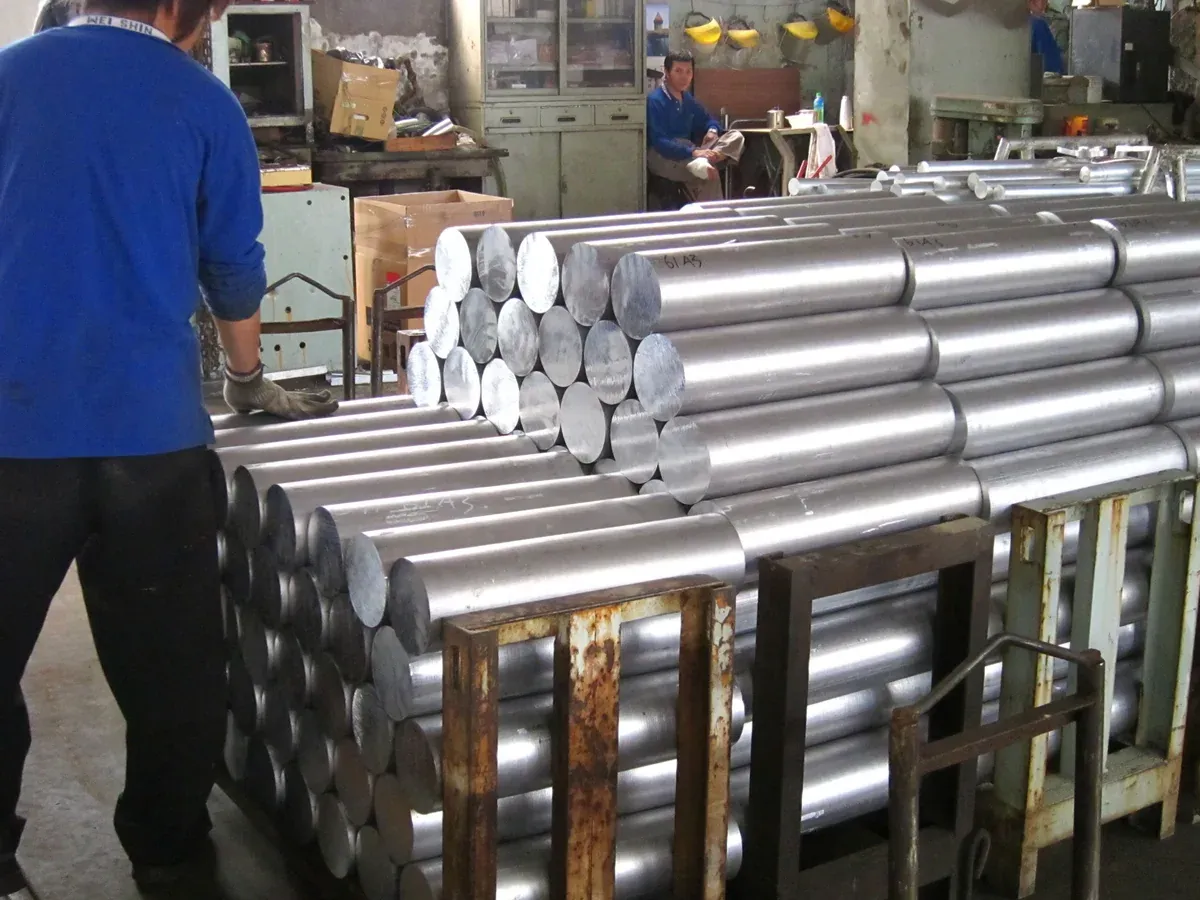
A seamless rolled ring starts as a solid aluminium billet. The billet is upset into a pancake, pierced to make a doughnut-shaped preform, and then rolled between a driven main roll and an inner mandrel roll while conical axial rolls control the height. The wall gets thinner and the diameter grows until the ring reaches its target size. Because the ring is never cut open and rewelded, the word "seamless" describes it exactly.
The rolling action does more than shape the part. It kneads the metal in the circumferential direction, closing any internal porosity from casting and aligning the grain along the ring. That tangential grain flow is the reason rolled rings outperform rings cut from plate, rings bent from bar and welded, or cast rings, wherever a part sees hoop stress, bolt loads or cyclic rotation.
Ring rolling is also efficient. A plate-cut ring of 1,500 mm outside diameter throws away the entire centre disc as scrap; a rolled ring uses almost all of the billet, and a profiled (contoured) ring can be rolled close to the final cross-section so that only a modest machining allowance remains. For large rings in costly aerospace alloys, that saving in material and machining time is often decisive.
Two details matter for buyers. First, quench sensitivity: thick ring walls cool slowly in the centre, so alloys such as 7050 and 2219, which hold strength in thick sections, are preferred over 7075 or 2014 for heavy rings. Second, distortion: a ring quenched without stress relief carries high residual stress and can move out of round when machined. Specifying a stress-relieved temper, or leaving extra allowance for semi-finish and finish passes, avoids scrapped parts.
| Aspect | Seamless rolled ring | Ring cut from plate | Bent and welded ring | Cast ring |
|---|---|---|---|---|
| Grain flow | Continuous, circumferential | Straight through the ring; end grain exposed at the edges | Interrupted at the weld | Random, as-cast |
| Internal soundness | Porosity closed by forging | Good (rolled plate) | Weld porosity and HAZ softening | Risk of porosity and segregation |
| Fatigue and fracture toughness | High | Medium, varies with direction | Lowest at the weld | Lowest |
| Material use on large diameters | High | Very low (centre wasted) | High | High |
| Machining allowance | Low; profiled rings even lower | High | High (distortion) | Medium |
| Size range | Medium to very large diameters | Limited by plate size | Very large | Wide |
| Best for | Load-bearing, rotating and pressure rings | Small rings, prototypes, low stress | Non-critical large frames | Complex shapes, low stress |
For small rings (under roughly 300 – 400 mm outside diameter) or very short runs, cutting from thick plate or machining from extruded or seamless tube can be cheaper, and an open-die forged ring (punched and expanded on a saddle mandrel without a ring mill) is another option. Our forged and rolled ring page covers those routes, and the rolled ring forging guide explains the rolling mill itself in more depth.
| Alloy | Common ring tempers | Character | Typical ring uses |
|---|---|---|---|
| 6061 | T6, T652 | Good strength, weldable, very good corrosion resistance and machinability | Flanges, vacuum rings, general machinery and bearing housings |
| 6082 | T6 | European structural equivalent of 6061, slightly stronger in thick sections | Machinery rings, slewing ring bodies, structural collars |
| 5083 | H112, O | Non-heat-treatable; excellent seawater and cryogenic performance, weldable | Marine flanges, LNG and cryogenic rings, welded vessel rings |
| 2014 | T6, T652 | High strength Al-Cu forging alloy; needs corrosion protection | Aerospace and defence fittings and rings |
| 2219 | T6, T852 | Weldable, strong at cryogenic and elevated temperatures | Propellant tank joint rings, cryogenic structures |
| 7075 | T6, T73, T7352 | Very high strength; T73 tempers for stress-corrosion resistance | Highly loaded aerospace and defence rings in moderate sections |
| 7050 | T7452 | High strength with low quench sensitivity, good toughness in thick sections | Large aerospace structural and engine rings |
Typical properties give a feel for the differences. The figures below are typical room-temperature values for forged product from ASM and Aluminum Association data; specified minimums in ASTM B247 and the AMS specifications are lower, depend on section thickness and on test direction, and are what you should design to.
| Alloy and temper | Typical tensile strength | Typical yield strength | Notes |
|---|---|---|---|
| 6061-T6 | 310 MPa | 275 MPa | Weldable, anodises well |
| 2014-T6 | 485 MPa | 415 MPa | Protect against corrosion |
| 2219-T6 | 415 MPa | 290 MPa | Good weldability for an Al-Cu alloy |
| 7075-T6 | 570 MPa | 505 MPa | Susceptible to stress-corrosion cracking in the short-transverse direction |
| 7075-T73 | 505 MPa | 435 MPa | Over-aged for stress-corrosion resistance |
7050, 6082 and 5083 ring properties depend strongly on thickness and temper; we quote them from the governing standard and confirm actual values on the mill certificate.
A rolled ring has three principal directions. The tangential (circumferential) direction follows the grain and gives the highest strength and elongation. The axial direction runs along the ring height, and the radial direction runs through the wall; these are the weaker, short-transverse-type directions, especially in 2xxx and 7xxx alloys. Specifications therefore state where tensile specimens are taken, and designers should orient the main loads of a part along the circumference wherever possible.
| Standard | Scope |
|---|---|
| ASTM B247 / B247M | Aluminium and aluminium-alloy die forgings, hand forgings and rolled ring forgings: chemistry, tempers, mechanical property minimums by thickness and direction |
| SAE AMS 4127 | 6061-T6 forgings and rolled or forged rings (limited to rings of moderate wall thickness with a high OD-to-wall ratio) |
| SAE AMS 4143 / AMS 4144 | 2219 rolled or forged rings in T6, and 2219 hand forgings and rolled rings in T852 / T851 |
| SAE AMS 2770 / AMS 2772 | Heat treatment of wrought aluminium parts and raw materials, used by aerospace ring producers |
| ASTM B594 / AMS-STD-2154 | Ultrasonic inspection of wrought aluminium products |
| EN 586-1/-2/-3 | European forgings: technical delivery conditions, mechanical properties, tolerances |
| ASME SB-247 | ASME adoption of B247 for pressure-boundary parts such as flanges |
Aerospace programmes often add their own material specifications on top of AMS, and pressure equipment may need ASME or PED compliance. Put every applicable specification and revision on the enquiry so the producer can plan test locations and documentation before the ring is rolled; adding tests after heat treatment is often impossible.
Send the finished part drawing as well as the ring size you want. The producer adds machining allowance on OD, ID and height that suits the alloy, diameter and heat-treatment distortion.
Stepped, flanged or tapered cross-sections can be rolled close to shape, saving material on large rings. They need special tooling, so they pay off on repeat quantities.
As-rolled (F), annealed, or heat treated and stress relieved; rough turned or finish machined. Heat-treated, rough-turned rings are the usual compromise.
Very thin, tall rings and very thick, small-bore rings are hardest to roll and to quench evenly. Ask for advice before fixing extreme height-to-wall ratios.
Tangential-only testing is cheaper; axial and radial tests and higher UT classes add cost and need extra material.
Rough machine, let the ring relax, then finish machine, especially for thin rings in 7xxx alloys or rings without stress relief.
Both are forged and seamless. A forged ring in the narrow sense is punched and then expanded on a press over a saddle mandrel; a rolled ring is finished on a ring rolling mill, which gives closer dimensions, better roundness and less machining allowance, especially for large, thin-walled rings.
Rolling aligns the grain around the circumference, which is the direction of hoop stress and bolt-circle loads in most rings. Strength, ductility, fatigue life and resistance to stress-corrosion cracking are all best in that tangential direction.
For aerospace, 7050-T7452 is often preferred for thick rings because it is less quench sensitive than 7075. For general machinery and flanges, 6061-T6 or 6082-T6 is the usual choice; 5083 suits marine and cryogenic service; 2219 is used where welding and cryogenic strength are both needed.
Aluminium is used for bearing housings, wire-race slewing ring bodies and lightweight gear-ring carriers, where steel raceways or tooth inserts carry the contact stress. It is not a substitute for hardened bearing steel in rolling-contact surfaces.
Typically by ultrasonic testing to ASTM B594 or AMS-STD-2154, tensile tests in the tangential direction, hardness or conductivity checks and a dimensional report, all recorded on an EN 10204 3.1 certificate.
Yes. Metline supplies aluminium rolled rings and other forgings to customers worldwide from Mumbai, rough or finish machined to drawing, with export packing and EXW, FOB, CIF or DAP delivery.
Send the drawing, alloy, quantity and inspection requirements. Our team will propose the blank size, heat treatment and test plan with a delivered price.






