Flat (plain) washer
Spreads load and protects the surface. Dimensions follow ISO 7089/7090, DIN 125 or ASME B18.22.1. Usually 3003, 5052 or 6061.



Aluminium washers are used where a joint must be light, non-magnetic, electrically conductive, corrosion-resistant or able to seal by deforming. Soft 1050 and 1100 make sealing (crush) washers; 3003 and 5052 make general flat washers; 6061-T6 and 2024 are used when the washer must carry higher loads. This guide covers the types, alloys, standard sizes and the mistakes to avoid when specifying them.
A washer spreads the clamping load of a bolt or screw, protects the surface underneath, seals a joint or locks it against loosening. Aluminium washers do those jobs at about one-third of the weight of steel, without rusting, and with good electrical and thermal conductivity.
They are the natural choice in aluminium assemblies, because matching metals avoid galvanic corrosion at the joint, and in sealing applications, because annealed aluminium flows under bolt load to fill surface irregularities. Their limitation is strength: an aluminium washer under a high-strength steel bolt can be crushed or embedded, so the alloy and thickness must match the clamp load.
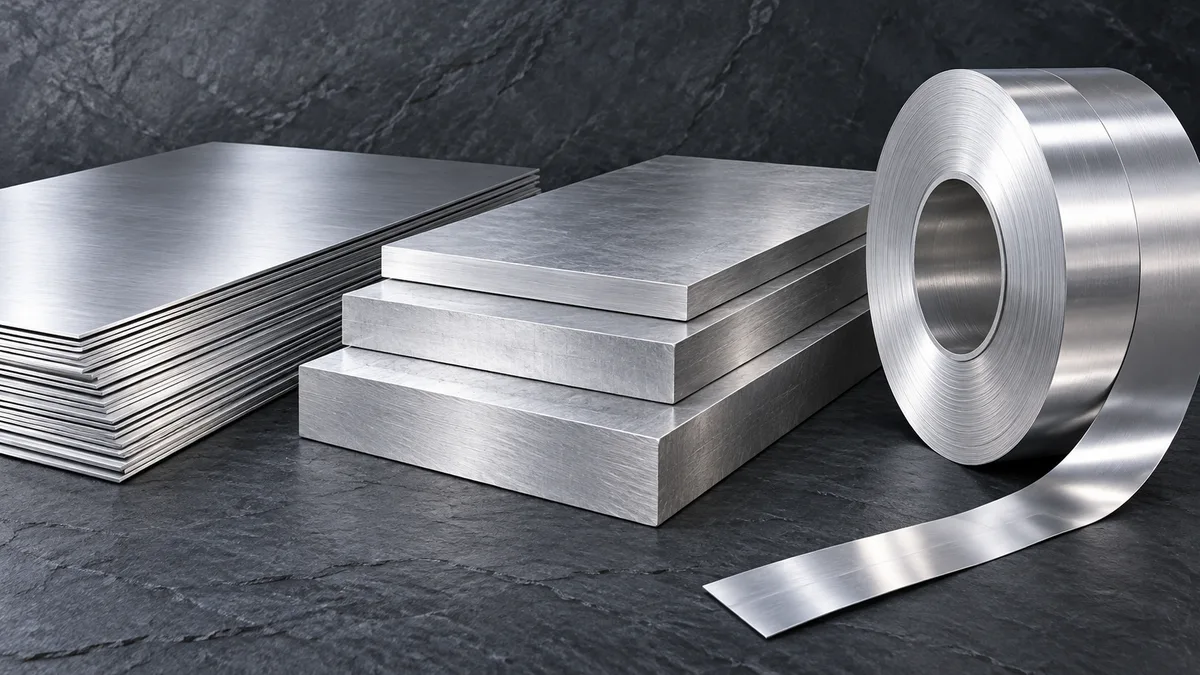
Metline supplies the aluminium strip, sheet, coil, discs and bar from which washers are stamped or turned, and can cut or machine washers and blanks to your drawing. Mill test certificates accompany every order.
Spreads load and protects the surface. Dimensions follow ISO 7089/7090, DIN 125 or ASME B18.22.1. Usually 3003, 5052 or 6061.
Soft annealed 1050 or 1100 ring that deforms under torque to seal oil, fuel, coolant and hydraulic ports and drain plugs. Common form: DIN 7603 form A. Replace after each use.
Provide preload against vibration and take up axial play. Aluminium has a low spring rate and relaxes, so these are used only for light duty; steel or stainless is normal for load-critical spring washers.
Teeth bite into the mating surface to resist rotation and can cut through oxide for electrical contact on aluminium busbars and earth points.
Seat countersunk screws flush or guide and locate a screw; used in enclosures, instruments and electronics.
Square, D-hole, tab, multi-hole and stepped designs stamped or laser-cut from strip or sheet to drawing, often anodised.
| Alloy and temper | Typical hardness (HB) | Typical tensile (MPa) | Best for |
|---|---|---|---|
| 1050-O / 1050-H14 | 21 / 34 | 76 / 110 | Sealing washers, electrical contact washers |
| 1100-O / 1100-H14 | 23 / 32 | 90 / 124 | Sealing and crush washers, spacers |
| 3003-H14 | 40 | 150 | General flat washers, outdoor and architectural fixings |
| 5052-H32 | 60 | 228 | Stronger flat washers, marine and vehicle use |
| 6061-T6 | 95 | 310 | Load-bearing washers, machined thick washers and spacers |
| 2024-T4 / T351 | 120 | 469 | Aerospace washers to AN/NAS/MS standards |
Typical values from Aluminum Association / ASM data. Hardness for sealing washers is often specified as a maximum, because softer washers seal better.
Two rules simplify selection. For sealing, pick the softest material that will not extrude out of the joint: annealed 1050 or 1100. For load spreading, the washer should be at least as hard as the surface under it and thick enough not to dish; for steel property-class 8.8 bolts and above, an aluminium washer is suitable only if the bearing stress stays within the aluminium’s compressive yield strength.
ISO 7089 (formerly DIN 125-A) is the most widely used metric flat washer standard. The nominal dimensions below are given for reference; aluminium washers are commonly made to these sizes, and tolerances follow the standard or the drawing.
| Bolt size | Inside diameter (mm) | Outside diameter (mm) | Thickness (mm) |
|---|---|---|---|
| M3 | 3.2 | 7 | 0.5 |
| M4 | 4.3 | 9 | 0.8 |
| M5 | 5.3 | 10 | 1.0 |
| M6 | 6.4 | 12 | 1.6 |
| M8 | 8.4 | 16 | 1.6 |
| M10 | 10.5 | 20 | 2.0 |
| M12 | 13 | 24 | 2.5 |
| M16 | 17 | 30 | 3.0 |
| M20 | 21 | 37 | 3.0 |
| M24 | 25 | 44 | 4.0 |
Sealing washers are sized by thread: for example 10 × 14 × 1 mm for M10 ports, 12 × 18 × 1.5 mm for M12 and 14 × 20 × 1.5 mm for M14 drain plugs, following DIN 7603 dimensions. Imperial plain washers follow ASME B18.22.1 (Type A and Type B series).
They are better where weight, corrosion resistance with aluminium parts, conductivity or sealing matter. Steel washers are better under high clamp loads and at high temperatures, because aluminium is softer and loses strength above about 150 °C.
It is not recommended. Annealed aluminium crush washers deform and work-harden when tightened, so a used washer will not seal as reliably. Fit a new one each time the joint is opened.
Soft, annealed commercially pure aluminium, usually 1050 (Al 99.5) or 1100 in O temper, because it flows under load to fill surface imperfections.
They do not rust. The natural oxide film protects them in most environments, and anodising adds protection. Galvanic corrosion can occur when aluminium touches stainless steel or copper in wet or salty conditions, so isolate dissimilar metals.
Indoors and in dry service, yes. Outdoors or in marine conditions, the aluminium washer can corrode sacrificially; use an insulating washer or sealant, or match fastener and washer materials.
Send alloy, temper, sizes and quantity. We will quote strip, sheet, discs or washers cut to your drawing, delivered worldwide.





