


7075 Aluminium Wire and Rod for Rivets and Fasteners
7075 rivet wire is precision-drawn 7075 aluminium supplied in coils or straight lengths for cold heading into high-strength solid rivets, pins, screws and special fasteners. It is normally bought in the soft O or lightly drawn H13 condition, headed, and then heat-treated to T73 for a strong fastener with good resistance to stress-corrosion cracking. This guide covers tempers, sizes, quality requirements and how 7075 compares with other rivet alloys.
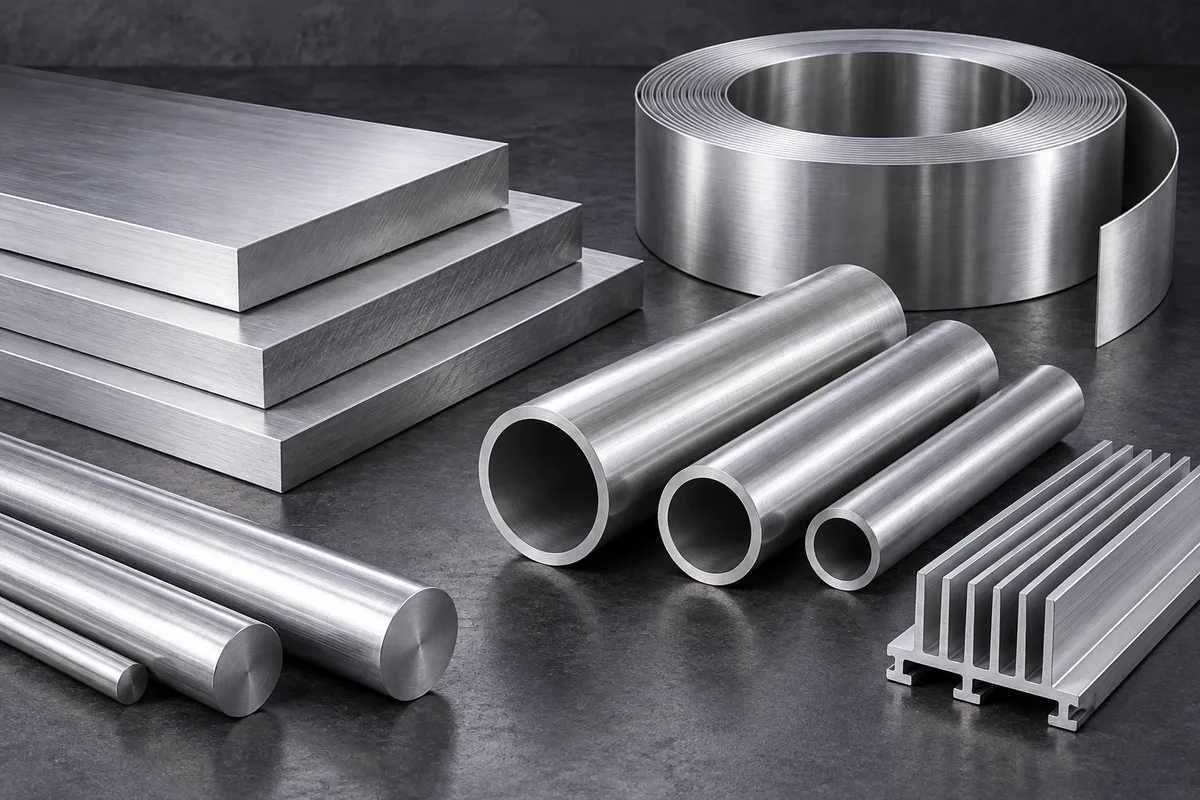
- Alloy
- 7075 (A97075)
- Supply tempers
- O, H13
- Fastener temper
- T73
- Diameter
- About 1.6 – 15 mm
What 7075 rivet wire is used for
Rivet and cold-heading wire is drawn wire made specifically to be cut into slugs and upset in a heading die. Compared with general-purpose wire, it has tighter diameter tolerances, cleaner surfaces and controlled mechanical properties so that heads form fully without cracking.
7075 is the strongest of the common aluminium rivet alloys after heat treatment. In the T73 over-aged temper it combines high shear strength with good resistance to stress-corrosion cracking, which matters because a driven rivet stays under residual stress for its whole life. T73 rivets can be driven as received, unlike 2024 "icebox" rivets, which must be kept refrigerated after solution treatment to stay soft enough to drive.
Today many aerospace programmes specify 7050-T73 for new solid-rivet designs, and 2117 or 2017 for general riveting, but 7075 remains in use for existing designs, for screws and pins machined or headed from wire, and for high-strength fasteners outside aerospace.
Supply tempers and the final fastener temper
| Temper | Condition | Role |
|---|---|---|
| O | Fully annealed, softest | Best headability for large or complex heads; parts are then solution treated and aged |
| H13 | Annealed and lightly drawn (about one-eighth hard) | Slightly firmer wire that feeds and cuts more cleanly in automatic headers |
| T73 | Solution treated and over-aged | Final condition of finished rivets and fasteners; high strength with stress-corrosion resistance |
| T6 | Solution treated and peak-aged | Higher strength than T73 but more prone to stress-corrosion; used for some pins and machined parts |
The usual route is: draw to size, anneal, head the parts in O or H13, solution treat at about 465 – 480 °C, quench, then apply the two-step T73 ageing cycle defined in AMS 2770 or the customer process. ASTM B316 qualifies the wire by testing samples that have been heat-treated in the same way, so the buyer knows the finished rivets will reach the required strength.
Typical properties of annealed 7075 are about 230 MPa tensile and 105 MPa yield. Required shear strength for finished rivets is set by the rivet specification and design allowables (for example MMPDS); refer to those documents rather than general data.
7075 composition (wt %)
Registered Aluminum Association limits, identical to EN 573-3 (EN AW-7075). The mill certificate reports the actual analysis of each lot.
| Element | Minimum | Maximum | Role in the alloy |
|---|---|---|---|
| Silicon (Si) | — | 0.40 | Impurity; kept low for toughness |
| Iron (Fe) | — | 0.50 | Impurity; forms coarse constituents that cut fatigue life |
| Copper (Cu) | 1.2 | 2.0 | Adds strength and improves stress-corrosion behaviour |
| Manganese (Mn) | — | 0.30 | Minor grain control |
| Magnesium (Mg) | 2.1 | 2.9 | Combines with Zn to form the MgZn2 strengthening phase |
| Chromium (Cr) | 0.18 | 0.28 | Controls recrystallisation and stress-corrosion cracking |
| Zinc (Zn) | 5.1 | 6.1 | Main alloying element |
| Titanium (Ti) | — | 0.20 | Grain refiner |
| Others, each / total | — | 0.05 / 0.15 | |
| Aluminium (Al) | Remainder | About 87 – 91 % |
Diameters, tolerances and coil sizes
Typical supply range
- Diameter
- About 1.6 – 15 mm; most rivet wire is 1.6 – 10 mm
- Tolerance
- Commonly ±0.02 mm on precision rivet wire, or the tolerance class of ASTM B316 / your specification
- Form
- Level-wound coils for automatic headers, or straight lengths
- Coil weight
- Matched to your header pay-off; coils above about 50 kg are common
- Surface
- Bright drawn, lightly lubricated
- Standard
- ASTM B316 / B316M, or national and aerospace rivet-wire specifications on request
Rivet makers often ask for a minus-only tolerance on small diameters so that slugs always enter the die, or a symmetric tolerance where consistent head volume matters more. State the tolerance on the order instead of relying on a supplier default.
| Surface condition | Typical requirement for rivet wire |
|---|---|
| Cracks, seams, laps, peeling, blisters | Not allowed |
| Metallic or non-metallic pick-up pressed into the surface | Not allowed |
| Corrosion spots | Not allowed |
| Light scratches, scuffs or dents | Allowed only if shallower than half the minus diameter tolerance |
| Light oil or drawing lubricant | Allowed; helps cold heading |
Cold heading and heat treatment tips
- Check headabilityRun an upset test on a sample (heading to a defined height-to-diameter ratio) before a production run. ASTM B316 includes a heading test for this purpose.
- Control lubricantLight, even lubricant on the wire reduces die wear and surface tearing on the head.
- Avoid ageing delaysHead O or H13 wire as supplied. If parts are solution treated before heading, they must be headed quickly or kept chilled, otherwise natural ageing hardens them.
- Heat treat in controlled furnacesSolution treat, quench with minimal delay and age to T73 under a recognised process such as AMS 2770. Check finished rivets for hardness or conductivity.
- Protect the surfaceFinished rivets are usually anodised or given a conversion coating, and may be supplied with a wet-installation sealant in aerospace use.
7075 compared with other rivet alloys
| Alloy and temper | Head marking (aerospace) | Relative strength | Driving condition | Notes |
|---|---|---|---|---|
| 1100-F | A, plain head | Lowest | As received | Non-structural, soft materials |
| 5056-H32 | B, raised cross | Low–medium | As received | For joining magnesium |
| 2117-T4 | AD, dimple | Medium | As received | Most common general aircraft rivet |
| 2017-T4 | D, raised dot | Medium–high | Freshly quenched or as received for small sizes | Being replaced by 2117 and 2024 |
| 2024-T4 | DD, raised dashes | High | Icebox: refrigerated after solution treatment | Handling overhead |
| 7050-T73 | E, raised ring | High | As received | Modern replacement for 2024 icebox rivets |
| 7075-T73 | Per specification | High | As received | Older designs, pins and special fasteners |
Use the rivet standard or the design allowables document for actual shear values; relative ratings here are for orientation only. For more alloys, see our 7000-series rivet wire, 7050 rivet wire and 2017 rivet wire guides.
Applications
- Aerospace: solid rivets and pins in existing airframe designs that call for 7075-T73
- Defence: high-strength fasteners for vehicles, shelters and munitions structures
- Motorsport and cycling: lightweight bolts, screws and pins machined or headed from 7075 wire
- Industrial: high-shear pins and special fasteners for aluminium structures where steel would add weight and galvanic risk
How to order
- SpecifyAlloy 7075, supply temper (O or H13), diameter and tolerance, coil or straight-length form, and governing standard.
- Test requirementsHeading test, heat-treated tensile or shear test on samples, and surface requirements.
- PackingCoils wrapped against moisture on pallets or in wooden cases for export.
- DocumentsEN 10204 3.1 certificate with chemistry and test results; shipped on EXW, FOB, CIF or DAP terms.
References and standards
- ASTM B316 / B316M – Aluminum and Aluminum-Alloy Rivet and Cold-Heading Wire and Rods
- SAE AMS 2770 – Heat Treatment of Wrought Aluminum Alloy Parts
- MMPDS – Metallic Materials Properties Development and Standardization (fastener allowables)
- The Aluminum Association – International Alloy Designations and Chemical Composition Limits
7075 rivet wire: frequently asked questions
In which temper is 7075 rivet wire supplied?
Usually O (annealed) or H13 (lightly drawn). The fastener maker heads the parts in this soft condition and then heat-treats them to T73.
Why are 7075 rivets heat-treated to T73 rather than T6?
T73 is over-aged. It gives up some strength compared with T6 but greatly improves resistance to stress-corrosion cracking, which is important because driven rivets carry residual stress for life.
Do 7075-T73 rivets need to be kept in a freezer?
No. Like 7050-T73 rivets, they are driven in the aged condition. Only rivets driven in the freshly quenched state, such as 2024 "icebox" rivets, need refrigeration.
What diameters of 7075 rivet wire are available?
From about 1.6 mm up to around 15 mm, with most rivet wire between 1.6 and 10 mm, supplied in coils for automatic headers or straight lengths.
Which standard covers 7075 rivet wire?
ASTM B316 / B316M is the general standard for aluminium rivet and cold-heading wire and rod. Aerospace customers may also cite their own or AMS specifications.
Making 7075 fasteners?
Send the diameter, temper, tolerance and specification. We will confirm availability, testing and a delivered price.





