T6
Peak strength for sheet and thinner plate used in controlled environments.



7A09, formerly LC9, is the GB-standard alloy that corresponds most closely to 7075: an Al-Zn-Mg-Cu alloy with high strength, good machinability and useful toughness. Metline supplies 7A09 sheet and plate in T6, T651 and over-aged tempers to GB/T 3880, certified and export-packed for customers worldwide.
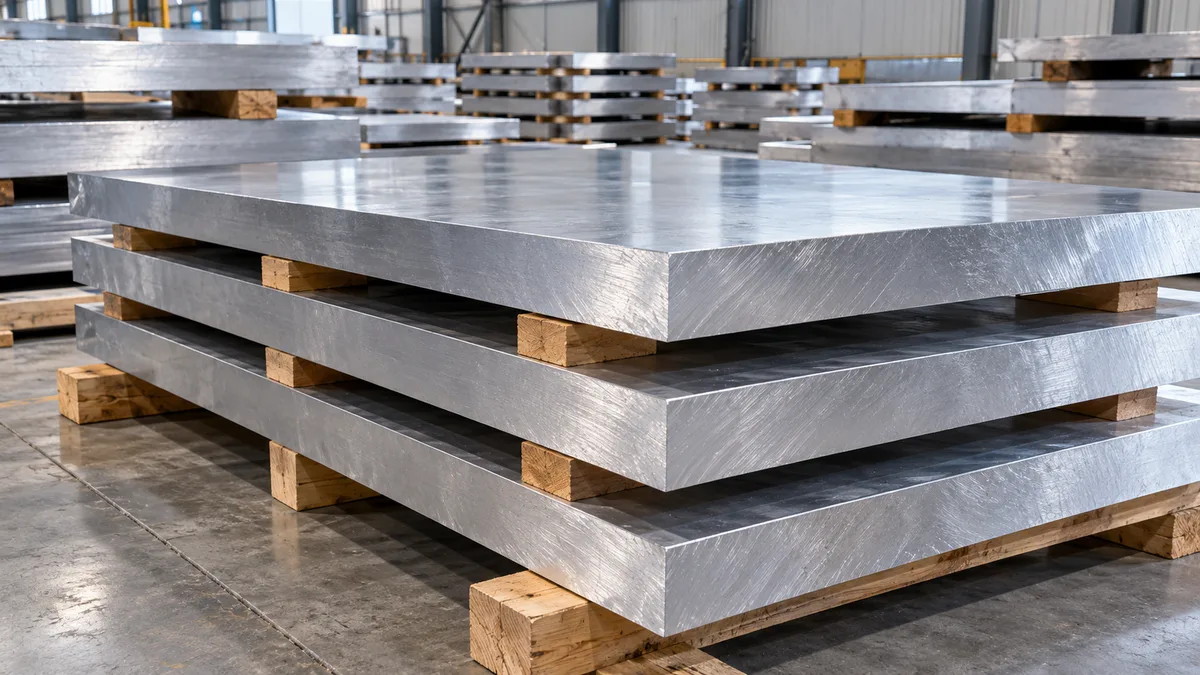
7A09 is a heat-treatable 7xxx alloy whose composition limits overlap almost entirely with 7075. It was introduced to give Chinese aerospace a grade with better toughness and stress-corrosion behaviour than the older 7A04.
Its strength comes from fine MgZn2 precipitates formed during ageing. In the peak-aged T6 condition it offers tensile strength above 500 MPa; in over-aged T73 and T74 conditions it gives up some strength for much better resistance to stress-corrosion cracking and exfoliation. The alloy keeps its strength well at low temperatures but should not be used for long periods above about 120 – 150 °C, where over-ageing reduces strength.
In practice 7A09 is specified on drawings from Chinese standards for aircraft frames, beams and fittings, and as a general high-strength sheet and plate for tooling and machined parts. On international projects, 7075 in the matching temper is the usual substitute.
| Element | 7A09 min | 7A09 max | 7075 range |
|---|---|---|---|
| Silicon (Si) | — | 0.50 | ≤ 0.40 |
| Iron (Fe) | — | 0.50 | ≤ 0.50 |
| Copper (Cu) | 1.2 | 2.0 | 1.2 – 2.0 |
| Manganese (Mn) | — | 0.15 | ≤ 0.30 |
| Magnesium (Mg) | 2.0 | 3.0 | 2.1 – 2.9 |
| Chromium (Cr) | 0.16 | 0.30 | 0.18 – 0.28 |
| Zinc (Zn) | 5.1 | 6.1 | 5.1 – 6.1 |
| Titanium (Ti) | — | 0.10 | ≤ 0.20 |
| Others, each / total | — | 0.05 / 0.10 | 0.05 / 0.15 |
| Aluminium (Al) | Remainder | Remainder |
7A09 limits per GB/T 3190; 7075 limits per the Aluminum Association registration.
Minimum properties for 7A09 sheet and plate are set in GB/T 3880.2 by temper and thickness. The figures below are representative of T6 sheet; over-aged tempers sit roughly 10 – 15 % lower in strength.
| Temper | Tensile strength | Yield strength (0.2 %) | Elongation |
|---|---|---|---|
| O (annealed) | ≤ about 245 MPa | — | ≥ about 10 % |
| T6 / T651, representative minimum | ≈ 490 – 530 MPa | ≈ 400 – 440 MPa | ≥ 6 % |
| T73 (over-aged) | Roughly 10 – 15 % lower than T6 | Lower than T6 | Similar to T6 |
Peak strength for sheet and thinner plate used in controlled environments.
T6 plus stretching to relieve quench stress; the standard choice for plate that will be machined.
Over-aged for stress-corrosion and exfoliation resistance in thick parts and outdoor service.
Annealed for forming; heat-treated to T6 afterwards.
| Thickness (mm) | kg per m² (approx.) | 1500 × 3000 mm (kg) |
|---|---|---|
| 1 | 2.8 | 13 |
| 2 | 5.6 | 25 |
| 3 | 8.5 | 38 |
| 5 | 14.1 | 63 |
| 10 | 28.2 | 127 |
| 20 | 56.4 | 254 |
| 40 | 112.8 | 508 |
| 60 | 169.2 | 761 |
| 100 | 282.0 | 1269 |
Very nearly. Zinc, copper and magnesium ranges match closely, so 7075 in the same temper is the usual international substitute. Check minor element limits if your specification is strict.
Not by fusion welding in structural applications; it cracks and loses strength. Use mechanical fastening or bonding.
The over-aged T73 temper, followed by T74. T6 and T651 are stronger but more susceptible.
LC9 is the old Chinese designation; GB/T 3190 now calls the alloy 7A09.
About 2.82 kg per m² per millimetre. A 1500 × 3000 × 10 mm plate weighs roughly 127 kg.
Send the temper, size, quantity and destination and we will quote with availability and documents.





