Machining
Machines well in T6 and T651, with short chips and a good finish. Use T651 for plate that will be pocketed heavily, so residual stress does not distort the part.



7A04, formerly designated LC4, is a high-strength Al-Zn-Mg-Cu alloy in the Chinese GB system, broadly comparable to 7075 but with a wider zinc range and a deliberate manganese addition. Metline supplies 7A04 sheet and plate in T6 and T651 tempers to GB/T 3880 for structural and aerospace-type parts, with mill certificates and export packing for customers worldwide.
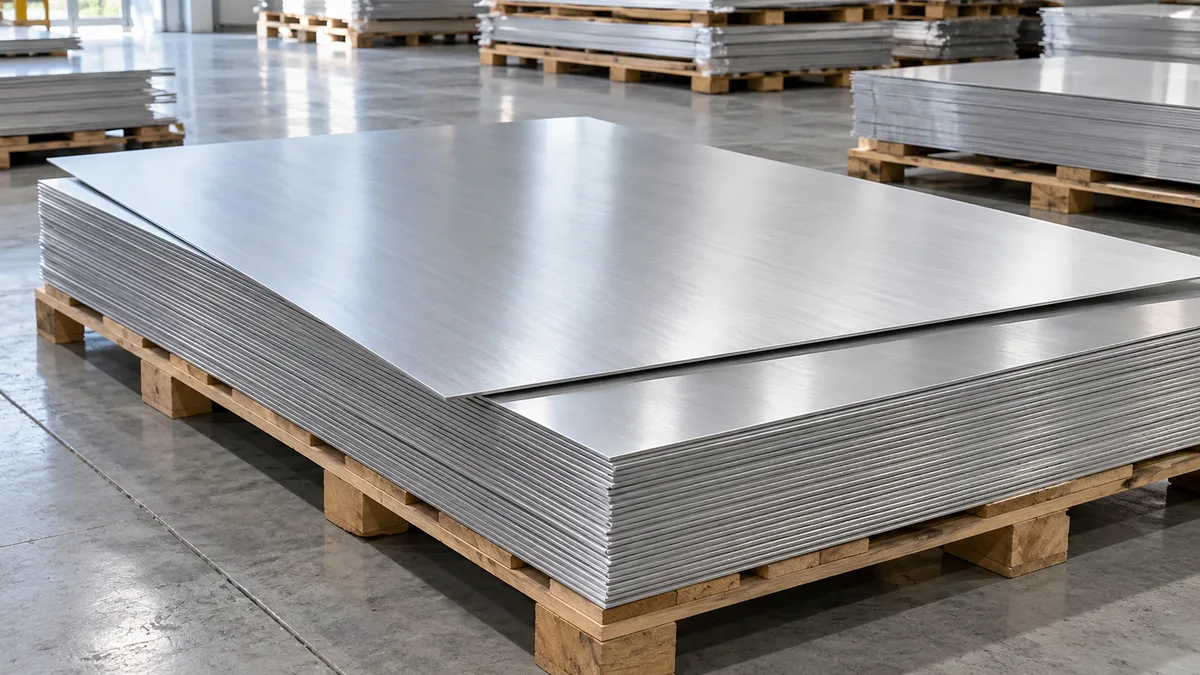
7A04 is one of the oldest high-strength aluminium alloys in the GB standard family. It gains strength from MgZn2 precipitates formed during artificial ageing, and in the T6 temper it reaches tensile strengths in the same region as 7075-T6.
Compared with 7075, 7A04 allows zinc from 5.0 % to 7.0 % and adds 0.20 – 0.6 % manganese alongside chromium. The manganese and chromium refine the grain structure, but the alloy is still sensitive to stress-corrosion cracking in the peak-aged T6 condition, and it has lower fracture toughness than modern high-purity grades such as 7475 or 7050. It is therefore used for parts that are loaded mainly in compression or in the rolling plane, or that are well protected by anodising and paint.
Buyers usually meet 7A04 on drawings that originate from Chinese aerospace or defence standards, or on general engineering drawings that need a strong, machinable 7xxx sheet. Where a drawing allows an international alternative, 7075-T6 or T651 is normally the direct substitute.
| Element | Min | Max |
|---|---|---|
| Silicon (Si) | — | 0.50 |
| Iron (Fe) | — | 0.50 |
| Copper (Cu) | 1.4 | 2.0 |
| Manganese (Mn) | 0.20 | 0.60 |
| Magnesium (Mg) | 1.8 | 2.8 |
| Chromium (Cr) | 0.10 | 0.25 |
| Zinc (Zn) | 5.0 | 7.0 |
| Titanium (Ti) | — | 0.10 |
| Others, each / total | — | 0.05 / 0.10 |
| Aluminium (Al) | Remainder |
Limits as registered in GB/T 3190. Each lot is supplied with a certificate reporting its actual analysis.
Specified minimums for 7A04 sheet and plate are set in GB/T 3880.2 and vary with thickness and with whether the sheet is bare or clad. For T6 sheet of moderate thickness, the figures below are representative. Thick plate has slightly lower minimums because the centre cools more slowly during quenching.
| Temper | Tensile strength | Yield strength (0.2 %) | Elongation |
|---|---|---|---|
| O (annealed) | ≤ about 245 MPa | — | ≥ about 10 % |
| T6 / T651 sheet and plate, representative minimum | ≈ 490 – 530 MPa | ≈ 400 – 440 MPa | ≥ 5 – 7 % |
Approximate weight is 2.85 kg per m² per millimetre of thickness:
| Thickness (mm) | kg per m² | 1500 × 3000 mm (kg) |
|---|---|---|
| 1 | 2.9 | 13 |
| 2 | 5.7 | 26 |
| 3 | 8.6 | 38 |
| 5 | 14.2 | 64 |
| 10 | 28.5 | 128 |
| 20 | 57.0 | 256 |
| 30 | 85.5 | 385 |
| 50 | 142.5 | 641 |
| 80 | 228.0 | 1026 |
| 100 | 285.0 | 1282 |
Machines well in T6 and T651, with short chips and a good finish. Use T651 for plate that will be pocketed heavily, so residual stress does not distort the part.
Spot and seam welding are workable, but fusion welding (gas, TIG, MIG) is not recommended: the alloy cracks and loses strength. Rivets and bolts are the normal joining method.
Stress-corrosion and exfoliation resistance in T6 are limited. Protect parts by anodising and priming, and avoid sustained tensile stress in the short-transverse direction.
Form in the O or freshly quenched condition and then age. T6 sheet tolerates only gentle bends.
| Property | 7A04 | 7A09 | 7075 |
|---|---|---|---|
| Zinc (%) | 5.0 – 7.0 | 5.1 – 6.1 | 5.1 – 6.1 |
| Manganese (%) | 0.20 – 0.60 | ≤ 0.15 | ≤ 0.30 |
| Peak strength | High | High | High |
| Stress-corrosion resistance (T6) | Low | Low to moderate; better in T73 | Low; good in T73 |
| Standard system | GB | GB | AA / ASTM / EN |
7A09 is the closer chemical match to 7075 and is now preferred for new designs in the GB system. Where an international equivalent is acceptable, 7075-T651 plate is easier to source globally.
There is no exact equivalent. 7075 is the closest in strength and use; 7A04 differs by its wider zinc range and higher manganese content.
Fusion welding is not recommended because of hot cracking and strength loss. Spot and seam resistance welding are possible; most structures are riveted or bolted.
Not in the T6 temper. Protect it with anodising and paint and avoid sustained short-transverse tensile stress, or choose an over-aged grade such as 7075-T7351.
LC4 is the older Chinese designation for this alloy. GB/T 3190 renamed it 7A04 to fit the four-digit international system.
About 2.85 kg per m² per millimetre. A 1500 × 3000 × 10 mm plate weighs roughly 128 kg.
Send the temper, size, quantity and destination, and we will reply with availability and a delivered quotation.





