Macro-etch and flow lines
Sectioned forgings are etched to confirm grain flow follows the part contour, with no laps, folds or flow-through defects.



6A10 is a GB/T 3190 forging alloy that adds copper, manganese, chromium and zirconium to a 6082-type Al-Mg-Si base. In T6 it reaches minimum tensile strength of about 380 MPa along the grain flow, roughly 20 % above 6082 forgings, which lets designers replace steel control arms and knuckles with lighter aluminium parts. Metline supplies 6A10-T6 die forgings, forging stock and machined components worldwide.
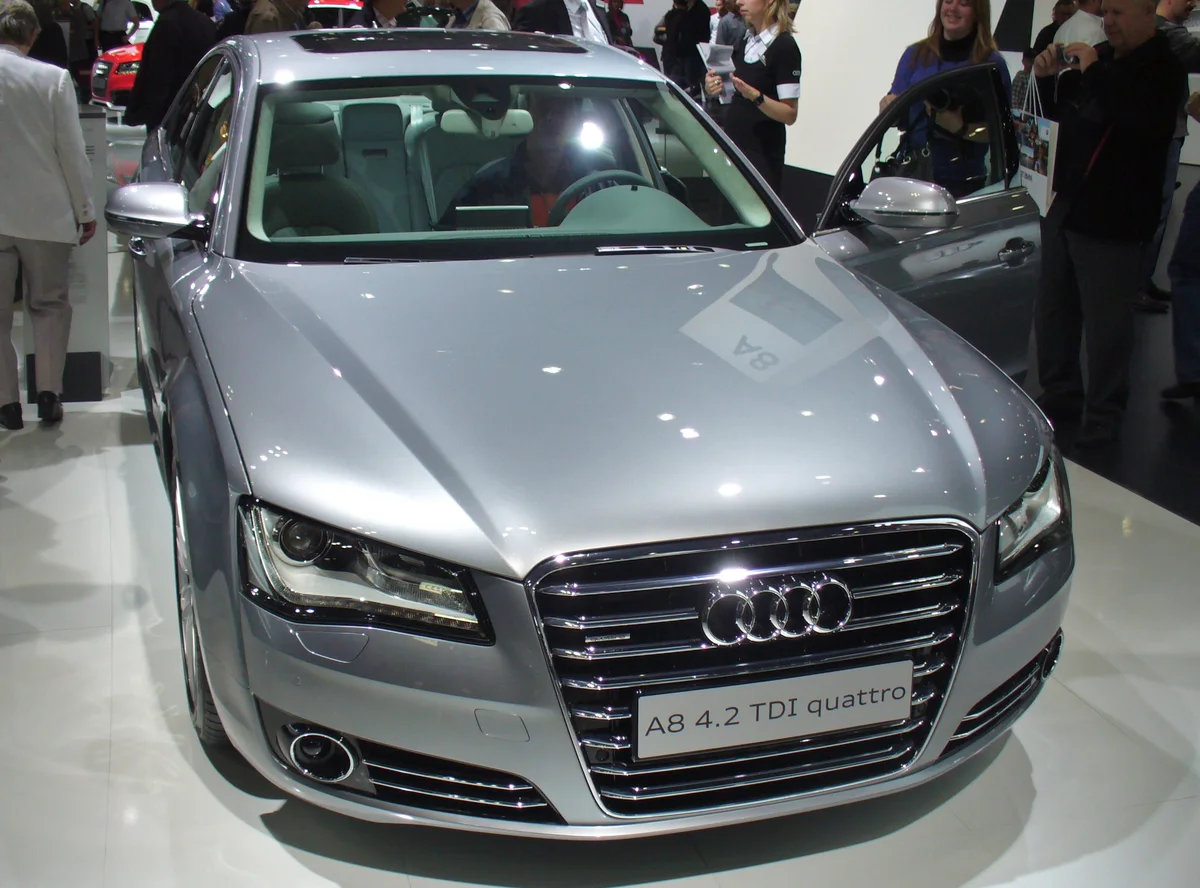
Unsprung chassis parts are where lightweighting pays most: every kilogram removed from a control arm or knuckle improves ride, handling and efficiency more than the same saving in the body. Forged 6082-T6 has been the standard aluminium choice for decades, but its strength limits how far section sizes can be reduced. 6A10 was developed to push that limit while keeping the forgeability, toughness and corrosion behaviour of 6xxx alloys.
Compared with 6082, 6A10 adds 0.30 – 0.80 % copper for extra precipitation strengthening and a small zirconium addition that, together with manganese and chromium, forms fine dispersoids. These pin grain boundaries during forging and solution treatment, so the part keeps a fine, fibrous grain structure that follows the forging flow lines. The result is higher strength, better fatigue performance and lower risk of coarse surface grains.
In Chinese passenger-car standards for aluminium control-arm forgings (GB/T 33823), 6xxx alloys of this kind are specified alongside 6082 and 6061. Internationally, similar copper-bearing high-strength forging alloys are used by suspension makers under OEM specifications.
Limits as listed for 6A10 in GB/T 3190. Confirm against the edition on your drawing; the lot certificate reports the actual analysis.
| Element | Minimum | Maximum |
|---|---|---|
| Silicon (Si) | 0.70 | 1.10 |
| Iron (Fe) | — | 0.50 |
| Copper (Cu) | 0.30 | 0.80 |
| Manganese (Mn) | 0.30 | 0.90 |
| Magnesium (Mg) | 0.70 | 1.10 |
| Chromium (Cr) | 0.05 | 0.25 |
| Zinc (Zn) | — | 0.20 |
| Titanium (Ti) | 0.02 | 0.10 |
| Zirconium (Zr) | 0.04 | 0.20 |
| Others, each / total | — | 0.05 / 0.15 |
| Aluminium (Al) | Remainder |
Values are minimums for die forgings up to 100 mm thick, tested along (L) and across (non-L) the grain flow. Forging drawings mark which zones are tested in which direction.
| Direction | Tensile strength Rm (min.) | Proof strength Rp0.2 (min.) | Elongation A (min.) | Hardness (min.) |
|---|---|---|---|---|
| Along grain flow | 380 MPa | 350 MPa | 10 % | 105 HBW |
| Across grain flow | 370 MPa | 330 MPa | 8 % | — |
| Alloy-temper (die forging) | Typical minimum Rm | Typical minimum Rp0.2 |
|---|---|---|
| 6061-T6 | about 260 – 290 MPa | about 240 MPa |
| 6082-T6 | about 310 MPa | about 260 MPa |
| 6A10-T6 | 380 MPa | 350 MPa |
Comparison figures for 6061 and 6082 are indicative; exact minimums depend on the standard and section thickness.
Control arms and knuckles are safety parts, so inspection goes well beyond a tensile test. A typical control plan includes:
Sectioned forgings are etched to confirm grain flow follows the part contour, with no laps, folds or flow-through defects.
Macro and fracture tests check for oxide films, with limits on the size and total area of any indications per inspected area.
The depth of any coarse recrystallised surface layer is measured; dispersoid-forming alloys like 6A10 help keep it shallow.
Forging stock and finished parts can be ultrasonically tested to detect internal defects.
Machined interfaces such as ball-joint bores and bushing seats are measured on CMM.
Component fatigue tests are run by the part owner to approve the design, alloy and process route.
Pistons, connecting rods and brake discs are not 6A10 applications: pistons use high-silicon casting or forging alloys, and brake discs are cast iron or composites.
6A10 adds 0.30 – 0.80 % copper and 0.04 – 0.20 % zirconium to a 6082-like base. That raises T6 minimum strength to about 380 / 350 MPa and keeps a finer grain structure.
Mainly suspension control arms, knuckles, links and other chassis forgings where high strength and low weight matter.
Forging aligns the grain structure with the metal flow. Strength and ductility are highest along the flow, so critical stress paths are designed to follow it.
Its copper content makes it slightly less resistant than copper-free 6082, but with shot blasting and a coating or e-coat it performs well under the vehicle.
Yes: extruded or cast forging stock, die forgings and machined parts, shipped worldwide with 3.1 certificates.
Send the part drawing, volume and inspection plan. We will reply with feasibility, certification and delivered pricing.






