Bending
Bend in T4; the high-silicon chemistry ages fast, so form promptly after delivery.



6016 is the main European outer-panel alloy: high in silicon, low in magnesium and copper, with a strong paint-bake response. Extruded in the same chemistry, it gives trim and reinforcement profiles that match 6016 panels for joining, finishing and recycling. Metline supplies 6016 profiles in T4, T5 and T6 to drawing, with mill certificates, worldwide.
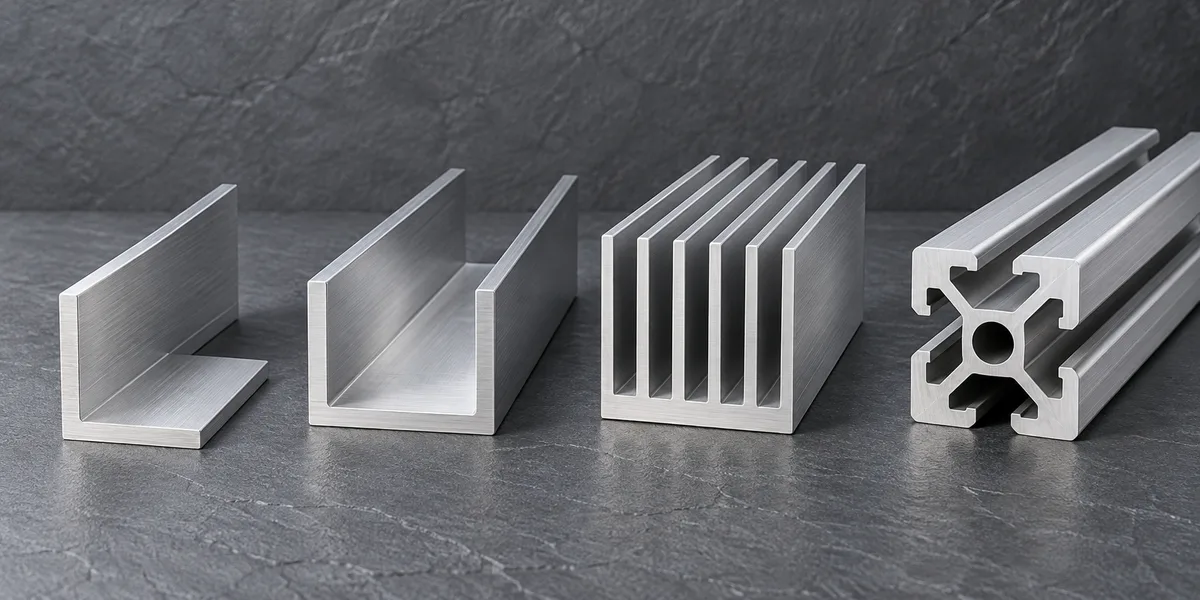
6016 is a silicon-rich 6xxx alloy: it contains more silicon than magnesium, the opposite of 6063 or 6061. The excess silicon makes the alloy respond quickly to short ageing cycles, which is why it hardens well in the automotive paint oven. Most 6016 is rolled into body sheet, but the alloy also extrudes and is used for profiles that sit alongside 6016 panels.
Matching profile and sheet alloys simplifies life in three ways. Weld and bonding procedures are qualified once. Both parts gain strength together in the paint bake. And press-shop and end-of-life scrap stays within one alloy family, which supports closed-loop recycling targets that many vehicle makers now set.
Some suppliers publish 6016 extrusion data with silicon of 0.4 – 0.9 % and magnesium of 0.6 – 1.2 %. That chemistry is closer to 6061 or 6063 and is not 6016. If a drawing calls for 6016, it should be supplied to the registered limits shown below.
Registered limits per EN 573-3 (EN AW-6016) and the Aluminum Association.
| Element | Minimum | Maximum |
|---|---|---|
| Silicon (Si) | 1.0 | 1.5 |
| Magnesium (Mg) | 0.25 | 0.6 |
| Iron (Fe) | — | 0.50 |
| Copper (Cu) | — | 0.20 |
| Manganese (Mn) | — | 0.20 |
| Chromium (Cr) | — | 0.10 |
| Zinc (Zn) | — | 0.20 |
| Titanium (Ti) | — | 0.15 |
| Others, each / total | — | 0.05 / 0.15 |
| Aluminium (Al) | Remainder |
EN 485-2 gives property limits for 6016 sheet; extruded profiles are normally ordered to the same targets or to the OEM specification. Use the sheet values below as a guide, then fix profile minimums on the drawing.
| Temper | Tensile Rm | Proof Rp0.2 | Elongation |
|---|---|---|---|
| T4 (EN 485-2, sheet) | 170 – 250 MPa | 80 – 140 MPa | 24 % min |
| T6 (EN 485-2, sheet) | 260 MPa min | 180 MPa min | 10 % min |
| T4 + paint bake (typical) | about 240 – 270 MPa | about 180 – 220 MPa | about 15 – 20 % |
The achievable section depends on the die and the alloy's extrudability; send a drawing so we can confirm wall, tolerance and length.
| Profile | Outer size guide (mm) | Wall guide (mm) |
|---|---|---|
| Square tube | about 10 × 10 to 150 × 150 | about 0.7 – 12 |
| Round tube | about 10 – 200 OD | about 0.7 – 12 |
| Rectangular tube | about 10 × 20 to 200 × 300 | about 0.7 – 12 |
| T and U profiles | about 10 – 40 mm series and custom | to drawing |
Bend in T4; the high-silicon chemistry ages fast, so form promptly after delivery.
T5 press-quench plus ageing suits thin walls. Paint baking adds strength to T4 parts in the body.
MIG with ER4043 or ER4047 filler matches the silicon-rich base well; laser welding is also used.
E-coats and paints well; anodising gives a slightly grey tone because of the high silicon.
Good in T5/T6; silicon helps chip breaking.
Low copper gives good corrosion resistance under paint.
| Property | 6016 | 6014 | 6063 | 6082 |
|---|---|---|---|---|
| Si / Mg balance | Si-rich | Balanced, lean | Mg-rich | Si-rich, higher Mg |
| Paint-bake response | Very good | Good | Slow | Moderate |
| Extrudability | Good | Very good | Excellent | Fair |
| Peak strength | Medium–high | Medium | Medium | High |
| Usual form | Sheet, some profiles | Sheet, some profiles | Profiles | Profiles, bar |
Choose 6016 profiles to match 6016 panels. For general profiles without that need, 6063 (formable) or 6082 (strong) are easier to source.
Silicon 1.0 – 1.5 %, magnesium 0.25 – 0.6 %, copper 0.20 % max, iron 0.50 % max. Tables showing 0.4 – 0.9 % Si and 0.6 – 1.2 % Mg describe a different alloy.
To match 6016 body panels for joining, paint-bake response and recycling. If matching is not needed, 6063 is easier to source.
Yes. T4 profiles gain significant yield strength in a standard paint-bake cycle, like 6016 sheet.
T4 for forming, T5 for press-quenched thin sections, and T6 for full strength.
Yes, but the high silicon gives a slightly grey tone. Painting or e-coating is the usual finish.
Send the drawing, temper and volume. Our team will reply with feasibility and a delivered price.





