O
Annealed. The most ductile condition, for preforms that are formed or wrapped around tubes.



4047 sheet, strip and foil are used in aerospace as brazing filler: cut into shims and preforms placed in heat-exchanger and duct joints, or roll-bonded as cladding on a 3xxx core. With 11 – 13 % silicon it melts at about 577 – 582 °C, well below the parts it joins. Metline supplies 4047 sheet and foil to AMS 4185 or your specification, worldwide.
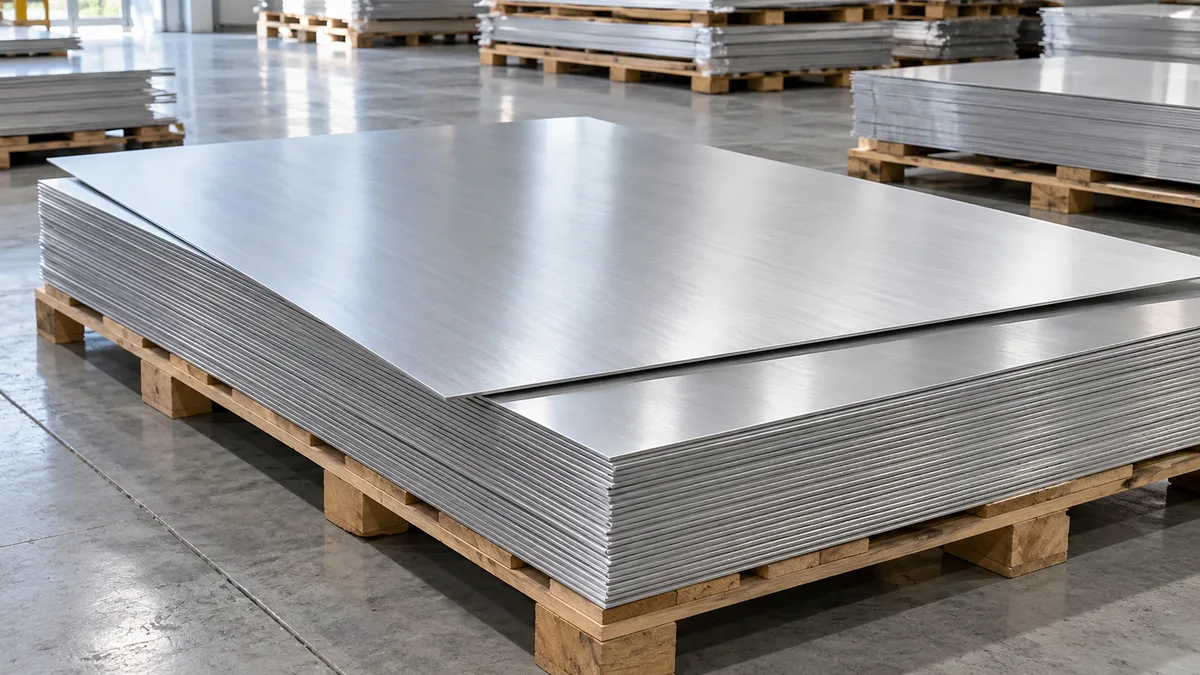
4047 is the near-eutectic Al-Si alloy. It is chosen not for its room-temperature strength but because it melts sharply, flows freely and wets aluminium surfaces when the assembly is heated to about 590 – 600 °C.
In aerospace manufacturing, thin 4047 sheet and foil are punched or cut into shims, washers and preforms that sit between the parts of a heat exchanger, cold plate or duct manifold before furnace or dip brazing. Strip is also roll-bonded onto a 3003 or 3103 core to make clad brazing sheet. Thicker sheet is occasionally machined into special preforms.
As a structural sheet 4047 has no place in an aircraft: it is not heat-treatable, its strength is modest and the high silicon makes it brittle in thick sections and abrasive to machine. Statements that 4047 sheet is used for wings, fuselages or tails are incorrect.
| Element | Limit |
|---|---|
| Silicon (Si) | 11.0 – 13.0 |
| Iron (Fe) | 0.8 max |
| Copper (Cu) | 0.30 max |
| Manganese (Mn) | 0.15 max |
| Magnesium (Mg) | 0.10 max |
| Zinc (Zn) | 0.20 max |
| Beryllium (Be) | 0.0003 max (welding grades) |
| Others, each / total | 0.05 / 0.15 |
| Aluminium (Al) | Remainder |
Iron, copper and zinc are kept low so the filler flows cleanly and does not leave brittle phases in the joint. Magnesium is limited to 0.10 % for flux brazing; vacuum-brazing alloys add magnesium deliberately and are a different product.
Annealed. The most ductile condition, for preforms that are formed or wrapped around tubes.
Cold-rolled for flat, stiff shims that punch cleanly and keep their shape in fixtures.
As fabricated, mainly for thicker sheet and plate to be machined.
We do not quote tensile figures for 4047 sheet. They are not a design value for brazing filler, and some older tables for this product put elongation and shear values in the wrong rows.
| Document | Covers |
|---|---|
| SAE AMS 4185 | 12Si aluminium brazing filler in wire, sheet, foil and other forms |
| AWS A5.8 | BAlSi-4 brazing filler classification |
| EN 573-3 | EN AW-4047A (AlSi12(A)) chemical composition |
| Customer specification | Programme-specific thickness, flatness and cleanliness requirements |
Exact thickness and width tolerances are agreed with the order; brazing foil normally needs tighter thickness control than general sheet.
No. It is a brazing filler material. Its value is its low, narrow melting range, not its strength.
O, H14, H18 and F / H112. It is not heat-treatable, so T tempers do not apply.
Standard 4047 is for flux and controlled-atmosphere brazing. Vacuum brazing uses Al-Si fillers with added magnesium.
About 582 – 604 °C, which is why the base metal must have a solidus well above that range.
Yes. Metline supplies 4047 sheet, strip, foil and preforms from Mumbai worldwide.
Send thickness, width, form and quantity. We will confirm availability and certification.





