Machining
Machines to a good finish with short chips, but the silicon particles wear tools quickly. Use carbide or PCD tooling, rigid set-ups and flood coolant.



4032 is a wrought aluminium alloy with about 12 % silicon plus copper, magnesium and nickel. It has the lowest thermal expansion and some of the best wear resistance of any wrought aluminium, which is why it is machined into pistons, bushes, valve parts and swashplates. Metline supplies 4032 bar to AMS 4318 (T86) and AMS 4319 (T651), worldwide.
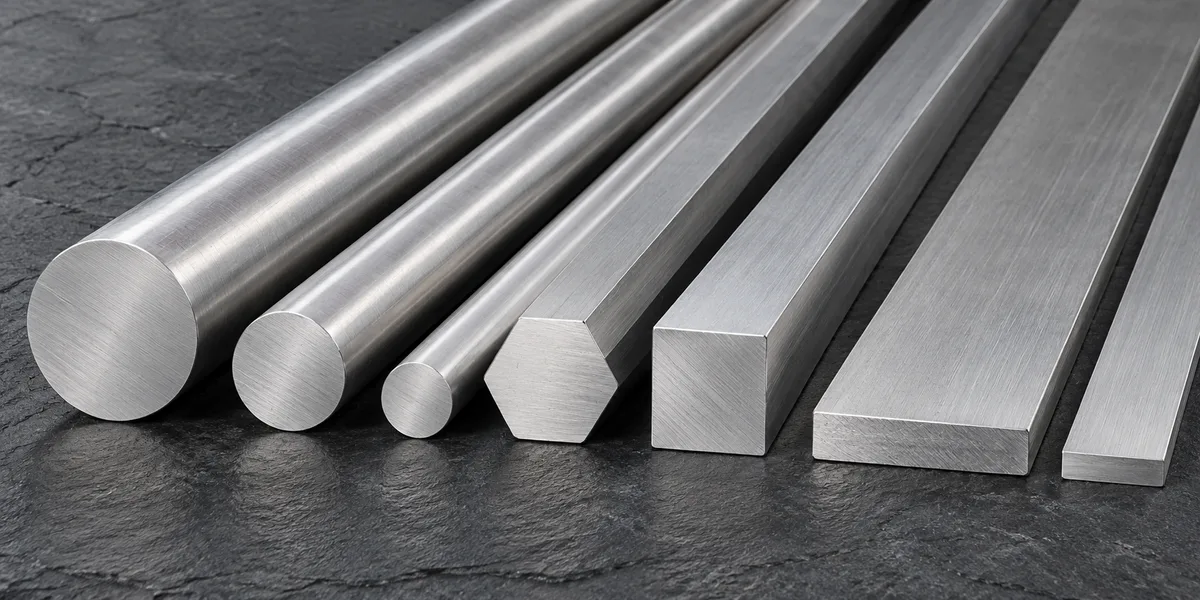
Most aluminium alloys expand about twice as much as steel when heated. 4032's high silicon content cuts that expansion noticeably, adds hard silicon particles that resist wear, and keeps useful strength at moderately raised temperatures.
Those three properties make 4032 the classic wrought piston alloy. A piston that expands less can run with tighter clearances in its bore, so it is quieter, seals better and wears less. The same logic applies to hydraulic and pneumatic parts, compressor components, bearing cages and bushes that run against steel or cast iron and see temperature changes.
In aerospace, 4032 bar is used for piston-engine pistons in general aviation, hydraulic pump pistons and swashplates, actuator and valve components, compressor parts and wear sleeves. It is not a structural airframe alloy, and claims that 4032 bar is used for wings, fuselages or turbine parts are not correct.
| Element | Minimum | Maximum | Role |
|---|---|---|---|
| Silicon (Si) | 11.0 | 13.5 | Low thermal expansion, wear resistance |
| Copper (Cu) | 0.50 | 1.3 | Strength and elevated-temperature strength |
| Magnesium (Mg) | 0.8 | 1.3 | Age hardening with Si |
| Nickel (Ni) | 0.50 | 1.3 | Strength retention at temperature |
| Iron (Fe) | — | 1.0 | Impurity |
| Chromium (Cr) | — | 0.10 | |
| Zinc (Zn) | — | 0.25 | Impurity |
| Others, each / total | — | 0.05 / 0.15 | |
| Aluminium (Al) | Remainder | About 82 – 87 % |
Registered Aluminum Association limits. Some older listings omit nickel and give the wrong copper and magnesium ranges; nickel is an essential part of 4032.
Typical values for T6-condition material are below. T86 bar is solution treated, cold worked and artificially aged, and T651 bar is stress-relieved by stretching before ageing; both reach similar strength. Specified minimums depend on diameter and are set by AMS 4318 and AMS 4319.
| Property | Typical value (T6) |
|---|---|
| Tensile strength | about 380 MPa (55 ksi) |
| Yield strength (0.2 %) | about 315 MPa (46 ksi) |
| Elongation | about 9 % |
| Shear strength | about 260 MPa |
| Fatigue strength (5 × 10⁸ cycles) | about 110 MPa |
| Temper | Process | Specification | Size range |
|---|---|---|---|
| T86 | Solution treated, cold worked about 6 %, artificially aged | AMS 4318 (rolled or cold-finished bar and rod) | 9.52 – 22.20 mm (0.375 – 0.874 in) |
| T651 | Solution treated, stretched to relieve stress, artificially aged | AMS 4319 | 19.05 – 88.90 mm (0.750 – 3.500 in) |
| T6 | Solution treated and artificially aged | Forgings: ASTM B247; bar to customer specification | Larger bar and forging stock |
The T651 temper matters for machined parts: stress relief keeps bar straight and dimensionally stable as material is removed. T86 gives slightly higher strength in small diameters through the cold-work step. 4032 is also registered as EN AW-4032 (AlSi12.5MgCuNi) and JIS A4032; 4A11 is the close GB counterpart.
Weight of round bar: kg per metre = 0.002105 × d² (d in mm), using 2.68 g/cm³. A 50 mm bar weighs about 5.3 kg/m.
Machines to a good finish with short chips, but the silicon particles wear tools quickly. Use carbide or PCD tooling, rigid set-ups and flood coolant.
Hard anodising is possible but the film is grey and less uniform than on low-silicon alloys; test before committing to a finish.
Not normally welded in service parts; the high silicon and heat-treated condition make fusion welding unattractive.
Specify T651 for close-tolerance parts and rough-machine before final finishing for best stability.
| Property | 4032-T6 | 2618-T61 | 2024-T351 |
|---|---|---|---|
| Typical tensile | 380 MPa | 440 MPa | 470 MPa |
| Thermal expansion | ≈ 19.4 µm/m·°C | ≈ 22 µm/m·°C | ≈ 23 µm/m·°C |
| Wear resistance | Very good | Fair | Fair |
| Ductility / toughness | Lower | Good | Good |
| Typical use | Pistons, bushes, valve parts | High-load pistons, hot parts | Structural fittings |
4032 and 2618 are the two forged-piston alloys. 4032 runs quieter with tighter clearances; 2618 is more ductile and tolerates higher loads and detonation. Choose by the duty cycle.
Pistons, hydraulic and pneumatic components, swashplates, bushes and other wear parts where low thermal expansion and wear resistance matter.
T86 includes a cold-work step before ageing and is covered by AMS 4318 for small diameters; T651 is stretched for stress relief and covered by AMS 4319 for larger diameters. Strength is similar; T651 is more stable when machined.
Nickel, with copper, helps 4032 keep strength at the moderately raised temperatures pistons run at.
It gives a good finish and short chips, but its silicon is abrasive. Carbide or PCD tools are recommended.
Yes. Metline supplies 4032 bar from Mumbai to customers worldwide with mill certificates.
Send diameter, temper, length and quantity. We will confirm availability and certification.





