Machining
Machines well with carbide tools and high spindle speeds. Stretched tempers limit distortion; still, balance stock removal on both legs to keep the angle straight.



7050 aluminium angle is an extruded L-section in the high-strength Al-Zn-Cu-Mg-Zr alloy developed for thick, stress-critical aircraft parts. Supplied in over-aged, stretched tempers such as T73511, T74511 and T76511, it combines strength close to 7075-T6 with much better resistance to stress-corrosion cracking and exfoliation. This guide covers its chemistry, properties, standards, sizes and how it compares with 7075 angle.
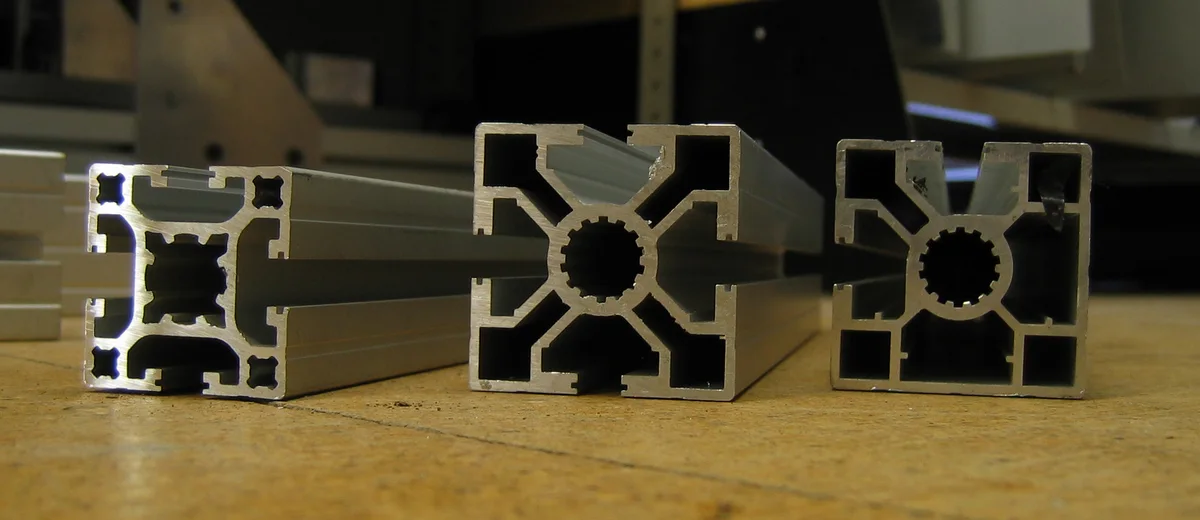
An angle is the simplest structural extrusion: two legs at 90°, either equal or unequal, with a defined wall thickness and root radius. In aircraft structures, 7050 angle is used for stringers, frame chords, clips, longeron details and fittings that are machined from the extrusion.
7050 was introduced in the 1970s to solve problems with 7075. In thick sections, 7075-T6 is vulnerable to stress-corrosion cracking in the short-transverse direction, and over-ageing 7075 to T73 to cure this costs a lot of strength. 7050 raises copper and zinc, keeps iron and silicon very low and uses zirconium instead of chromium for grain control. Zirconium makes the alloy far less quench sensitive, so a thick extrusion develops nearly the same strength at its centre as at its surface.
The practical outcome is an angle that can be ordered in over-aged tempers and still deliver strength close to 7075-T6, while offering much better stress-corrosion, exfoliation and fatigue performance. That is why 7050 is the default 7xxx extrusion alloy on many modern airframes.
| Element | Minimum | Maximum | Role |
|---|---|---|---|
| Zinc (Zn) | 5.7 | 6.7 | Main strengthening element (MgZn2 precipitates) |
| Copper (Cu) | 2.0 | 2.6 | Adds strength and improves SCC behaviour in over-aged tempers |
| Magnesium (Mg) | 1.9 | 2.6 | Combines with Zn for precipitation hardening |
| Zirconium (Zr) | 0.08 | 0.15 | Grain control with low quench sensitivity |
| Silicon (Si) | — | 0.12 | Kept very low for toughness |
| Iron (Fe) | — | 0.15 | Kept very low for toughness and fatigue |
| Manganese (Mn) | — | 0.10 | |
| Chromium (Cr) | — | 0.04 | Deliberately low |
| Titanium (Ti) | — | 0.06 | Grain refiner |
| Others each / total | — | 0.05 / 0.15 | |
| Aluminium | Remainder |
Over-aged 7050 tempers form a ladder: T73 has the best stress-corrosion resistance and the lowest strength, T76 has the highest strength and moderate SCC resistance, and T74 sits between. The "511" suffix means the extrusion was stretched to relieve stress and may be straightened afterwards.
| Temper | Tensile strength (typical) | Yield strength (typical) | Elongation | Main reason to choose |
|---|---|---|---|---|
| T73511 | About 500 MPa | About 435 – 440 MPa | About 12 % | Maximum stress-corrosion resistance |
| T74511 | Between T73511 and T76511 | Between T73511 and T76511 | See certificate | Balanced strength and SCC resistance |
| T76511 | About 550 MPa | About 490 MPa | About 11 % | Highest strength, good exfoliation resistance |
Typical values from published data. Guaranteed minimums depend on section thickness and are set by the order specification (for example AMS 4341 for T73511); design values come from MMPDS. The old T736 temper designation is now T74.
Electrical conductivity is more than a curiosity: aerospace specifications use eddy-current conductivity readings together with hardness to confirm that an over-aged temper has actually been reached. Expect conductivity checks in the inspection plan for T73 and T74 material.
| System | Designation / document | Covers |
|---|---|---|
| Aluminum Association | 7050 | Alloy registration |
| UNS | A97050 | Unified numbering |
| SAE AMS | AMS 4341 | 7050-T73511 extruded bars, rods, profiles and tubing |
| SAE AMS | AMS 4340 | 7050-T76511 extrusions |
| SAE AMS | Other AMS sheets | T74511 extrusions and specific product forms; confirm the sheet called up on your drawing |
| ASTM | ASTM B221 | Commercial extruded bars, rods, wire, profiles and tubes |
| EN | EN AW-7050 (AlZn6CuMgZr), EN 755 | European extrusions; aerospace EN 2xxx/3xxx series for specific tempers |
| Allowables | MMPDS | Design values for aircraft structures |
Commercial and aerospace angle can look identical but are not interchangeable. Aerospace material is produced, inspected and certified to the AMS sheet, often with ultrasonic inspection, conductivity checks and lot traceability back to the cast. If the drawing calls up AMS 4341, certification to ASTM B221 alone is not acceptable.
7050 angle is most often specified in inch sizes, reflecting its aerospace roots. Equal angles from about 1/2 × 1/2 in to 8 × 8 in and unequal angles up to about 8 × 6 in are common, with walls from 1/16 in to 1 in. Metric angles and special sections with radiused or sharp corners can be extruded to drawing. Standard lengths are typically 3 – 6 m (about 10 – 20 ft), or cut to length.
| Size A × B × t (in) | kg per metre | lb per foot |
|---|---|---|
| 1 × 1 × 1/8 | 0.43 | 0.29 |
| 1 × 1 × 1/4 | 0.80 | 0.54 |
| 1-1/2 × 1-1/2 × 1/8 | 0.66 | 0.44 |
| 1-1/2 × 1-1/2 × 1/4 | 1.26 | 0.84 |
| 2 × 1-1/2 × 1/4 | 1.48 | 0.99 |
| 2 × 2 × 1/4 | 1.71 | 1.15 |
| 2 × 2 × 3/8 | 2.48 | 1.66 |
| 2-1/2 × 2-1/2 × 1/4 | 2.17 | 1.45 |
| 3 × 2 × 1/4 | 2.17 | 1.45 |
| 3 × 3 × 1/4 | 2.62 | 1.76 |
| 3 × 3 × 1/2 | 5.02 | 3.37 |
| 4 × 3 × 3/8 | 4.54 | 3.04 |
| 4 × 4 × 1/2 | 6.85 | 4.59 |
| 5 × 5 × 1/2 | 8.67 | 5.81 |
| 6 × 4 × 1/2 | 8.67 | 5.81 |
| 6 × 6 × 3/4 | 15.41 | 10.33 |
| 8 × 8 × 1 | 27.39 | 18.36 |
Weights calculated from the nominal section (t × (A + B − t)) at 2.83 g/cm³, ignoring root and toe radii; actual weights differ slightly.
| Factor | 7050-T7x511 | 7075-T6511 | 7075-T73511 |
|---|---|---|---|
| Typical tensile strength | About 495 – 550 MPa | About 570 MPa | About 505 MPa |
| Stress-corrosion resistance | Very good (T73) to good (T76) | Low in short-transverse direction | Very good |
| Quench sensitivity / thick sections | Low; good through-thickness properties | Higher; properties drop in thick sections | Higher |
| Fracture toughness and fatigue | Better | Lower | Moderate |
| Availability and cost | Mainly aerospace channels; higher cost | Very widely available | Widely available |
Choose 7050 for heavy-wall angle, primary structure and any part where stress corrosion or fatigue governs. Choose 7075-T6511 for thinner, lightly loaded parts where cost and availability matter and SCC is not a risk, and 7075-T73511 when an existing design is qualified on 7075 but needs better SCC resistance. Compare with our 7075 angle guide.
Machines well with carbide tools and high spindle speeds. Stretched tempers limit distortion; still, balance stock removal on both legs to keep the angle straight.
Not suitable for arc welding: fusion causes hot cracking and severe strength loss. Use rivets, bolts or Hi-Lok type fasteners, or structural adhesive bonding.
Limited cold formability in T7x tempers. Joggles and bends are usually machined in or formed before final ageing under qualified procedures.
Chromic, sulphuric or boric-sulphuric acid anodising and conversion coatings are standard before priming, especially for aerospace parts.
Over-aged tempers resist exfoliation and SCC well, but bare 7050 still needs coating and sealant in exposed or wet locations.
Avoid processes that reheat the part above about 120 – 150 °C for long periods, such as some paint cures, unless approved.
Where 7050 angle is used. Typical applications follow directly from these properties:
Not in peak temper: 7075-T6 is slightly stronger than any 7050 over-aged temper. But 7050-T76511 comes close and 7050 keeps its strength far better in thick sections, while offering much better stress-corrosion and fatigue performance.
Solution heat-treated, stress-relieved by controlled stretching (with minor straightening allowed), and over-aged to the T73 condition for maximum stress-corrosion resistance. It is the temper covered by AMS 4341.
No, not by conventional MIG or TIG welding. It hot-cracks and loses most of its strength in the weld zone. Assemblies use mechanical fasteners or adhesive bonding.
Multiply the cross-section area t × (A + B − t) by the length and by the density of 2.83 g/cm³. A 2 × 2 × 1/4 in angle weighs about 1.71 kg per metre (1.15 lb per foot), before allowing for corner radii.
Yes. Chromic, sulphuric and boric-sulphuric acid anodising are routine for 7050 aerospace parts, usually followed by primer. Expect a slightly darker, less bright film than on 6xxx alloys.
Yes. Metline cuts angle to length on request and ships with an EN 10204 3.1 mill certificate tied to the production lot, to customers worldwide.
Send the section, temper, specification and quantity. We will confirm availability, inspection and a delivered price.





