Heading
O-temper 5052 upsets readily to about 2.5 times its diameter in one blow. A clean, lubricated surface and a burr-free cut-off are what keep the head free of splits.



5052 rivet wire is an annealed aluminium-magnesium wire drawn for cold heading into solid and blind rivets, pins and small fasteners. With about 2.5 % magnesium it is stronger than 1xxx and 3xxx rivet wire, resists seawater well and needs no heat treatment before or after heading. Metline supplies 5052-O wire from 1.6 to 10 mm in coils or straight lengths, with mill test certificates, to fastener makers worldwide.
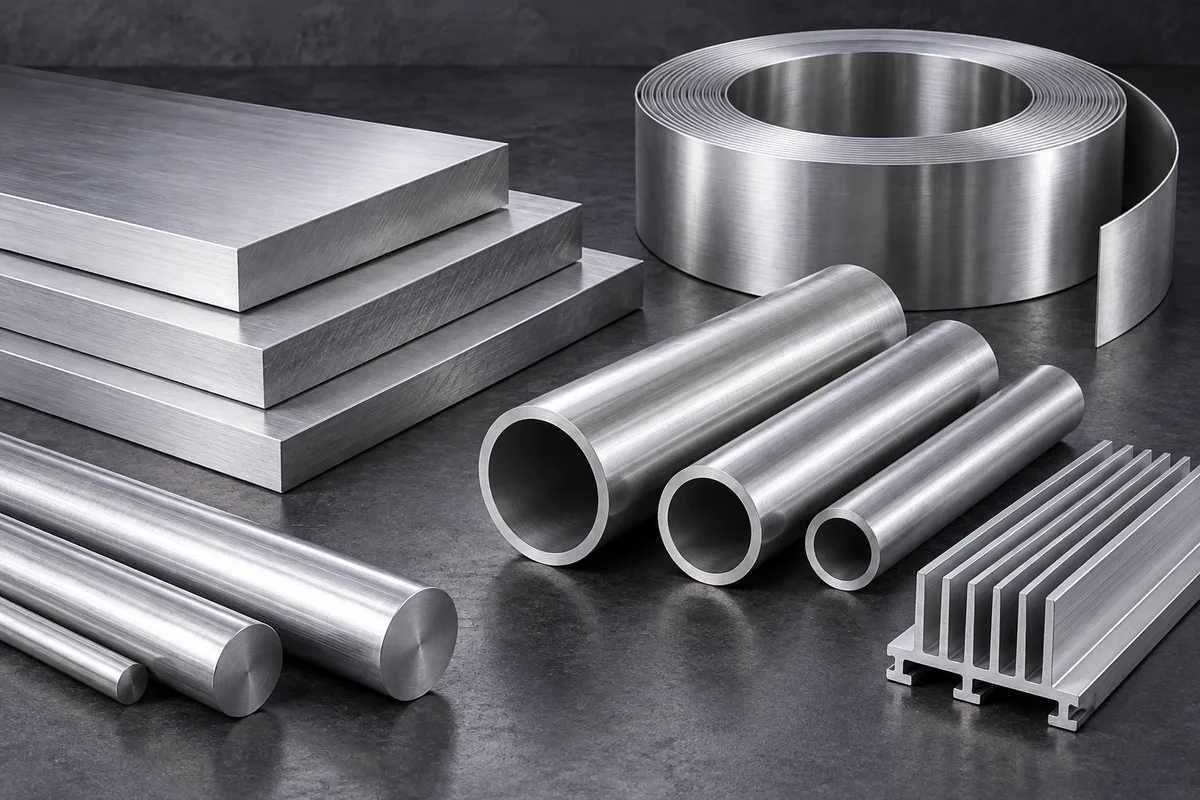
Rivet wire is drawn wire supplied in a soft, uniform condition so that a header can upset one end into a rivet head in a single blow without splitting. 5052 rivet wire uses the familiar 5052 aluminium-magnesium alloy, the same chemistry as 5052 sheet, but processed for clean surfaces, tight diameter control and consistent softness along the whole coil.
Because 5052 is strengthened by magnesium in solid solution rather than by precipitation, the wire does not age or harden on the shelf. A coil bought today heads the same way in six months, which is a practical advantage over heat-treatable rivet alloys such as 2117 or 2017 that must be driven within a fixed time or kept refrigerated.
The headed rivet gains strength from the cold work of heading itself. A 5052 rivet is therefore noticeably stronger than its annealed wire, typically delivering a shear strength somewhere between that of 3003 and 5056 rivets, while keeping excellent resistance to marine and industrial atmospheres.
The limits below are the registered values for alloy 5052 (UNS A95052, EN AW-5052 / AlMg2.5), which rivet wire standards follow. Chromium, not manganese, is the grain-control element in 5052; some older data sheets mix these up, so check the certificate against this table.
| Element | Limit (%) | Effect on rivet wire |
|---|---|---|
| Magnesium (Mg) | 2.2 – 2.8 | Solid-solution strengthening; sets rivet strength |
| Chromium (Cr) | 0.15 – 0.35 | Controls grain size and improves corrosion resistance |
| Silicon (Si) | 0.25 max | Impurity |
| Iron (Fe) | 0.40 max | Impurity; high iron reduces heading ductility |
| Copper (Cu) | 0.10 max | Kept low for corrosion resistance |
| Manganese (Mn) | 0.10 max | Impurity in this alloy |
| Zinc (Zn) | 0.10 max | Impurity |
| Others, each / total | 0.05 / 0.15 | |
| Aluminium (Al) | Remainder | About 96 – 97.5 % |
For rivet wire the key property is a maximum tensile strength: wire that is too hard will crack during heading. Rod and wire standards for 5052-O cap tensile strength at roughly 220 MPa (32 ksi). Typical values for the alloy are shown below for comparison.
| Condition | Tensile strength | Yield strength (0.2 %) | Elongation | Shear strength |
|---|---|---|---|---|
| 5052-O wire, specified | ≤ 220 MPa (max) | — | — | — |
| 5052-O, typical | 195 MPa | 90 MPa | 25 – 30 % | 125 MPa |
| 5052-H32, typical | 230 MPa | 195 MPa | 12 – 18 % | 140 MPa |
Headers set their dies to a narrow diameter band, so rivet wire is usually ordered to one of several tolerance classes. The table shows a commonly used class system for drawn rivet wire (GB/T 3195); ASTM B316 and EN 1301-3 have their own tables. State the class or the tolerance you need on the order.
| Diameter (mm) | Class A | Class B | Class C | Class D |
|---|---|---|---|---|
| > 1.6 – 4.0 | +0 / −0.025 | +0.025 / −0.015 | ±0.025 | +0 / −0.05 |
| > 4.0 – 6.0 | +0 / −0.030 | +0.025 / −0.025 | ±0.040 | +0 / −0.08 |
| > 6.0 – 10.0 | +0 / −0.040 | +0.050 / −0.025 | ±0.060 | +0 / −0.12 |
O-temper 5052 upsets readily to about 2.5 times its diameter in one blow. A clean, lubricated surface and a burr-free cut-off are what keep the head free of splits.
5052 hardens faster than 1100 or 3003, so heavy multi-stage heading may need intermediate annealing. For simple rivets the extra hardening is useful: it raises the strength of the finished head.
A 5052 rivet in 5052, 5083 or 5754 sheet behaves almost like the parent metal, which is why it is a common choice for boats, tanks and coastal structures.
Avoid 5052 rivets in copper-bearing 2xxx structures in wet service, and isolate them from steel or carbon-fibre parts with sealant or washers.
Unlike the 5% Mg alloys, 5052 is not prone to sensitisation, so rivets can work at moderately elevated temperatures without risk of intergranular attack.
Rivets can be anodised or chemically coated after heading. 5052 anodises with a clear, slightly warm tone.
Where a joint needs more shear strength, 5056 rivets are the next step up within the same family; for aircraft structures, 2117-T4 rivets remain the standard.
| Alloy | Strength of rivet | Corrosion resistance | Heat treatment | Typical use |
|---|---|---|---|---|
| 1100 / 1050 | Low | Excellent | None | Light-duty, decorative |
| 3003 | Low–medium | Very good | None | General sheet-metal work |
| 5052 | Medium | Excellent | None | Marine, transport, blind rivets |
| 5056 | Medium–high | Very good | None | Magnesium structures, zip fasteners |
| 2117 | High | Fair | T4, driven as received | Aircraft structures |
| 2017 / 2024 | Very high | Fair | Solution treat, drive quickly | Aerospace, high-load joints |
Store coils indoors in dry conditions and avoid temperature swings that cause condensation, which leaves stains that can mark the rivet heads.
Annealed wire has the lowest hardness and highest ductility, so it can be upset into a head without cracking. The heading operation then work-hardens the rivet, raising its strength above that of the wire.
No. 5052 is non-heat-treatable and does not age, so it can be stored indefinitely and headed as received. That is a key difference from 2017 or 2024 rivet wire.
No. 5056 contains about 5 % magnesium against 2.5 % in 5052, so 5056 rivets are stronger, but 5052 is easier to head and is not susceptible to sensitisation at elevated temperature.
Metline supplies 5052 rivet wire from about 1.6 to 10 mm, with imperial sizes on request, in coils or straight lengths and to the tolerance class you specify.
Yes. 5052 has excellent resistance to seawater and marine air and is widely used for riveting 5xxx sheet on boats and coastal structures. Isolate the rivets from steel, copper and carbon-fibre parts.
Each lot ships with an EN 10204 3.1 mill test certificate showing chemical composition and tensile results; heading tests and third-party inspection can be arranged.
Tell us the diameter, tolerance class, coil size and quantity. We will reply with availability, certification and a delivered price.





