Pedestrian and cycle bridges
Prefabricated truss or girder spans lifted in one piece over roads, rail and rivers.



An aluminium bridge, whether a footbridge, a portable military bridge or a floating pontoon crossing, is built from a family of extruded sections: girders, chords and cross-beams that carry load, and deck planks, edge closures and handrails that complete it. This guide walks through 36 typical sections, what each does and which alloy and temper it is normally extruded in.
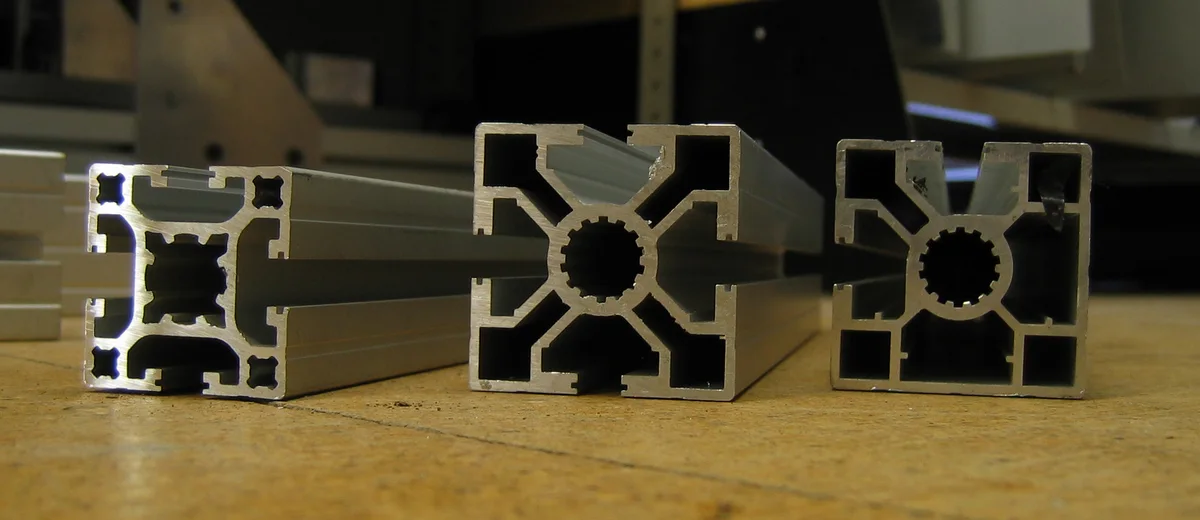
Aluminium weighs about a third as much as steel, does not rust, and can be extruded into hollow multi-cell shapes that put material exactly where it is needed. For bridges, that means light spans that can be lifted in one piece, quick to install and close to maintenance-free.
The extrusion process lets designers combine several functions in one section: a girder with integral bolt channels, a deck plank with interlocking edges and an anti-slip top, or a pontoon wall with built-in stiffeners. Fewer parts and fewer welds reduce fabrication cost and fatigue risk. The sections below fall into two groups: primary members that carry the bridge loads, and secondary members that form the walking surface, parapets and finishes.
These members are designed to EN 1999 (Eurocode 9) or the Aluminum Design Manual and AASHTO LRFD, and are extruded in structural 6xxx alloys in T6 temper. Multi-cell closed sections dominate because they resist torsion and local buckling far better than open shapes of the same weight.
| No. | Section | Function | Typical alloy / temper |
|---|---|---|---|
| 1 | Floor beam / bracket section | Floor beams, pressed-on brackets, pontoon end connectors and clip grooves | 6061-T6, 6082-T6 |
| 2 | Grooved chord | Top and bottom chords of trusses; grooves take bolts or connectors | 6082-T6, 6005A-T6 |
| 3 | Grooved main beam | Primary longitudinal girders with fixing channels | 6082-T6, 6061-T6 |
| 4 | Channel guide | Guide rails for launching, sliding or folding sections | 6061-T6 |
| 5 | Multi-purpose beam | Beams, crossbars, bracing, uprights and handrail posts | 6005A-T6, 6061-T6 |
| 6 | Three-cell beam | Closed hollow beam with internal webs for torsional stiffness | 6005A-T6 |
| 7 | Three-cell asymmetric lower beam | Lower beam where the deck or a pontoon sits on one side | 6005A-T6, 6082-T6 |
| 8 | Three-cell main girder | Heavier closed girder for longer spans | 6082-T6, 7020-T6 |
| 9 | Four-cell rectangular cross-beam | Upper cross-beams carrying deck loads across the width | 6005A-T6 |
| 10 | Five-cell cross-beam | Wider upper cross-beam with more bearing area | 6005A-T6 |
| 11 | Six-cell cross-beam | Deep cross-beam for heavy axle loads | 6082-T6 |
| 12 | Six-cell symmetric frame | Frame member loaded equally from both sides | 6082-T6 |
| 13 | Six-cell asymmetric frame | Edge frame member with connection on one side | 6082-T6 |
| 14 | Internal longitudinal beam | Stringers between main girders | 6061-T6, 6005A-T6 |
| 15 | Main pontoon section | Buoyancy hull section for floating bridges | 5083 / 6082-T6 (marine) |
| 16 | Support bracket | Bearing and support brackets, often machined | 6082-T6 |
| 17 | Expansion joint section | Deck expansion joints that accommodate thermal movement | 6061-T6, 6082-T6 |
Secondary sections still carry pedestrian or vehicle loads locally (deck planks and treads in particular), but many are architectural. 6063 is preferred for trims and handrails because it extrudes thin walls with a fine surface that anodises or powder-coats well.
| No. | Section | Function | Typical alloy / temper |
|---|---|---|---|
| 18 | Angle | Bracing, edge stiffeners and fixings | 6063-T6, 6061-T6 |
| 19 – 23 | One- to five-cell deck panel | Hollow deck planks; more cells mean wider planks and longer spans | 6005A-T6, 6082-T6 |
| 24 – 25 | Three- and four-cell interlocking stair tread | Treads that interlock without separate fixings | 6005A-T6 |
| 26 | Three-cell interlocking deck panel | Deck planks that clip together, often friction-stir welded | 6005A-T6 |
| 27 | Parapet section | Pedestrian parapet rails and posts | 6063-T6, 6061-T6 |
| 28 – 29 | Left and right edge closures | Close the deck edges and hide the structure | 6063-T5/T6 |
| 30 | Deck cover | Cover strips over joints and cable runs | 6063-T5 |
| 31 | Girder trim cover | Cosmetic cladding over main girders | 6063-T5 |
| 32 – 33 | Decorative and handrail panel connectors | Join infill and handrail cover panels | 6063-T5/T6 |
| 34 | Handrail cover panel | Infill panels below the handrail | 6063-T5 |
| 35 | Deck connecting panel | Transition planks between deck modules | 6005A-T6 |
| 36 | Stair handrail | Hand-grip profile for stairs and ramps | 6063-T6 |
| Alloy and temper | Typical minimum yield (EN 755-2, thin walls) | Strengths | Typical use |
|---|---|---|---|
| 6005A-T6 | about 215 – 225 MPa | Extrudes complex hollow shapes; good strength | Deck planks, multi-cell beams |
| 6082-T6 | about 250 – 260 MPa | Highest strength common 6xxx alloy in Europe | Main girders, chords, frames |
| 6061-T6 | about 240 MPa | Widely available; good toughness | Beams, brackets, posts (Americas, Asia) |
| 6063-T5 / T6 | about 110 – 170 MPa | Best surface finish, thin walls | Handrails, trims, closures |
| 7020-T6 / 7005 | about 280 – 290 MPa | Weldable with natural re-ageing | Military and portable bridges |
| 5083-H111 / H321 | about 125 – 215 MPa | Seawater resistance, weldable | Pontoon plating and hulls |
Values are indicative minimums for typical section thicknesses; the governing values are those of EN 755-2 or ASTM B221 for the actual wall thickness. Welding reduces 6xxx T6 strength in the heat-affected zone, which Eurocode 9 accounts for with reduction factors.
Prefabricated truss or girder spans lifted in one piece over roads, rail and rivers.
Light aluminium decks on existing steel structures, raising load rating by cutting dead weight.
Modular pontoons with aluminium decks for marinas, temporary crossings and emergency use.
Rapidly deployed gap-crossing bridges in high-strength weldable 7xxx and 6xxx alloys.
Ship-to-shore, offshore and industrial access gangways.
Interlocking treads and handrails for bridge approaches and platforms.
6082-T6 in Europe and 6061-T6 elsewhere are the usual choices for main girders; 6005A-T6 is preferred for complex multi-cell sections such as deck planks. 7020 is used where higher weldable strength is needed.
Commonly 6 – 12 m per piece, limited by the extrusion press, ageing ovens and transport. Longer members are spliced by bolting or welding.
Closed cells resist local buckling and torsion, carry wheel loads between webs and let wide planks be friction-stir welded into flat panels.
Usually not. Most are left mill finish or anodised; coatings are used for colour or appearance.
EN 1999 (Eurocode 9) in Europe and many other regions, and AASHTO LRFD with the Aluminum Design Manual in North America.
Yes. Send the section drawings with alloy, temper, length and finish, and we will confirm die and supply options.
Send section drawings, alloys, tempers and quantities. We will confirm supply, certification and delivery to site.





