Lid and base joints
For a case that opens, pair the double angle with a mating lid profile (tongue-and-groove or "hybrid" section) so the lid locates and seals on closing.



A double angle extrusion is an aluminium corner profile with two slots set at 90°, so that two panels slide or click into it and form a square, reinforced edge. It is the standard framing member for flight cases, road cases, display cabinets and panel enclosures. Metline supplies double angle profiles in 6063 and 6061 with slots for common panel thicknesses, cut to length and finished as required, worldwide.
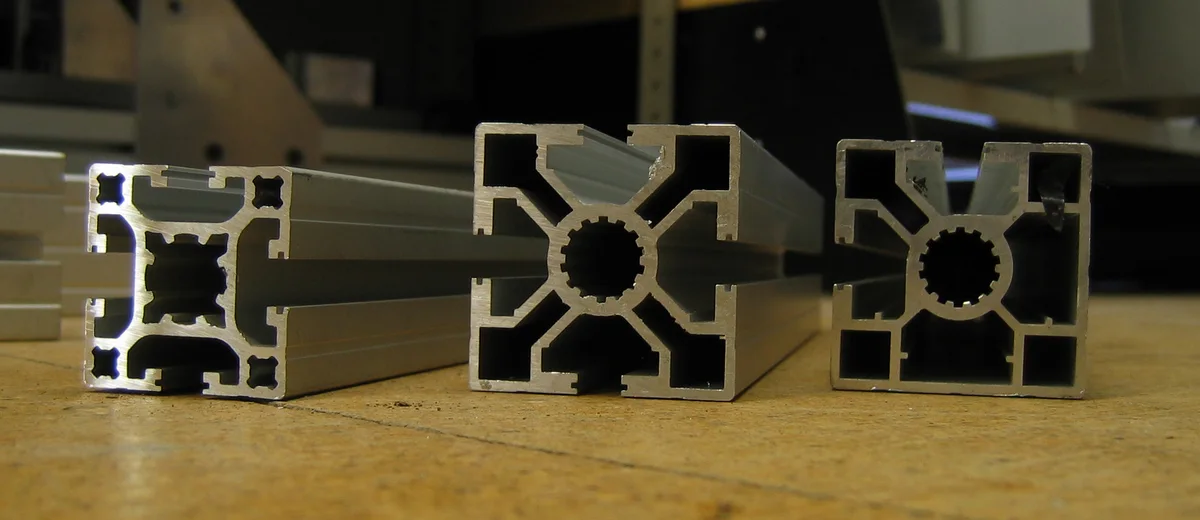
Two panels meeting at a right angle are the weakest point of any box. A double angle extrusion wraps that corner in metal: each panel edge sits in its own channel, the outer legs lie flat on the panel faces and are riveted or screwed through, and the rounded or squared nose takes knocks that would otherwise split the board.
The profile is essentially two U channels joined back to back at 90°, sharing a common corner. Because the panels are captured on both faces, the joint resists racking and impact far better than a glued butt joint or a single external angle. Ball corners, brackets and catches are then fitted over the ends where three extrusions meet.
Double angles are made in several variants: with standard or long legs (more leg gives more rivet edge distance and stiffness), with smooth or ribbed outer faces, as a slide-on profile that accepts a range of panel thicknesses, or as a click-on profile with internal barbs that grip a grooved panel edge. Click-on types need the panel thickness held closely; slide-on types are more forgiving but rely on rivets to hold the panel.
The same idea appears in other industries under other names: corner trims for partition and cleanroom panels, glazing corner profiles, and aerospace "double angle" clips that join a frame to a skin. The engineering is the same: two perpendicular surfaces in one extrusion.
The key dimension is the slot width, which must match the actual panel thickness, not its nominal size. Laminated plywood often measures a few tenths of a millimetre over or under nominal, so measure the panels you will use, or send samples.
| Nominal panel | Metric equivalent | Typical use |
|---|---|---|
| 1/8 in | 3.2 mm | Light display and instrument cases, polycarbonate panels |
| 3/16 in | 4.8 mm | Small cases and inserts |
| 1/4 in | 6.35 mm (often 6 – 7 mm ply) | Light-duty road and carry cases |
| 5/16 in | 7.9 mm | Medium cases |
| 3/8 in | 9.5 mm (often 9 – 10 mm ply) | Standard touring flight cases and rack cases |
| 1/2 in | 12.7 mm (often 12 mm ply) | Heavy-duty cases, large equipment and transport crates |
| 3/4 in | 19 mm | Furniture, partition and heavy panel frames |
6063-T5 or T6 is the standard alloy. It extrudes the thin, intricate slot walls and barbs cleanly, takes a uniform anodised colour and is soft enough to rivet without cracking. 6061-T6 or 6082-T6 is used for heavy-duty crates and frames where the extrusion contributes real structural strength, or where a thicker section will be machined.
| Alloy and temper | Standard and size band | Tensile strength, min. | Yield strength (0.2 %), min. | Elongation, min. |
|---|---|---|---|---|
| 6060-T5 | EN 755-2, wall ≤ 5 mm | 160 MPa | 120 MPa | 8 % |
| 6063-T5 | ASTM B221, ≤ 12.5 mm | 150 MPa (22 ksi) | 110 MPa (16 ksi) | 7 – 8 % |
| 6063-T6 | ASTM B221 / EN 755-2 | 205 – 215 MPa (30 ksi) | 170 MPa (25 ksi) | 8 % |
| 6061-T6 / T6511 | ASTM B221 / B308 | 260 MPa (38 ksi) | 240 MPa (35 ksi) | 8 % |
| 6082-T6 | EN 755-2, open profile ≤ 5 mm | 290 MPa | 250 MPa | 8 % |
Specified minimums for extruded profiles; thicker walls fall into different bands. Typical values run 10 – 20 % higher (6061-T6 typically 310 MPa tensile, 276 MPa yield). Design to the minimums and the actual figures on the mill certificate.
| Alloy | Si | Fe | Cu | Mn | Mg | Cr | Zn | Ti |
|---|---|---|---|---|---|---|---|---|
| 6060 | 0.30 – 0.6 | 0.10 – 0.30 | 0.10 | 0.10 | 0.35 – 0.6 | 0.05 | 0.15 | 0.10 |
| 6063 | 0.20 – 0.6 | 0.35 | 0.10 | 0.10 | 0.45 – 0.9 | 0.10 | 0.10 | 0.10 |
| 6061 | 0.40 – 0.8 | 0.7 | 0.15 – 0.40 | 0.15 | 0.8 – 1.2 | 0.04 – 0.35 | 0.25 | 0.15 |
| 6082 | 0.7 – 1.3 | 0.50 | 0.10 | 0.40 – 1.0 | 0.6 – 1.2 | 0.25 | 0.20 | 0.10 |
Single values are maximums. Others 0.05 % each, 0.15 % total; aluminium is the remainder. Limits follow the Aluminum Association registrations and EN 573-3.
Density is about 2.70 g/cm³ for all of these alloys, so the extrusion adds very little weight to a case compared with steel edging, while giving it a rigid, impact-resistant frame.
For a case that opens, pair the double angle with a mating lid profile (tongue-and-groove or "hybrid" section) so the lid locates and seals on closing.
Choose long legs on heavy or large cases: more leg gives more rivet edge distance and better resistance to panel pull-out.
For lightweight cases, aluminium honeycomb or composite panels can be used in place of ply; check slot size and use inserts at rivet points.
Anodising can be specified to MIL-A-8625 (Type II) or to a film thickness class; for cases that see heavy handling, 15 – 20 µm gives a good balance of wear resistance and cost.
| Item | Standard |
|---|---|
| Extruded profiles, material and properties | ASTM B221; EN 755-1 and EN 755-2 |
| Chemical composition | Aluminum Association registrations; EN 573-3 |
| Dimensional tolerances | ANSI H35.2; EN 755-9; EN 12020-2 for precision 6060/6063 profiles |
| Anodising | MIL-A-8625; ISO 7599 |
| General | ISO 6362 for wrought extruded products |
Slot width and the position of click-on barbs are the critical features; they are checked against the profile drawing with gauges on each production run. Each shipment carries a mill test certificate to EN 10204 3.1, and RoHS or REACH declarations can be provided for case makers who need them.
It joins two panels at a right angle and protects the edge. Its main use is framing flight cases and road cases, but it is also used for display cases, enclosures, crates and partition corners.
Match the slot to the measured thickness of your panels, not the nominal size. For example, "3/8 in" plywood often measures 9 – 10 mm. Send a panel sample if you are unsure.
Slide-on profiles accept a range of panel thicknesses and rely on rivets to hold the panel. Click-on profiles have internal barbs that lock into a groove routed in the panel edge, which needs a closely controlled panel thickness.
6063 in T5 or T6 temper is standard because it extrudes the thin slot walls cleanly and anodises well. 6061-T6 or 6082-T6 is used for heavy-duty frames.
Yes. Profiles can be anodised black, clear, gold or bronze, or powder coated, and cut and drilled to your lengths.
Send your panel thickness, finish and lengths. We will confirm the right double angle profile and a delivered price.





