Machining
In T6 and T9, 6110 machines well with short chips, similar to or better than 6061-T6. Use sharp, polished carbide tools and good coolant.



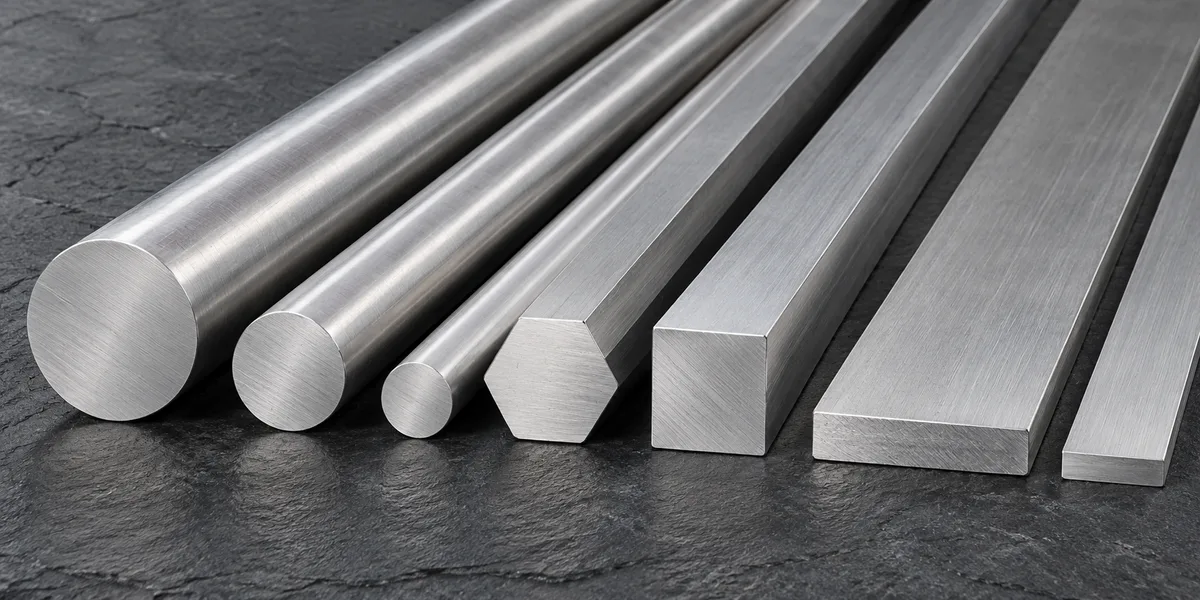
6110 is a copper- and manganese-bearing 6xxx alloy designed to reach higher strength than 6061 or 6082 while keeping the corrosion resistance and processability of the Al-Mg-Si family. It is used as bar, rod, wire and forging stock for heavily loaded machined and forged parts. Metline supplies 6110 and the related EN AW-6110A as round, square, flat and forged bar in T6 or T9, certified to agreed properties, worldwide.
6110 is an Aluminum Association registered wrought alloy (UNS A96110). It sits in the 6xxx series but is richer in alloying than 6061: silicon up to 1.5 %, magnesium up to 1.1 %, and deliberate additions of 0.2 – 0.7 % copper and 0.2 – 0.7 % manganese. The extra Mg2Si plus copper raises age-hardening response, and manganese and chromium refine the grain, so 6110 is among the strongest 6xxx alloys.
Because its copper content is far below that of 2xxx alloys, 6110 keeps much of the corrosion resistance and weldability that make 6xxx alloys easy to live with. That combination makes it a candidate wherever 6061 or 6082 is not quite strong enough but a 2xxx or 7xxx alloy would bring corrosion, cost or processing penalties.
In Europe the closely related EN AW-6110A (AlMg0.9Si0.9MnCu) is more common. It has tighter limits on silicon and iron, a small zirconium allowance, and is included in EN 573-3 and in the EN 755-2 property tables for extruded products. Many buyers who ask for "6110" in Europe are actually ordering 6110A, so confirm which designation your drawing calls for.
| Element | 6110 (AA registration) | 6110A (EN 573-3) |
|---|---|---|
| Silicon (Si) | 0.70 – 1.5 | 0.70 – 1.1 |
| Magnesium (Mg) | 0.50 – 1.1 | 0.70 – 1.1 |
| Copper (Cu) | 0.20 – 0.70 | 0.30 – 0.80 |
| Manganese (Mn) | 0.20 – 0.70 | 0.30 – 0.90 |
| Iron (Fe) | 0.80 max. | 0.50 max. |
| Chromium (Cr) | 0.04 – 0.25 | 0.05 – 0.25 |
| Zinc (Zn) | 0.30 max. | 0.20 max. |
| Titanium (Ti) | 0.15 max. | 0.20 max. |
| Zirconium (Zr) | — | 0.20 max. |
| Others, each / total | 0.05 / 0.15 | 0.05 / 0.15 |
| Aluminium (Al) | Remainder | Remainder |
Check the current registration or standard edition before ordering; the certificate must report the analysis against the designation on your purchase order.
Unlike 6061 or 6082, 6110 bar does not appear in the everyday ASTM bar tables most buyers know, so guaranteed minimums are normally agreed between buyer and supplier for the product, size and temper. The figures below are indicative reference values from published alloy data, not specification minimums.
| Temper | Condition | Indicative properties | Comment |
|---|---|---|---|
| T6 | Solution treated, quenched, artificially aged | Strength above 6082-T6, with useful ductility | Best balance of strength, toughness and machinability |
| T9 | Solution treated, aged, then cold worked | Published reference data show tensile strength around 500 MPa, with elongation of only about 2 % | For wire, rod and fastener stock; low ductility limits forming |
| 6110A-T6 | Per EN 755-2 (extruded) | Minimums listed in EN 755-2 by product and size | Order to the standard for guaranteed values |
Because the copper content is higher than in 6061, expect somewhat lower electrical and thermal conductivity and slightly lower general corrosion resistance. The mill test certificate for your lot is the governing record of properties.
| System | Designation | Notes |
|---|---|---|
| Aluminum Association | 6110 | Registered composition; general data in SAE J454 |
| UNS | A96110 | — |
| European | EN AW-6110 / EN AW-6110A | 6110A in EN 573-3; extruded properties in EN 755-2 |
| Purchase specification | Agreed | State temper, size-specific minimums, tolerances and test requirements on the order |
Some older listings link 6110 bar with electrical bus conductor standards; those standards cover conductor alloys such as 6101 and are not the right reference for high-strength 6110 bar. If your enquiry cites a standard, we will check that it actually covers 6110 in the form you need.
| Form | Typical range | Notes |
|---|---|---|
| Extruded round bar | about 10 – 200 mm diameter | T6 or T4; T6511 stretched by agreement |
| Drawn rod and wire | small diameters | Often T9 for cold-headed or machined fasteners |
| Square and flat bar | to drawing | Extruded sections by enquiry |
| Forged bar and blanks | larger sections | For parts beyond extrusion size, or for improved grain flow |
Approximate weight per metre for round bar (density 2.71 g/cm³). Use the bar weight calculator for other shapes.
| Diameter (mm) | Approx. inch | kg per metre | kg per 3 m bar | lb per foot |
|---|---|---|---|---|
| 10 | 0.39 | 0.213 | 0.64 | 0.143 |
| 16 | 0.63 | 0.545 | 1.63 | 0.366 |
| 20 | 0.79 | 0.851 | 2.55 | 0.572 |
| 25 | 0.98 | 1.33 | 3.99 | 0.894 |
| 30 | 1.18 | 1.92 | 5.75 | 1.287 |
| 40 | 1.57 | 3.41 | 10.22 | 2.288 |
| 50 | 1.97 | 5.32 | 15.96 | 3.576 |
| 60 | 2.36 | 7.66 | 22.99 | 5.149 |
| 80 | 3.15 | 13.62 | 40.87 | 9.154 |
| 100 | 3.94 | 21.28 | 63.85 | 14.302 |
| 120 | 4.72 | 30.65 | 91.95 | 20.595 |
| 150 | 5.91 | 47.89 | 143.7 | 32.180 |
| 200 | 7.87 | 85.14 | 255.4 | 57.210 |
In T6 and T9, 6110 machines well with short chips, similar to or better than 6061-T6. Use sharp, polished carbide tools and good coolant.
Forges readily in the usual 6xxx temperature range; forgings are then solution treated and aged to T6.
Form in O or T4 and age afterwards. T9 is cold worked and has little ductility left for bending.
Weldable by MIG and TIG, but the heat-affected zone loses most of its aged strength. Copper raises hot-cracking sensitivity slightly, so control filler choice and joint design.
Anodises for protection; copper gives a slightly darker, less clear film than 6063 or 6061.
Good in normal atmospheres. In aggressive or marine service, protect by anodising or painting and avoid galvanic contact with steel or copper.
| Alloy | Relative strength (T6) | Corrosion resistance | Weldability | Availability |
|---|---|---|---|---|
| 6061 | Medium | Very good | Good | Very wide |
| 6082 | Medium-high | Very good | Good | Very wide |
| 6110 / 6110A | High for 6xxx | Good | Fair to good | Specialist |
| 2014 | High | Fair; needs protection | Poor for fusion welding | Wide |
| 7075 | Very high | Fair; needs protection | Not fusion weldable | Wide |
If availability or documented minimums are a priority, 6082-T6 or 6061-T6 bar is usually the safer choice. Choose 6110 when the extra strength is needed and the design and qualification process can accept a specialist alloy.
Yes. Its higher silicon, magnesium and copper content give a stronger age-hardening response, so 6110 in T6 is stronger than 6061-T6 or 6082-T6. Exact minimums depend on product, size and temper and should be agreed on the order.
6110A is the European variant in EN 573-3. It has narrower silicon and iron limits, slightly higher copper and manganese ranges, and a zirconium allowance. The two are not interchangeable on a certificate, so order the designation your drawing names.
The bar is solution treated, artificially aged and then cold worked. Cold working after ageing raises strength further, but leaves little elongation, so T9 suits wire, rod and fastener stock rather than formed parts.
For EN AW-6110A extrusions, EN 755-2 gives guaranteed minimums. For AA 6110, write a purchase specification stating composition, temper, size-specific minimum tensile and yield values, tolerances and test requirements.
Yes, by MIG or TIG, but the heat-affected zone loses much of its T6 strength and the copper content makes it slightly more sensitive to cracking than 6061. Most high-strength 6110 parts are machined or forged, not welded.
Not usually. 7075-T6 is much stronger. 6110 is better viewed as an upgrade from 6082 where you want more strength while keeping 6xxx-type corrosion resistance and forgeability.
Send designation, temper, shape, size, required properties and quantity. We will confirm availability, certification and a delivered price.





