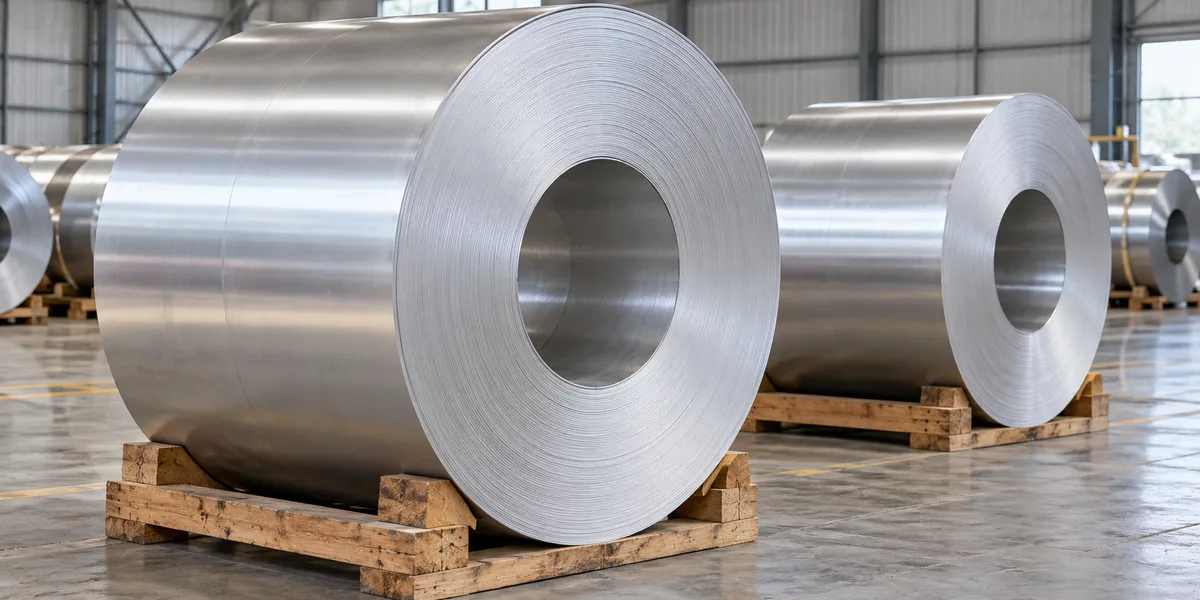
Aluminium MIG wire is a solid filler wire fed continuously through a gas metal arc welding (GMAW) torch. The right grade depends mainly on the base alloy: ER4043 suits most 6xxx and casting alloys, while ER5356, ER5183 and ER5556 suit the magnesium-bearing 5xxx alloys used in marine and structural work. This guide covers grades, chemistry, selection, sizes, shielding gas and the feeding problems that cause most aluminium MIG defects.
What aluminium MIG wire is and how it differs from steel wire
In MIG (GMAW) welding the wire is both the electrode that carries the arc and the filler metal that forms the weld. For aluminium the wire is a bare, solid alloy wire, classified in North America under AWS A5.10 with an "ER" prefix (electrode or rod) and in Europe and most of Asia under EN ISO 18273 with an "S Al" prefix.
Aluminium wire behaves very differently from steel wire. It is soft, so it buckles easily in long feed paths and is crushed by knurled drive rolls. It conducts heat so well that welds need high current and fast travel. Its surface oxide melts at around 2,050 °C, far above the metal itself, so the oxide must be cleaned off or broken up by the arc. And molten aluminium dissolves hydrogen from moisture, oil and dirt, which comes out as porosity when the weld freezes. Almost every aluminium MIG problem traces back to one of these four facts.
Filler choice also matters more than with mild steel. The filler mixes with melted base metal in the weld pool, and some combinations crack as they solidify, lose strength at temperature, or change colour after anodising. Choosing the wire therefore starts with the base alloy, then considers strength, service temperature, corrosion environment and finish.
Filler grades
The main aluminium MIG wire grades
ER4043 (Al-5Si)
The most widely used general-purpose wire. Silicon lowers the melting point and makes the weld pool very fluid, which gives smooth beads and strong resistance to hot cracking on 6xxx alloys and castings. Welds are relatively low in ductility and turn dark grey when anodised.
ER5356 (Al-5Mg)
The standard wire for 5xxx alloys and the most common choice for structural and marine fabrication. Stronger and more ductile than 4043, with a better colour match after anodising, and stiff enough to feed well. Not recommended for sustained service above about 65 °C.
ER5183 (Al-4.5Mg-Mn)
Higher manganese gives higher weld strength than 5356. Used for 5083 and 5456 plate in ships, cryogenic tanks and pressure vessels where the joint must match the strength of the base plate.
ER5556 (Al-5Mg-Mn)
Similar to 5183 with slightly higher strength; used on high-strength 5xxx alloys and on 7xxx structural alloys such as 7005 in some fabrications.
ER5554 (Al-2.7Mg)
Lower magnesium makes it the 5xxx filler of choice for parts operating above about 65 °C, such as tankers carrying hot products and wheels, usually on 5454 base metal.
ER4047 (Al-12Si)
Very high silicon gives the lowest melting point and highest fluidity. Used for leak-tight joints, heat-exchanger work and where shrinkage cracking must be minimised; also used as a brazing filler.
ER4943
A newer Al-Si filler with a small magnesium addition that raises as-welded strength over 4043 while keeping its crack resistance.
ER1100 / ER1188
Near-pure aluminium fillers for welding 1xxx alloys, mainly in electrical bus work and chemical equipment where conductivity or purity matter.
ER2319
An aluminium-copper filler for welding heat-treatable 2219 alloy in aerospace and cryogenic tanks, usually to AMS 4191.
Chemical composition of the common MIG wires (wt %)
The limits below summarise the AWS A5.10 classification ranges for the four most-used wires. Single values are maximums. Beryllium is held to 0.0003 % maximum in all aluminium filler metals for health reasons. Each Metline wire lot is supplied with a certificate stating the actual analysis.
Element
ER4043
ER5356
ER5183
ER5556
Silicon (Si)
4.5 – 6.0
0.25
0.40
0.25
Iron (Fe)
0.80
0.40
0.40
0.40
Copper (Cu)
0.30
0.10
0.10
0.10
Manganese (Mn)
0.05
0.05 – 0.20
0.50 – 1.0
0.50 – 1.0
Magnesium (Mg)
0.05
4.5 – 5.5
4.3 – 5.2
4.7 – 5.5
Chromium (Cr)
—
0.05 – 0.20
0.05 – 0.25
0.05 – 0.20
Zinc (Zn)
0.10
0.10
0.25
0.25
Titanium (Ti)
0.20
0.06 – 0.20
0.15
0.05 – 0.20
Beryllium (Be)
0.0003
0.0003
0.0003
0.0003
Aluminium (Al)
Remainder
Remainder
Remainder
Remainder
Summarised from AWS A5.10/A5.10M. Check the current edition and the ISO 18273 equivalent (for example S Al 4043, S Al 5356, S Al 5183) if your contract cites the European standard.
Filler selection
How to choose the right wire for your base alloy
The table gives the usual first-choice filler for common base alloys. Where two wires are listed, the first is chosen for crack resistance or general use and the second for higher strength, ductility or anodised colour match. Always confirm against your welding procedure specification and the filler selection chart in AWS D1.2 or your design code.
Base alloy
First choice
Alternative
Notes
1050, 1100, 1350
ER1100 / ER1188
ER4043
4043 is easier to weld but lowers conductivity
3003, 3004
ER4043
ER5356
5356 where higher strength or anodised colour match is needed
5052, 5251
ER5356
ER4043 (low Mg only)
4043 acceptable only on low-magnesium alloys
5083, 5086, 5456
ER5183
ER5356, ER5556
Never use 4xxx fillers: brittle Mg2Si forms in the weld
5454
ER5554
ER5356
5554 for service above about 65 °C
6061, 6082
ER4043
ER5356
4043 for crack resistance; 5356 for higher shear strength and anodised colour
6063
ER4043
ER5356
Common for architectural and pipe work
6061 to 5083
ER5356
ER5183
Mixed joints: the magnesium-rich filler is usually chosen
7005, 7020
ER5356
ER5556, ER5183
Welded structural 7xxx; not for 7075
A356 / 356 castings
ER4043
ER4047
Si fillers match casting chemistry
2219
ER2319
—
Aerospace; to AMS 4191 where specified
Two rules prevent most filler mistakes. First, do not use a silicon (4xxx) filler on 5xxx alloys containing more than about 3 % magnesium: magnesium and silicon combine into brittle magnesium silicide in the weld and ductility collapses. Second, do not use a 5xxx filler with more than about 3 % magnesium (5356, 5183, 5556) for parts that run continuously above about 65 °C, because a magnesium-rich phase can form along grain boundaries and make the weld prone to stress-corrosion cracking. For those parts use ER5554 or a 4xxx filler on compatible base metal.
Weld strength
Weld strength and filler behaviour compared
Weld strength in aluminium is usually limited by the heat-affected zone of the base metal rather than by the filler. In 6061-T6, for example, the zone next to the weld anneals and over-ages, so the groove weld tensile strength falls to roughly 165 MPa (24 ksi) minimum, the value used in AWS D1.2 procedure qualification, whichever common filler is used. Filler choice matters most for fillet welds, where the weld metal carries the shear load, and for non-heat-treatable alloys such as 5083.
Minimum values used for welding procedure qualification under AWS D1.2 and ASME Section IX; thickness limits and exact figures depend on the edition of the code.
Shear strengths are typical published filler-metal values (about 11.5/15, 17/26, 18.5/28 and 20/30 ksi) used for fillet weld design; use the values in your governing design code.
Supply range
Wire diameters, spools and packaging
Supply range
Diameters
0.8, 0.9, 1.0, 1.2, 1.6 mm (0.030, 0.035, 3/64, 1/16 in); 2.0 and 2.4 mm on request
Small spools
100 mm (about 0.5 kg) and 200 mm (about 2 kg) for spool guns and light work
Standard spools
300 mm spools (about 6 – 7 kg) for push and push-pull feeders
Bulk packs
Large spools and drums for robotic and automated lines
Diameter tolerance
To AWS A5.10 / ISO 544 limits for solid wire
Packing
Each spool sealed in a moisture-barrier bag with desiccant, boxed and palletised for export
Documents
Certificate of analysis or EN 10204 3.1 certificate per lot
Wire is also available as straight TIG rods; see the TIG filler rod guide below.
Choose the diameter by thickness and current. As a starting point, 0.8 – 0.9 mm wire suits sheet of about 1 – 3 mm with short-circuit or pulsed transfer; 1.0 – 1.2 mm suits most work from about 3 mm to 12 mm; 1.6 mm suits thick plate in spray transfer and high-deposition mechanised welding. Larger wire is stiffer and easier to feed, so many fabricators use 1.2 mm for general work even on moderately thin material with a pulsed power source.
Process set-up
Shielding gas, transfer mode and feeding
Shielding gas
Effect
Typical use
100 % argon
Stable arc, good cleaning action, narrow penetration profile
Most work up to about 12 mm; all positions
Argon + 25 – 75 % helium
Hotter arc, wider and deeper penetration, faster travel, less porosity
Oxidises the weld pool, causes heavy oxide and porosity
Not used for aluminium
Transfer mode
How it works
Best for
Short-circuit
Wire touches the pool and short-circuits; low heat
Limited use on aluminium; thin sheet only, prone to lack of fusion
Spray
Fine droplets cross the arc above a threshold current
Plate above about 3 – 4 mm in flat and horizontal positions
Pulsed spray
Current pulses between high and low levels
Thin to medium material and positional welding; the most versatile mode
Low-heat-input modes (e.g. CMT-type)
Wire retracts each cycle to detach droplets
Very thin sheet and robotic welding with minimal distortion
Drive rolls
Use U-groove rolls and only enough tension to feed without slipping. V-groove or knurled rolls shave and flatten soft wire, sending swarf into the liner.
Liner
Use a PTFE, nylon or carbon-filled plastic liner, trimmed cleanly at both ends, and keep it as short and straight as possible.
Gun choice
For long leads or thin wire, use a spool gun or a push-pull gun that pulls the wire from the torch end.
Contact tip
Use tips made for aluminium, which are slightly oversized to allow for thermal expansion, and replace them as soon as they show wear or arcing.
Torch technique
Push the torch (forehand) at about 10 – 15° so the gas cover leads the pool; dragging causes soot and poor cleaning.
Joint preparation
Degrease with solvent, then brush with a stainless-steel brush used only for aluminium, shortly before welding.
Troubleshooting
Common aluminium MIG defects and how to fix them
Problem
Likely causes
Corrective action
Porosity
Moisture or oil on wire or joint, poor gas cover, draughts, contaminated gas lines
Store wire dry, clean joints, check gas flow and hoses, shield from draughts
Bird-nesting at feeder
Too much roll pressure, worn liner, long cable, tip too tight
Reduce tension, replace liner, shorten cable or use push-pull gun
Burn-back to tip
Wire-feed speed too low for voltage, worn or undersized tip
Increase wire speed, use aluminium tips, check feed path
Hot cracking
Wrong filler for base metal, concave crater, high restraint
Use 4043/4047 on 6xxx, fill craters, reduce restraint
Lack of fusion
Too little heat for thickness, short-circuit transfer on thick material
Use spray or pulsed transfer, more current, add helium
Black soot
Dragging torch, insufficient gas, magnesium burn-off from 5xxx wire
Push torch, increase gas, clean after welding
Storage is a frequent and overlooked cause of porosity. Keep wire in its sealed bag until use, in a dry store at a stable temperature, and return part-used spools to a sealed bag with desiccant. Moving cold spools into a warm, humid workshop causes condensation on the wire surface, so let them reach room temperature before opening.
Use ER4043 for 6xxx alloys and castings when crack resistance and a smooth bead matter, and for parts that run hot. Use ER5356 for 5xxx alloys, for higher shear strength and ductility, and when the part will be anodised. On 5083 or 5086 plate never use 4043.
Which wire do I use for 6061 aluminium?
ER4043 is the usual choice because it resists hot cracking. ER5356 is used when higher fillet shear strength or a better colour match after anodising is needed. Either way, the heat-affected zone limits groove weld strength to about 165 MPa unless the part is heat-treated after welding.
What gas do I need for aluminum MIG welding?
Pure argon for most work, or an argon-helium mix (25 – 75 % helium) for thick sections and faster welding. Gases containing CO2 or oxygen, used for steel, must not be used on aluminium.
Why does my aluminium wire keep tangling at the feeder?
Soft aluminium wire buckles if the feed path resists it. Use U-groove drive rolls with light tension, a plastic liner, aluminium contact tips and a short cable, or switch to a spool gun or push-pull gun.
What causes porosity in aluminium MIG welds?
Hydrogen, almost always from moisture, oil or hydrated oxide on the wire or joint, or from poor gas cover. Keep wire sealed and dry, degrease and brush the joint, and check gas flow and hoses for leaks.
Can ER5356 be used on parts that get hot?
Not for sustained service above about 65 °C. Prolonged heating can make high-magnesium welds sensitive to stress-corrosion cracking. Use ER5554 on 5454, or a 4xxx filler where the base metal allows.
Need aluminium MIG wire for your next job?
Tell us the grade, diameter, spool type and quantity. We will reply with availability, certification and a delivered price.