Pin-fin and plate-fin heat sinks
Solid one-piece heat sinks for LED lighting, power electronics, inverters and on-board chargers. Fins are extruded backward from the base, so there is no bonded joint and no porosity to block heat flow.



Aluminium cold forging shapes a solid slug at or near room temperature inside closed dies, producing near-net parts such as heat sinks, shafts, sleeves, housings and brackets with tight tolerances, a clean surface and very little scrap. It pays off for small and medium parts made in steady volumes, typically from several thousand pieces a year. This guide explains which alloys cold forge well, how the process works, how to design for it and when another route is the better choice.
Cold forging is a family of bulk-forming operations in which a pre-cut aluminium slug is pressed into shape by punches and dies without heating it to forging temperature. The metal flows plastically into the die cavity, so the part takes its outline, bores, steps, fins or splines in one or a few strokes.
The term covers several closely related operations. Upsetting shortens and widens a slug to form heads and flanges. Forward extrusion pushes metal through a die opening to make shafts and stems. Backward (reverse) extrusion drives a punch into the slug so metal flows back around it, forming cups, sleeves and housings. Combined extrusion does both at once, and coining or sizing finishes faces to tight dimensions. Impact extrusion, used for aerosol cans and battery cases, is a high-speed form of backward extrusion and belongs to the same family.
Because the work is done cold, the part comes out with no scale, a fine surface and dimensions set by the tooling. The metal grain follows the contour of the part instead of being cut through as in machining, and the strain hardens the alloy. Aluminium is particularly well suited: its low flow stress and high ductility in the annealed condition mean it can accept large reductions in a single stroke, which harder metals such as steel can only achieve with intermediate anneals.
A key design decision is how many forming stages a part needs. Simple cups and heads may take one stroke; parts with deep bores and a long shaft may need two or three, sometimes with an intermediate anneal when the cumulative strain becomes too high for the alloy.
Cold forgeability falls as alloy content and annealed strength rise. The lower the annealed strength and the higher the elongation, the larger the reduction the slug will take before cracking and the lower the press load. Typical annealed values from Aluminum Association data show the spread:
| Alloy | Typical tensile strength, O temper | Cold forgeability | Typical use after forging |
|---|---|---|---|
| 1050 / 1070 | about 70 – 80 MPa | Excellent | Heat sinks, electrical parts, impact-extruded cans |
| 1100 | about 90 MPa | Excellent | Heat sinks, cups, cosmetic shells |
| 3003 | about 110 MPa | Very good | Heat sinks, housings, sleeves needing more strength than 1xxx |
| 6063 | about 90 MPa | Very good | Heat sinks and housings, heat treated to T6 after forming |
| 6061 | about 125 MPa | Good | Shafts, brackets, housings, aged to T6 after forming |
| 6082 | similar to 6061 | Good | Structural brackets and fittings, aged to T6 |
| 5052 | about 195 MPa | Fair | Corrosion-resistant parts; needs conversion coating |
| 2014 / 2024 | about 185 MPa | Fair–limited | High-strength fittings; more stages, careful die design |
| 7075 | about 230 MPa | Limited | Small high-strength connectors; demanding tooling and lubrication |
Annealed strengths are typical published values for orientation. Actual forgeability depends on slug quality, grain size and the strain path, so trials are normal for new geometries.
In practice, thermal-management parts are forged from 1050, 1070, 1100 or 6063 because they combine easy flow with high thermal conductivity. Mechanical parts are mostly 6061 or 6082, forged soft and then heat treated to T6 for strength. 5xxx alloys are chosen for marine or chemical exposure where welding is not needed, and 2xxx/7xxx alloys only where the strength is essential and the volumes justify more complex tooling.
Solid one-piece heat sinks for LED lighting, power electronics, inverters and on-board chargers. Fins are extruded backward from the base, so there is no bonded joint and no porosity to block heat flow.
Stepped, splined and flanged shafts in 6061 or 6082 for steering, pumps and actuators. Forward extrusion forms the steps; upsetting forms the flange head.
Backward extrusion produces thin-walled cups and sleeves with good concentricity for hydraulic and pneumatic housings, sensor bodies and motor cases.
Compact load-bearing brackets with ribs and pre-formed holes where fatigue life matters more than appearance.
Housings whose outer contour and main bores are formed in the die, leaving only ports and threads to machine.
Pre-shaped blanks that replace parts machined from solid bar, cutting chip volume and cycle time.
A typical cold-forged pin-fin heat sink in 1070 has a 60 – 100 mm base and dense round or elliptical pins; the forged base is then machined flat on the contact face to keep thermal resistance low. A typical steering or pump shaft in 6061 is forged soft, solution treated and aged, and then turned and ground only on bearing journals and seals.
| Factor | Cold forging | Hot forging | Machining from bar | Die casting |
|---|---|---|---|---|
| Temperature | Room temperature | About 350 – 500 °C for aluminium | Room temperature | Molten metal |
| Material use | Very high; minimal chips | Good; flash and machining allowance | Low; most metal becomes chips | High; runners recycled |
| Dimensional accuracy | High, set by dies | Medium; needs finish machining | Highest, but slow | Good on many features |
| Internal soundness | Dense, no porosity | Dense, good grain flow | Depends on bar quality | Risk of porosity and shrinkage |
| Strength and fatigue | High; grain flow plus work hardening | High; grain flow | Bar properties, grain cut through | Lower; cast alloys |
| Part size | Small to medium | Small to very large | Any | Small to large, thin walls |
| Shape complexity | Axisymmetric and moderately complex | Complex 3D shapes | Unlimited | Very complex, thin-walled |
| Tooling cost | Medium to high | Medium to high | Low | High |
| Economic volume | Several thousand pieces a year and up | Hundreds and up | Prototypes to medium volumes | Tens of thousands and up |
In short: choose hot forging for large, thick, high-load parts and complex 3D shapes; machining from bar for prototypes, small batches and designs still changing; die casting for complex thin-walled housings where strength and pressure tightness are less critical; and cold forging for compact, repeatable parts where accuracy, strength and material cost all matter. Many programmes start with machined prototypes and move to cold forging once the design is frozen and volumes are clear.
Three quick checks give a reliable first answer. If a part meets at least two of them, it is worth a feasibility study.
Sharp internal corners concentrate strain and cause folds or die cracking. Give internal and external radii wherever the function allows.
Even wall thickness lets metal flow evenly. Abrupt section changes cause underfill on one side and laps on the other.
Backward-extruded cups need little or no draft, but deep features may need slight taper or ejector design to release cleanly.
Thin, tall fins are possible in soft 1xxx alloys; stronger alloys need thicker fins and lower aspect ratios. Agree limits with the forger early.
Leave stock only on faces that need tight fits, flatness or sealing. Forged surfaces can often be used as-forged elsewhere.
Undercuts, side holes and threads are added by machining afterwards. Designing them out of the forging keeps the die simple.
Volume constancy governs the whole design: the slug must contain exactly the metal the part needs plus any trimmed web. Designers who work with the forger at the drawing stage typically gain the most, because small changes in radii, wall thickness or bore depth can remove a forming stage or an anneal.
Cold-forged dimensions are controlled by the tooling, so diameters and heights produced in the die are typically held within a few tenths of a millimetre, and to tighter limits after a sizing stroke. Fits such as H7 – H9 bores, bearing journals and sealing faces are machined. Typical quality checks on a cold-forging programme are:
Common defects and their usual causes: folds or laps (poor flow path or sharp radii), underfill (slug too light or lubrication failure), surface galling (lubricant breakdown, especially in 5xxx and 7xxx alloys), and internal chevron cracks in forward-extruded shafts (excessive reduction in one stroke). Each is prevented at the design and process-planning stage rather than by inspection.
| Cost element | What influences it | How to reduce it |
|---|---|---|
| Tooling | Number of stages, die complexity, required die life | Simplify geometry, combine operations, plan realistic volumes |
| Material | Alloy, slug weight, scrap from trimming | Use the softest alloy that meets the specification; minimise webs |
| Forming | Press size, strokes per part, anneals between stages | Design to reduce stages and intermediate anneals |
| Heat treatment | Needed for 6xxx/7xxx to reach T6 | Choose non-heat-treatable alloys where strength allows |
| Machining | Number of machined faces and tolerances | Use as-forged surfaces where the function permits |
| Finishing and inspection | Anodising, coating, NDT, documentation | Specify only what the application really needs |
The cross-over point against machining depends on how much metal a machined part would waste and how many parts are needed. For a heat sink or sleeve where machining would remove most of the bar, cold forging can become cheaper at modest volumes; for a part that is close to bar shape anyway, machining may stay competitive for longer.
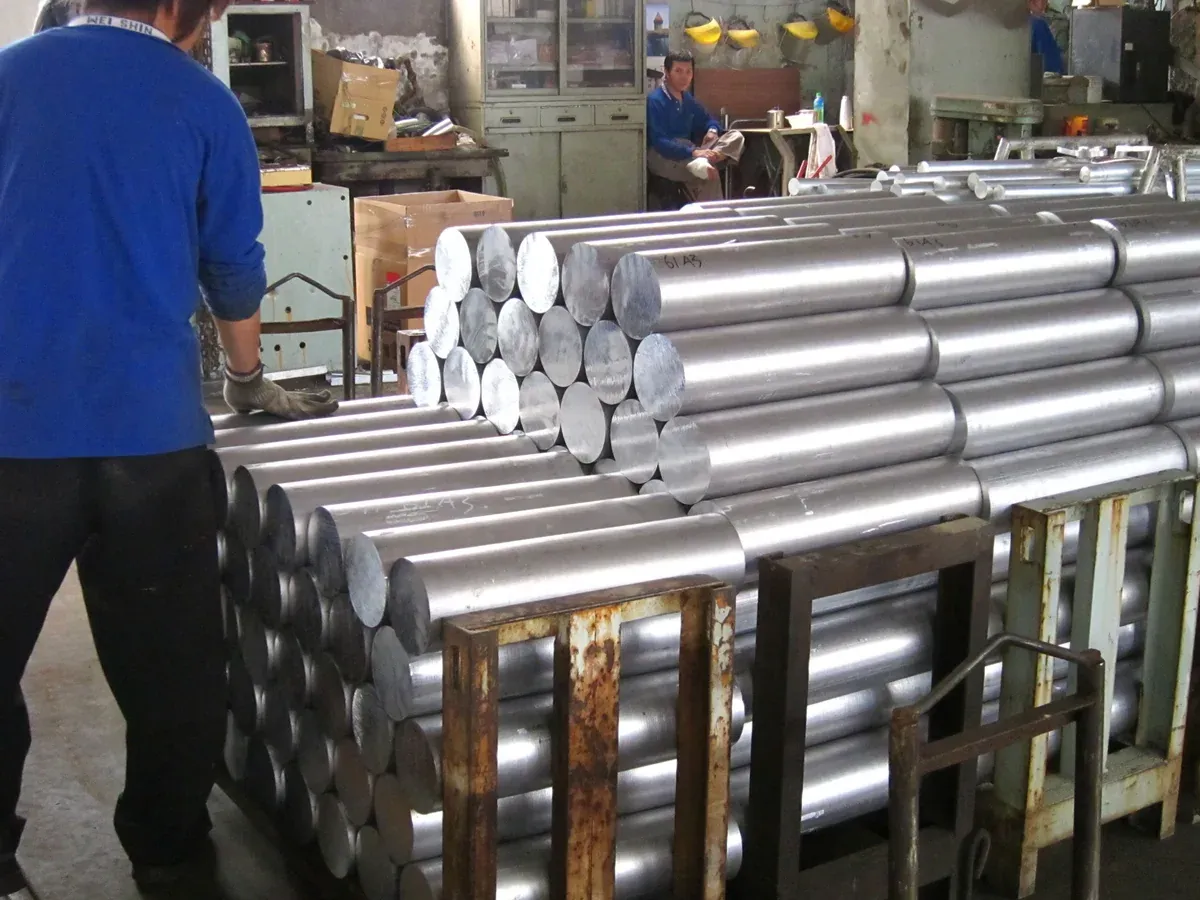
Metline supplies the input materials for cold forging, including slugs, wire rod, drawn and extruded bar in 1xxx, 3xxx, 5xxx, 6xxx and 7xxx alloys, and can supply forged blanks to drawing on request, with mill certificates and export packing for delivery worldwide.
Hot forging heats the billet to about 350 – 500 °C so the metal flows easily into large, complex dies. Cold forging works at room temperature, which gives better accuracy, surface finish and material yield, but limits part size and the amount of deformation per stroke. Cold forging suits small and medium repeat parts; hot forging suits large or highly complex ones.
Yes. 6061 is forged in the annealed O condition and then solution treated and aged to T6, which restores full strength. It needs more press force than 1xxx or 3xxx alloys, and deep or complex shapes may need more than one forming stage.
7075 can be cold forged only in limited reductions, from fully annealed slugs with a conversion coating and a robust lubricant. For most 7075 parts, hot forging is the more practical route.
Cold-forged heat sinks are made from wrought 1xxx or 6063 aluminium with much higher thermal conductivity than die-casting alloys, and the forged metal is dense with no porosity. The fins are integral with the base, so there is no bonded interface adding thermal resistance.
Generally a steady demand of several thousand pieces a year or more, so the die cost is spread over enough parts. The break-even is lower when machining would waste a large share of the bar.
Usually only on functional features: precision fits, threads, sealing faces, side holes and the contact face of heat sinks. Many surfaces can be used as forged.
Send the drawing, alloy and annual volume. We will recommend the material and supply slugs, stock or forged blanks with full certification.






