Thin sheet, small bead
1.6 – 2.4 mm (1/16 – 3/32 in). A finer rod melts quickly without chilling the pool, so the welder can keep heat input low and the bead neat. 2.4 mm is the safest starting point for visible welds on 2 – 3 mm sheet.



5356 is the most widely used aluminium-magnesium filler rod for TIG welding 5xxx alloys and many 6xxx alloys. It gives strong, ductile, corrosion-resistant welds that stay close in colour to the parent metal after anodising. This guide covers rod sizes, how to choose a diameter, which base metals it suits, how it compares with 4043, and how to store it. Metline supplies 5356 rod in straight lengths from 1.6 to 6.4 mm and larger, to AWS A5.10, worldwide.
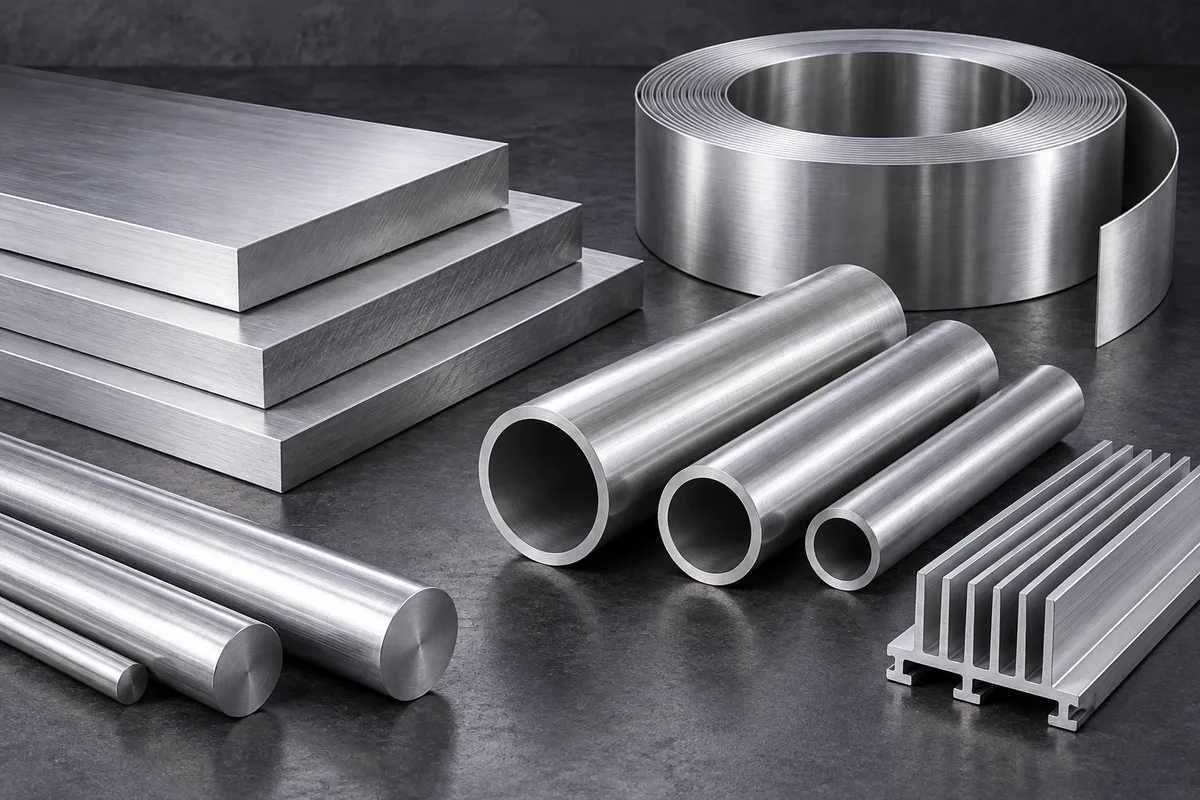
5356 filler rod is a straight, cut length of aluminium alloy with about 5 % magnesium, fed by hand into the weld pool during gas tungsten arc (TIG) welding. It is classified as ER5356 and R5356 under AWS A5.10 and as S Al 5356 (AlMg5Cr(A)) under EN ISO 18273. The chemistry is identical to 5356 MIG wire; only the form and the process differ.
Magnesium in solid solution gives 5356 weld metal roughly double the shear strength of 4043 weld metal, and a small titanium addition (0.06 – 0.20 %) refines the grain as the weld solidifies, lowering the risk of hot cracking. The alloy is non-heat-treatable, so welds reach their full strength as welded.
Those properties make 5356 the default rod for boats, trailers, truck bodies, tanks, railings and frames in 5xxx and 6xxx alloys, and for any part that will be anodised after welding.
| Diameter (in) | Diameter (mm) | Length | Typical base thickness |
|---|---|---|---|
| 0.035 in | 0.9 mm | 36 in (914 mm) | Foil-thin parts, repairs |
| 0.045 in | 1.2 mm | 36 in | Thin sheet under 1.5 mm |
| 1/16 in | 1.6 mm | 36 in or 1000 mm | about 1 – 2 mm |
| 5/64 in | 2.0 mm | 36 in or 1000 mm | about 2 – 3 mm |
| 3/32 in | 2.4 mm | 36 in or 1000 mm | about 2 – 4 mm |
| 1/8 in | 3.2 mm | 36 in or 1000 mm | about 3 – 6 mm |
| 5/32 in | 4.0 mm | 36 in or 1000 mm | about 5 – 10 mm |
| 3/16 in | 4.8 mm | 36 in or 1000 mm | thick plate, large fillets |
| 1/4 in | 6.4 mm | 36 in | heavy sections, build-up |
Rods are packed in sealed tubes or cartons, typically 1 lb, 5 lb or 10 lb in imperial packs and 2.5, 5 or 10 kg in metric packs. Larger diameters to 3/8 in (9.5 mm), other lengths and private-label packs can be arranged.
1.6 – 2.4 mm (1/16 – 3/32 in). A finer rod melts quickly without chilling the pool, so the welder can keep heat input low and the bead neat. 2.4 mm is the safest starting point for visible welds on 2 – 3 mm sheet.
2.4 – 3.2 mm (3/32 – 1/8 in). Covers most brackets, frames, railings and trailer parts. Start with 3.2 mm for 4 – 6 mm material to keep travel speed up.
3.2 – 4.8 mm (1/8 – 3/16 in). Larger rods add metal faster for big fillets and groove fills; step up to 4.0 mm when the pool needs more filler than a 3.2 mm rod can supply.
A useful rule of thumb: rod diameter is roughly equal to the base thickness up to about 3 mm, and about half to two-thirds of the thickness above that. If the rod tip balls up before it reaches the pool, it is too thin; if it chills the pool and will not melt cleanly, it is too thick.
| Base metal | Suitability | Notes |
|---|---|---|
| 5005, 5050, 5052, 5754 | Recommended | Strong, ductile, colour-matched welds |
| 5083, 5086, 5456 | Suitable | 5183 or 5556 give higher strength for fully loaded joints |
| 5454 | Ambient service only | Use 5554 for service above about 65 °C |
| 6061, 6063, 6082 | Recommended | Higher shear strength than 4043, better anodised colour; use enough filler to avoid cracking |
| 6xxx joined to 5xxx | Recommended | 4043 is not suitable when one part has more than about 2.5 % Mg |
| Al-Si castings (A356 etc.) | Not recommended | Use 4043 or 4047 |
| 2xxx and most 7xxx alloys | Not recommended | Check special fillers (2319, 4145, 5039) |
| Factor | 5356 | 4043 |
|---|---|---|
| Weld shear strength | High (about 1.5 – 1.7 × 4043) | Moderate |
| Ductility | Higher | Lower |
| Colour after anodising | White, close match | Dark grey |
| Hot-crack resistance on 6xxx | Good with correct dilution | Better |
| Service above 65 °C | Not advised | Suitable |
| Puddle behaviour | Less fluid, more soot | Very fluid, smoother bead |
| Use on high-Mg alloys | Yes | No (brittle Mg2Si) |
| Use on Al-Si castings | No | Yes |
For 6061 either rod works: choose 5356 for strength, ductility and anodising, and 4043 for crack-sensitive joints, warm service or a smoother bead. Read our 4043 vs 5356 comparison for a deeper look.
Fillet weld strength is where filler choice matters most, because the weld metal itself carries the load. The values below are typical minimum shear strengths widely published for aluminium filler alloys.
| Filler alloy | Longitudinal shear | Transverse shear |
|---|---|---|
| 1100 | 7.5 ksi (52 MPa) | 7.5 ksi (52 MPa) |
| 4043 | 11.5 ksi (79 MPa) | 15 ksi (103 MPa) |
| 4643 | 13.5 ksi (93 MPa) | 20 ksi (138 MPa) |
| 5654 | 12 ksi (83 MPa) | 18 ksi (124 MPa) |
| 5356 | 17 ksi (117 MPa) | 26 ksi (179 MPa) |
| 5183 | 18.5 ksi (128 MPa) | 28 ksi (193 MPa) |
| 5556 | 20 ksi (138 MPa) | 30 ksi (207 MPa) |
Typical values for comparison; design strengths come from the welding code that applies (for example AWS D1.2 or EN 1999-1-1).
In groove welds the heat-affected base metal usually limits strength. For example, as-welded 6061-T6 joints are typically qualified at about 165 MPa (24 ksi) minimum tensile, whether 4043 or 5356 is used.
| Element | Limit (%) |
|---|---|
| Magnesium (Mg) | 4.5 – 5.5 |
| Manganese (Mn) | 0.05 – 0.20 |
| Chromium (Cr) | 0.05 – 0.20 |
| Titanium (Ti) | 0.06 – 0.20 |
| Silicon (Si) | 0.25 max |
| Iron (Fe) | 0.40 max |
| Copper (Cu) | 0.10 max |
| Zinc (Zn) | 0.10 max |
| Beryllium (Be) | 0.0003 max |
| Others, each / total | 0.05 / 0.15 |
| Aluminium (Al) | Remainder |
Some data sheets list 5356 with 1.6 – 2.5 % magnesium and up to 1.1 % manganese; those figures are wrong for 5356.
AC (square wave on inverters) to break up the oxide film. As a starting point, about 1 A per 0.025 mm (0.001 in) of thickness.
Ceriated or lanthanated electrodes with a slightly rounded tip; pure tungsten balls readily on older transformer sets.
Pure argon at about 7 – 10 L/min (15 – 20 cfh); argon-helium for thick plate.
Degrease, then brush with a dedicated stainless brush. Wipe rods with a clean solvent cloth if they have been handled.
Dab the rod into the leading edge of the pool rather than into the arc; keep the hot rod tip inside the gas shield.
Fill craters or taper current at the end of the weld; 5356 craters can crack if left concave.
The alloy is the same. Rod is supplied in straight lengths for hand-fed TIG welding; wire is wound on spools for machine-fed MIG welding.
Yes. It is one of the two standard fillers for 6061, giving higher shear strength and a better anodised colour than 4043. Use enough filler to keep dilution low and avoid cracking.
Yes. 5356 weld metal anodises white and closely matches 5xxx and 6xxx base metals, whereas 4043 turns dark grey.
Not for sustained service above about 65 °C, where the high magnesium content can cause sensitisation. Use 5554 on 5454 or 4043 on 6xxx alloys for warm service.
2.4 mm (3/32 in) suits most work on 2 – 4 mm material. Use 1.6 mm for thinner sheet and 3.2 mm or larger for thicker plate.
A grey or black film beside the weld is magnesium oxide smut, normal with 5xxx fillers. Improve gas coverage, clean the joint and brush the smut off after welding.
Send the diameter, length, pack size and quantity. We will confirm availability, certification and a delivered price.





